EasyManua.ls Logo

HP HP-15C - Contour Integrals

HP HP-15C
224 pages
Print Icon
To Next Page IconTo Next Page
To Previous Page IconTo Previous Page
Loading...
SectionS:
Calculating
in
Complex
Mode
85
As
n
increases,
the
first guess
A( n)
comes ever closer
to the
desired
root
2.
(When you're finished,
press
[T)
|
USER
| to
deactivate User
mode.)
Since
all
roots have negative real
parts,
the
system
is
stable,
but
the
margin
of
stability (the smallest
in
magnitude among
the
real
parts,
namely -0.1497)
is
small enough
to
cause concern
if the
system must withstand much noise.
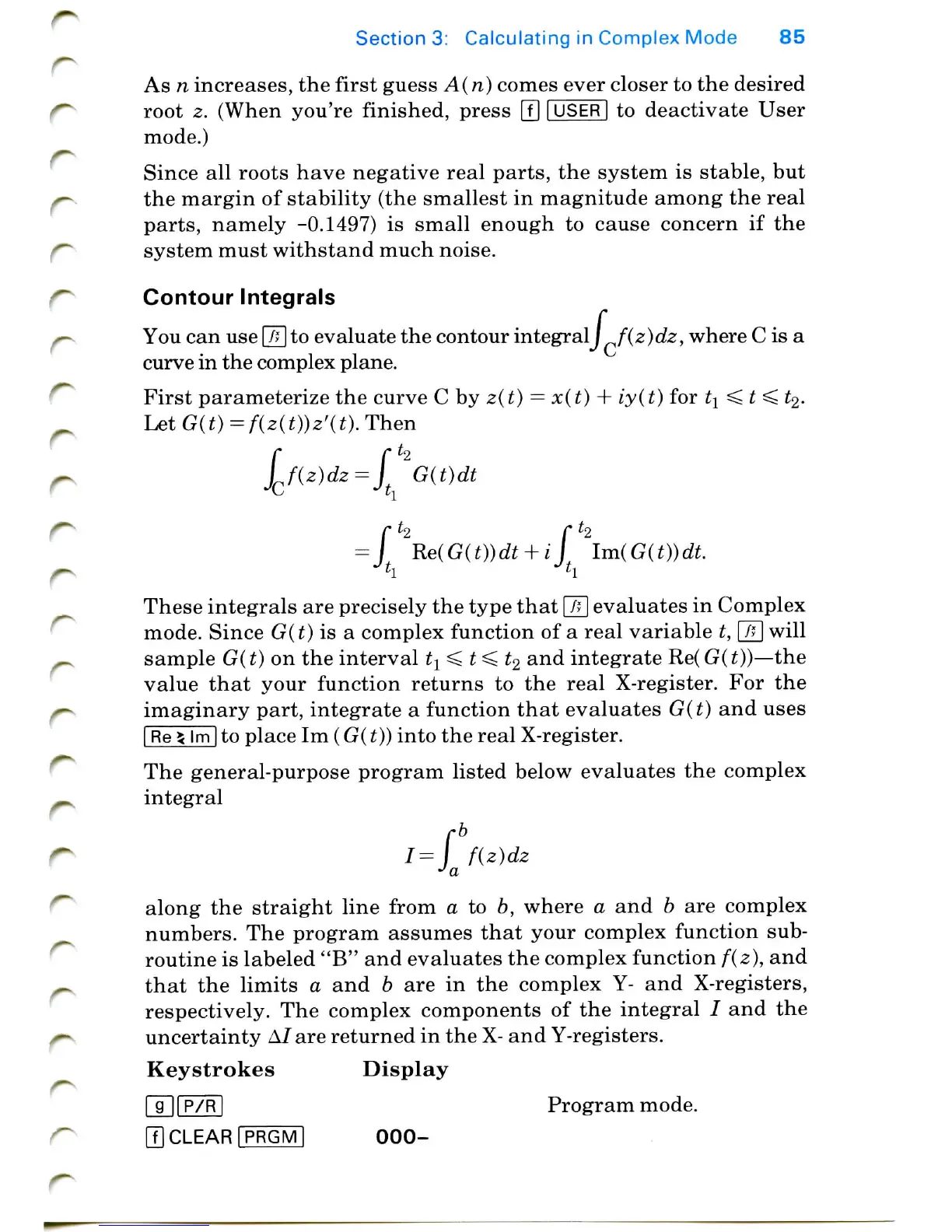
Contour
Integrals
You
can use
\W\o
evaluate
the
contour
integral
\f(
z)dz,
where
C is a
curve
in the
complex plane.
First
parameterize
the
curve
C by
z(t)
=
x(t)
+
iy(t)
for
^
^
t
<
t%.
Let
G(t)
=f(z(t))z'(t).
Then
G(t)dt
ch
rh
=
1
Re(G(t))dt
+
il
lm(G(t))dt.
These integrals
are
precisely
the
type
that
[7T|
evaluates
in
Complex
mode.
Since G(t)
is a
complex function
of a
real
variable
t,
[7F]
will
sample G(t)
on the
interval
tl^
t^t2
and
integrate
Re(Cr(£))—the
value
that
your function returns
to the
real
X-register.
For the
imaginary part, integrate
a
function
that
evaluates
G(t)
and
uses
[Res
lm|
to
place
Im
(G(
t))
into
the
real X-register.
The
general-purpose program listed below evaluates
the
complex
integral
rb
I
=
J
f(z)dz
along
the
straight
line
from
a to b,
where
a and b are
complex
numbers.
The
program assumes
that
your complex function sub-
routine
is
labeled
"B" and
evaluates
the
complex function f(z),
and
that
the
limits
a and b are in the
complex
Y- and
X-registers,
respectively.
The
complex components
of the
integral
/
and the
uncertainty
A/are
returned
in the X- and
Y-registers.
Keystrokes
Display
rsT||P/R|
Program
mode.
IT]
CLEAR
|
PRGM|
000-

Table of Contents

Other manuals for HP HP-15C

Related product manuals