EasyManua.ls Logo

HP HP-15C - When No Root Is Found

HP HP-15C
224 pages
Print Icon
To Next Page IconTo Next Page
To Previous Page IconTo Previous Page
Loading...
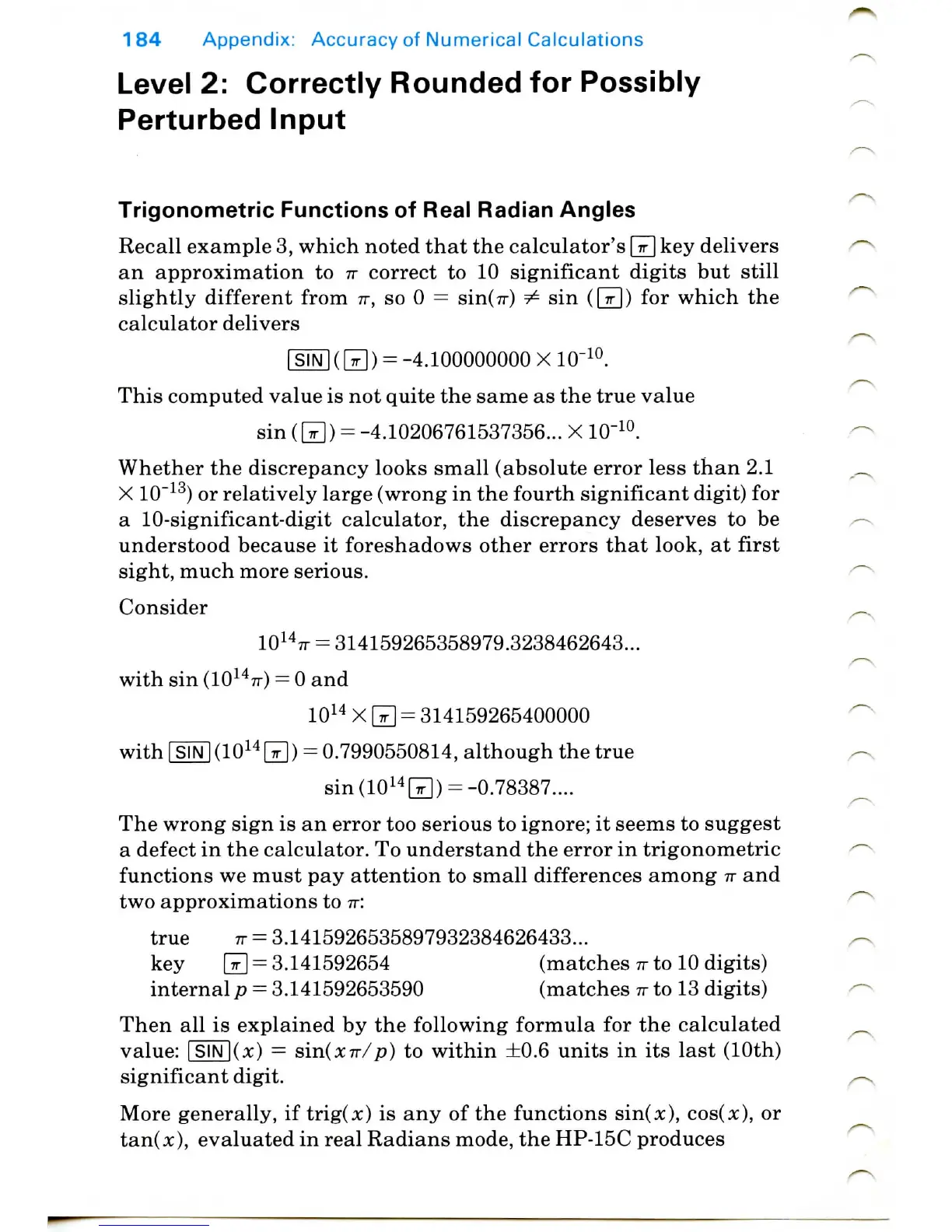
184
Appendix:
Accuracy
of
Numerical
Calculations
Level
2:
Correctly Rounded
for
Possibly
Perturbed Input
Trigonometric
Functions
of
Real
Radian
Angles
Recall
example
3,
which noted
that
the
calculator's
(jr]
key
delivers
an
approximation
to
TT
correct
to 10
significant
digits
but
still
slightly different
from
rr,
so 0 =
sin(Tr)
¥=
sin (0)
r
which
the
calculator delivers
fSINl
(H)
=
-4.100000000
X
ID'10.
This
computed value
is not
quite
the
same
as the
true value
sin
(H)
=
-4.10206761537356...
X
10"10.
Whether
the
discrepancy
looks
small
(absolute
error
less
than
2.1
X
10"13)
or
relatively large (wrong
in the
fourth significant digit)
for
a
10-significant-digit
calculator,
the
discrepancy deserves
to be
understood because
it
foreshadows other errors
that
look,
at
first
sight, much more serious.
Consider
10147r
=
314159265358979.3238462643...
with
sin
(10147r)
= 0 and
1014
X
0
=
314159265400000
with
[SIN]
(1014
0) =
0.7990550814, although
the
true
sin
(1014H)
=
-0.78387....
The
wrong
sign
is an
error
too
serious
to
ignore;
it
seems
to
suggest
a
defect
in the
calculator.
To
understand
the
error
in
trigonometric
functions
we
must
pay
attention
to
small differences among
TT
and
two
approximations
to
TT:
true
TT
=
3.1415926535897932384626433...
key
H
=
3.141592654 (matches
rr
to 10
digits)
internal
p =
3.141592653590 (matches
TT
to 13
digits)
Then
all is
explained
by the
following formula
for the
calculated
value:
|SIN|(;c)
sm(xir/p)
to
within ±0.6 units
in its
last
(10th)
significant digit.
More
generally,
if
trig(^c)
is any of the
functions
sin(jc),
cos(x),
or
tan(x),
evaluated
in
real
Radians
mode,
the
HP-15C produces

Table of Contents

Other manuals for HP HP-15C

Related product manuals