EasyManua.ls Logo

HP HP-15C - Least-Squares Using Successive Rows

HP HP-15C
224 pages
Print Icon
To Next Page IconTo Next Page
To Previous Page IconTo Previous Page
Loading...
140
Section
4:
Using
Matrix
Operations
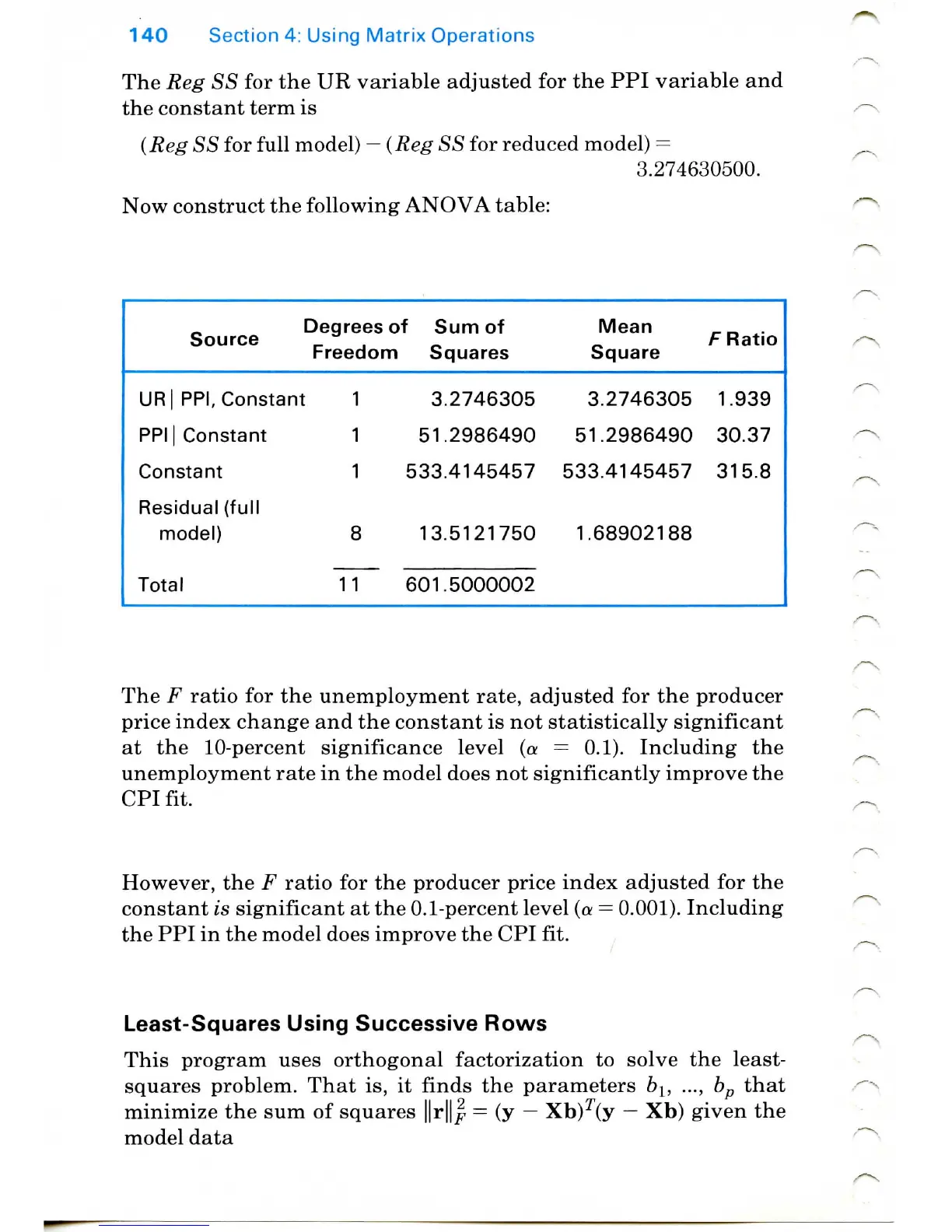
The
Reg SS for the UR
variable adjusted
for the
PPI
variable
and
the
constant term
is
(Reg
SS
for
full
model)
-
(Reg
SS
for
reduced
model)
=
3.274630500.
Now
construct
the
following ANOVA table:
_
Degrees
of Sum of
Source
"
Freedom
Squares
UR|
PPI,
Constant
PPI
|
Constant
Constant
Residual
(full
model)
Total
1
1
1
8
11
3.2746305
51.2986490
533.4145457
13.5121750
601.5000002
Mean
Square
3.2746305
51.2986490
533.4145457
1.68902188
F
Ratio
1.939
30.37
315.8
The F
ratio
for the
unemployment rate, adjusted
for the
producer
price
index change
and the
constant
is not
statistically
significant
at the
10-percent significance level
(a =
0.1). Including
the
unemployment
rate
in the
model does
not
significantly improve
the
CPI
fit.
However,
the F
ratio
for the
producer price index adjusted
for the
constant
is
significant
at the
0.1-percent level
(a
0.001). Including
the PPI in the
model does improve
the CPI
fit.
Least-Squares Using Successive Rows
This program uses orthogonal factorization
to
solve
the
least-
squares problem. That
is, it
finds
the
parameters
61;
...,
bp
that
minimize
the sum of
squares
||r||^
= (y
Xb)r(y
Xb)
given
the
model
data

Table of Contents

Other manuals for HP HP-15C

Related product manuals