Appendix: Accuracy
of
Numerical Calculations
191
Example
6: The
Smaller
Root
of a
Quadratic.
The two
roots
x
and y of the
quadratic equation
c
—
2bz
+ az2 = 0 are
real whenever
d
= b2 — ac is
nonnegative. Then
the
root
y of
smaller magnitude
can
be
regarded
as a
function
y =
f(a,b,c)
of the
quadratic's
coefficients
I
(6-x/dsgn(6))/a
ifa^O
f(a,b,c)—
<
I
(c/6)/2
otherwise.
Were
this
formula translated directly
in a
program F(a,
b, c)
intended
to
calculate
f(a,
b, c),
then whenever
ac is so
small
compared
with
b2
that
the
computed value
of d
rounds
to
b2,
that
program could deliver
F = 0
even though
f^
0. So
drastic
an
error
cannot
be
explained
by
backward error analysis because
no
relatively
small
perturbations
to
each
coefficient
a, b, and c
could
drive
c to
zero,
as
would
be
necessary
to
change
the
smaller root
y
into
0. On the
other hand,
the
algebraically equivalent formula
(
c
/(b
+
\fd
sgn(
b))
if
divisor
is
nonzero
0
otherwise
translates
into
a
much more accurate program
F
whose errors
do
no
more damage
than
would
a
perturbation
in the
last
(10th)
significant digit
of c.
Such
a
program will
be
listed
later (page 205)
and
must
be
used
in
those instances, common
in
engineering, when
the
smaller root
y is
needed accurately despite
the
fact
that
the
quadratic's other unwanted root
is
relatively large.
Almost
all the
functions built into
the
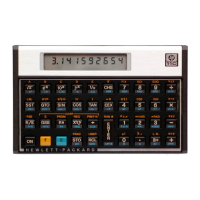
HP-15C
have been designed
so
that
backward error
analysis
will account
for
their
errors
satisfactorily.
The
exceptions
are
[SOLVE],
[7T|,
and the
statistics
keys
[si,
|
L.R.
|, and
|y,r|
which
can
malfunction
in
certain
pathological cases. Otherwise, every calculator function
F
intended
to
produce
f(x)
produces instead
a
value F(x)
no
farther
from/(;t)
than
if
first
x had
been perturbed
to x + 8x
with|<5;c|^
TI\X\,
thenf(x
+ dx)
were perturbed
to
(f+df)(x
+ 5x)
with
\8f\
e|/|.
The
tolerances
r\d e
vary
a
little
from
function
to
function; roughly
speaking,
rj
—
0 and
e
<
10~9
for all
functions
in
Level
1,
77
<
10~12
and e < 6 X
10~10
for
other real
and
complex functions.


 To Next Page
 Loading...