EasyManua.ls Logo

HP HP-15C - Example: Certain problems in physics and engineering require calculating Bessel functions

HP HP-15C
224 pages
Print Icon
To Next Page IconTo Next Page
To Previous Page IconTo Previous Page
Loading...
Appendix:
Accuracy
of
Numerical Calculations
193
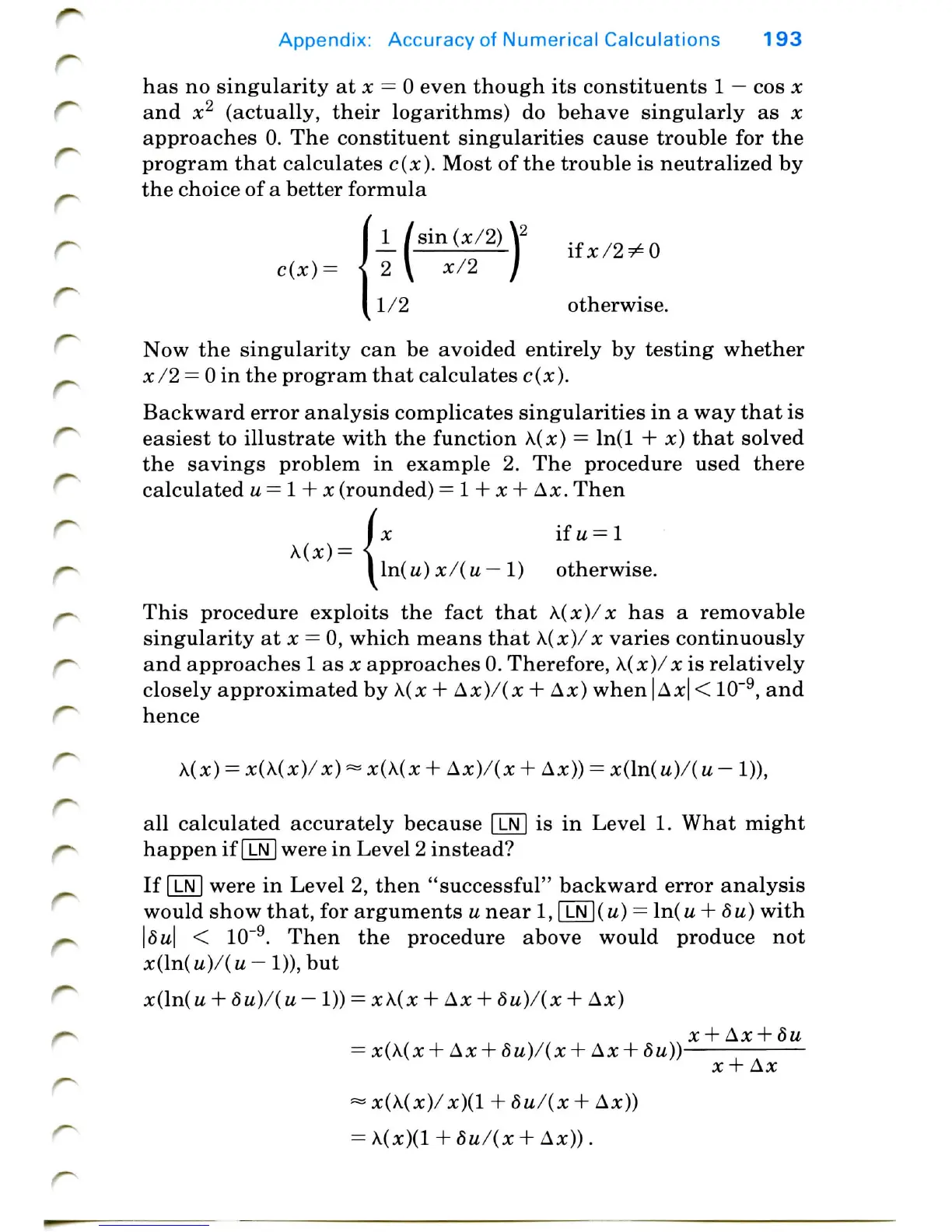
has no
singularity
at x 0
even though
its
constituents
1
cos x
and
x2
(actually,
their
logarithms)
do
behave singularly
as x
approaches
0. The
constituent
singularities
cause trouble
for the
program
that
calculates c(x). Most
of the
trouble
is
neutralized
by
the
choice
of a
better formula
if
x
72^0
otherwise.
Now
the
singularity
can be
avoided entirely
by
testing
whether
x/2 = 0 in the
program
that
calculates c(x).
Backward
error analysis complicates singularities
in a way
that
is
easiest
to
illustrate with
the
function
X(^)
=
ln(l
+ x)
that
solved
the
savings
problem
in
example
2. The
procedure used
there
calculated
u =
I
+ x
(rounded)
=
1 + x +
Ax.
Then
x if u
1
ln(u)
x/(u
1)
otherwise.
This
procedure exploits
the
fact
that
\(x)/x
has a
removable
singularity
at x = 0,
which means
that
\(x)/x
varies
continuously
and
approaches
1 as x
approaches
0.
Therefore,
K(x)/x
is
relatively
closely
approximated
by
\(x
+
Ax)/(x
+ Ax)
when
|
Ax\
10~9,
and
hence
\(x)
x(\(x)/x)«
x(\(
x +
Ax)/(x
+
Ax))
=
x(\n(u)/(u-
1)),
all
calculated accurately because
|LN|
is in
Level
1.
What might
happen
if |
LN
[were
in
Level
2
instead?
If
|
LN
|
were
in
Level
2,
then "successful" backward error
analysis
would
show
that,
for
arguments
u
near
1,
|
LN
\(u)
=
\n(u
+
8u)
with
\du\
1CT9.
Then
the
procedure above would produce
not
x(ln(
u +
5u)/(u-
1))
=
xk(x
+
AJC
+
8u)/(x
+
Ax)
=
x(\(x
+ Ax +
8u)/(x
+ Ax +
du))
x
+ Ax
x(\(x)/x)(l
+
du/(x
+
Ax))

Table of Contents

Other manuals for HP HP-15C

Related product manuals