
 Need help?
Do you have a question about the HP ProCurve 2626-PWR and is the answer not in the manual?
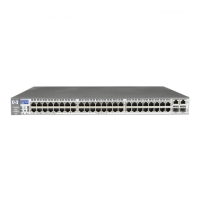
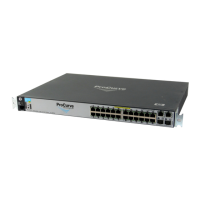
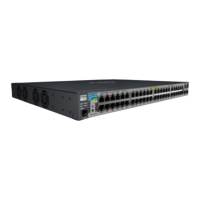
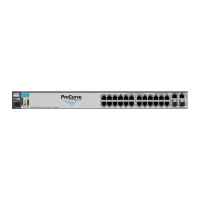
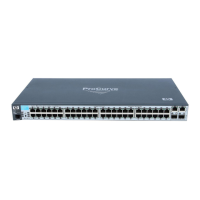
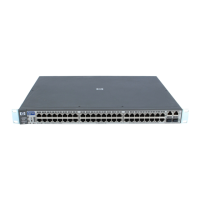
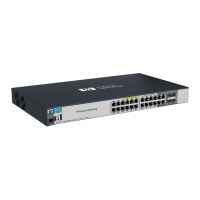
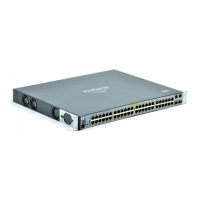
This manual supplement describes the Power Over Ethernet (PoE) operation for the HP ProCurve Switch 2626-PWR (J8164A) and the HP ProCurve Switch 2650-PWR (J8165A). These switches are designed to provide both data transfer and power to compatible devices over existing LAN cabling, leveraging PoE technology.
The core function of these HP ProCurve switches is to act as Power-Sourcing Equipment (PSE) for IEEE 802.3af-compliant Powered Devices (PDs). This means they supply power to devices like Voice-over-IP (VoIP) telephones, wireless access points, and remote video cameras directly through their 10/100Base-TX PoE RJ-45 ports. The Switch 2626-PWR and 2650-PWR are classified as endpoint PSEs.
The Switch 2626-PWR and 2650-PWR provision their 10/100Base-TX ports with a total of 406 watts of power for PoE applications. For the Switch 2650-PWR, there's an optional configuration where ports 1-24 can be provisioned with 406 watts of internal power, and ports 25-48 can receive 368 watts of external power by adding an HP ProCurve 600 Redundant and External Power Supply (HP RPS/EPS; J8168A). It's important to note that the switches support the normal operation of non-PoE devices on ports configured for PoE operation, allowing for flexible network deployment. The PoE power is supplied over the data pair of Cat-5 cabling, in compliance with the 802.3af standard.
A key aspect of the switch's functionality is its ability to manage power allocation, especially when the demand for PoE power exceeds the available supply (oversubscription). In such scenarios, the switch employs a power prioritization scheme. This scheme uses two methods: priority class and port-number priority. The priority class method allows for assigning ports to Low (default), High, or Critical priority. The port-number priority method, within the same priority class, gives preference to lower-numbered ports over higher-numbered ones. This ensures that critical devices receive power even when resources are limited, by potentially removing power from lower-priority ports.
The switch requires a minimum of 15.4 watts of unused PoE power to begin supplying power to a newly connected 802.3af-compliant PD. Once a PD is connected and operating, the port retains only the power needed for that PD's operation, making any unneeded power available for other connections. If a new PD connects to a port with a higher PoE priority than an existing PD on a lower-priority port, the switch will reallocate power, denying power to the lower-priority port to satisfy the higher-priority one. If a new PD connects to a port with a lower priority than all other active PoE ports, and there's insufficient power, the switch will not deliver power to the new PD. Disconnecting a PD frees up power for other ports.
The HP ProCurve switches offer several configurable features to optimize PoE operation:
The switches provide robust monitoring and logging capabilities to assist with maintenance and troubleshooting of PoE operations:
show power-management command displays the switch's global PoE power status, including:
show power-management brief command provides an overview of PoE status on all ports, listing:
show power-management [e] <port-list> command provides detailed PoE status and statistics for specific ports since the last reboot. This includes:
These features collectively enable efficient management, monitoring, and troubleshooting of PoE operations, contributing to the overall reliability and performance of the network.
 General
| Power over Ethernet (PoE) | Yes |
|---|---|
| Available PoE Power | 370 W |
| PoE Budget | 370 W |
| Jumbo Frame Support | Yes |
| Manageable | Yes |
| Form Factor | Rack-mountable |
| Power Supply | Internal |
| Ports | 24 x 10/100 + 2 x 10/100/1000 |
| MAC Address Table Size | 8K |
| Management | Web, SNMP, CLI |
| Dimensions | 44.2 x 25.4 x 4.4 cm |
| Operating Temperature | 32°F to 113°F (0°C to 45°C) |
| Operating Humidity | 10% to 90% non-condensing |


 To Next Page