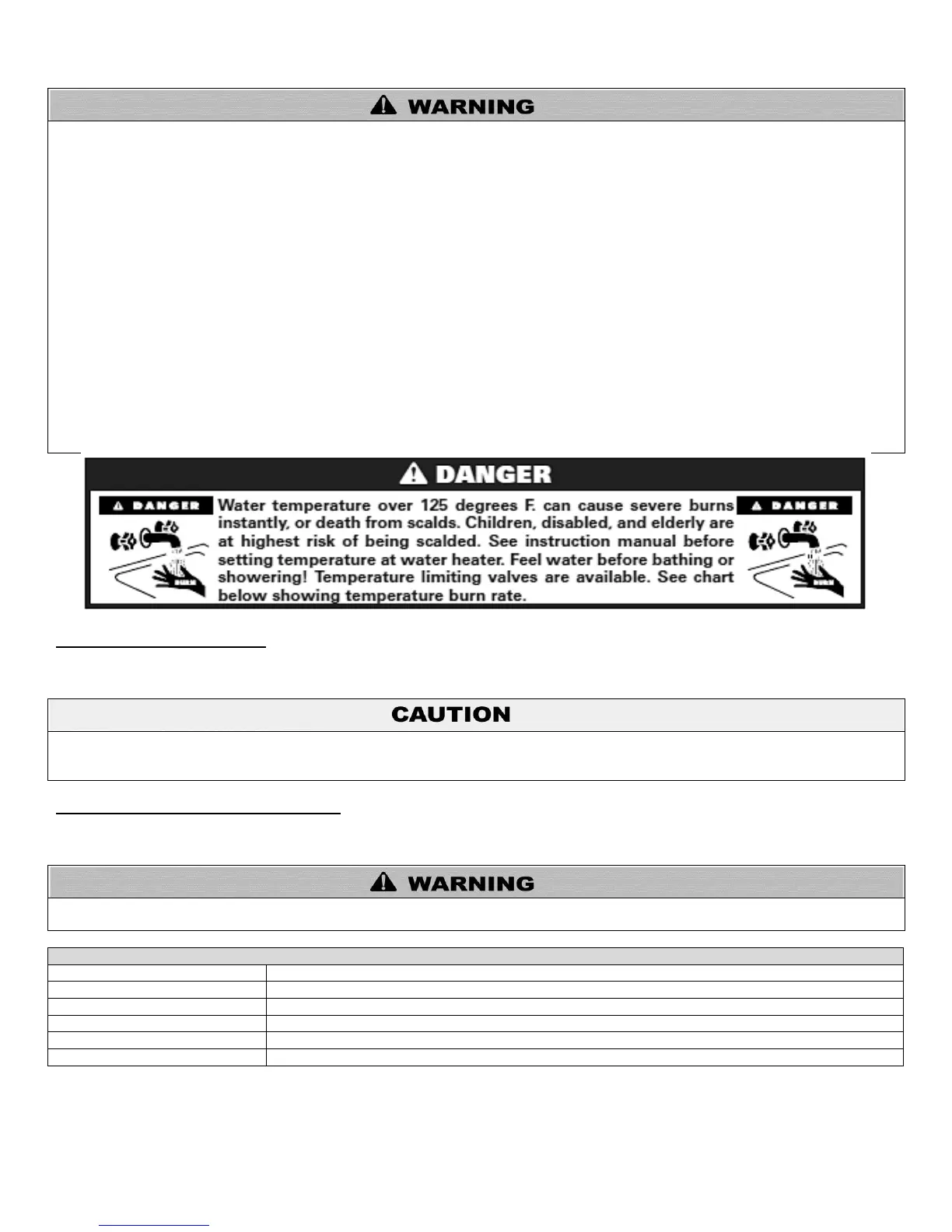
To avoid water damage or scalding due to relief valve operation:
Discharge line must be connected to relief valve outlet and run to a safe place of disposal. Terminate the discharge line in a
manner that will prevent possibility of severe burns or property damage should the relief valve discharge.
Discharge line must be as short as possible and the same size as the valve discharge connection throughout its entire length.
Discharge line must pitch downward from the valve and terminate at least 6” above the floor drain, making discharge clearly
visible.
Discharge line shall terminate plain, not threaded, with a material serviceable for temperatures of 375
o
F or greater.
Do not pipe discharge to any location where freezing could occur.
No shutoff valve may be installed between the relief valve and boiler or in the discharge line. Do not plug or place any
obstruction in the discharge line.
Test the operation of the relief valve after filling and pressurizing the system by lifting the lever. Make sure the valve
discharges freely. If the valve fails to operate correctly, replace it with a new relief valve.
Test relief valve at least once annually to ensure the waterway is clear. If valve does not operate, turn the boiler “off” and call
a plumber immediately.
Take care whenever operating relief valve to avoid scalding injury or property damage.
For boilers installed with only a pressure relief valve, the separate storage vessel must have a temperature and pressure relief
valve installed. This relief valve shall comply with Relief Valves for Hot Water Supply Systems, ANSI Z21.22 CSA4.4.
FAILURE TO COMPLY WITH THE ABOVE GUIDELINES COULD RESULT IN FAILURE OF RELIEF VALVE OPERATION,
RESULTING IN POSSIBILITY OF SUBSTANTIAL PROPERTY DAMAGE, SEVERE PERSONAL INJURY, OR DEATH.
C. BACKFLOW PREVENTER
All piping methods shown in this manual use primary/secondary connection to the boiler loop. This is to avoid the possibility of
inadequate flow through the boiler. For other piping methods, consult your HTP representative or refer to separate Piping Details,
Section J, in this manual.
D. SYSTEM WATER PIPING METHODS
1. Ensure that the expansion tank is designed and sized to correctly handle system water volume and temperature.
Expansion tanks must be sized according to total system volume. This includes all length of pipe, all fixtures, boilers, etc. Failure to
properly size system expansion could result in wasted time, money, and possible property damage, personal injury, or death.




 To Next Page