nt
r
• Boatin
Safet
4.1
nic and non-p
rotechnic equipment must be U.
.
oast
uard approved
rotechnic U.
.
oast
uard approved visual distress
si
nals and associated equipment include: Red
lares,
handheld or aerial
ran
e smoke, hand held or floatin
Launchers
or aerial red meteor or parachute
lares. Non-
p
rotechnic equipment includes an oran
e distress
la
,
e mar
ers, an
an e
ectr
c
stress
t.
No sin
le si
nalin
device is ideal under all conditions
or
all purposes. Consider carr
in
various t
pes of equip-
ment.
are
ul selection and proper stowa
e o
visual
distress equipment is ver
important. I
oun
children
are frequentl
aboard,
ou should select devices with
packa
es which children, but not adults, will
ind di
icult
to open
ther help
ul publications available
rom the U.
.
oast
uard include
Aids to Navi
ation”
U.
.
oast
uard
pamphlet #123
, which explains the si
nificance o
various li
hts and buo
s, the
Boatin
a
et
Trainin
anual”, and
Federal Requirements
or Recreational
Boats”. Check with
our local Coast Guard Station,
our
new dealer, or a local marina about navi
ational aids
unique to
our area
.5.3 Runnin
and Navi
ation Li
ht
Your boat must have runnin
and navi
ation li
hts for
sa
e operation a
ter dark.
bserve all navi
ation rules
or meetin
and passin
. Do not run at hi
h speeds dur-
n
n
t operat
on.
wa
s use common sense an
oo
ud
ment.
peratin
at ni
ht can present some special challen
es.
Not onl
is
our depth perception lessened, bri
ht li
hts
n the shore can cast misleadin
re
lections on the water
and if
ou wear
lasses, or worse
et, bifocals,
ou sim-
pl
don
t see as well at ni
ht as
ou do durin
the da
.
It is not onl
important that
ou be able to identi
other
vesse
s operat
n
n
our prox
m
t
,
t
s equa
mportant
that other vessels see
ou. Most recreational vessels are
less than 30
eet in len
th and, accordin
to
The Rules
f the Road”, shall be equipped with navi
ation li
hts.
These li
hts not onl
have a certain arc throu
h which
the
can be seen but must be seen
rom a minimum dis-
tance. Table 1, on pa
e 4.14 will show
ou the followin
li
htin
requirements
or recreational vessels both less
than 12 meters in len
th
approximatel
39.4”
, and over
12 meters in len
th to 20 meters
65'
Ligh
r
olor
i
i
l
an
th
22
Wh
tarboar
112.
r
P
r
ideli
h
.
ternli
h
1
5
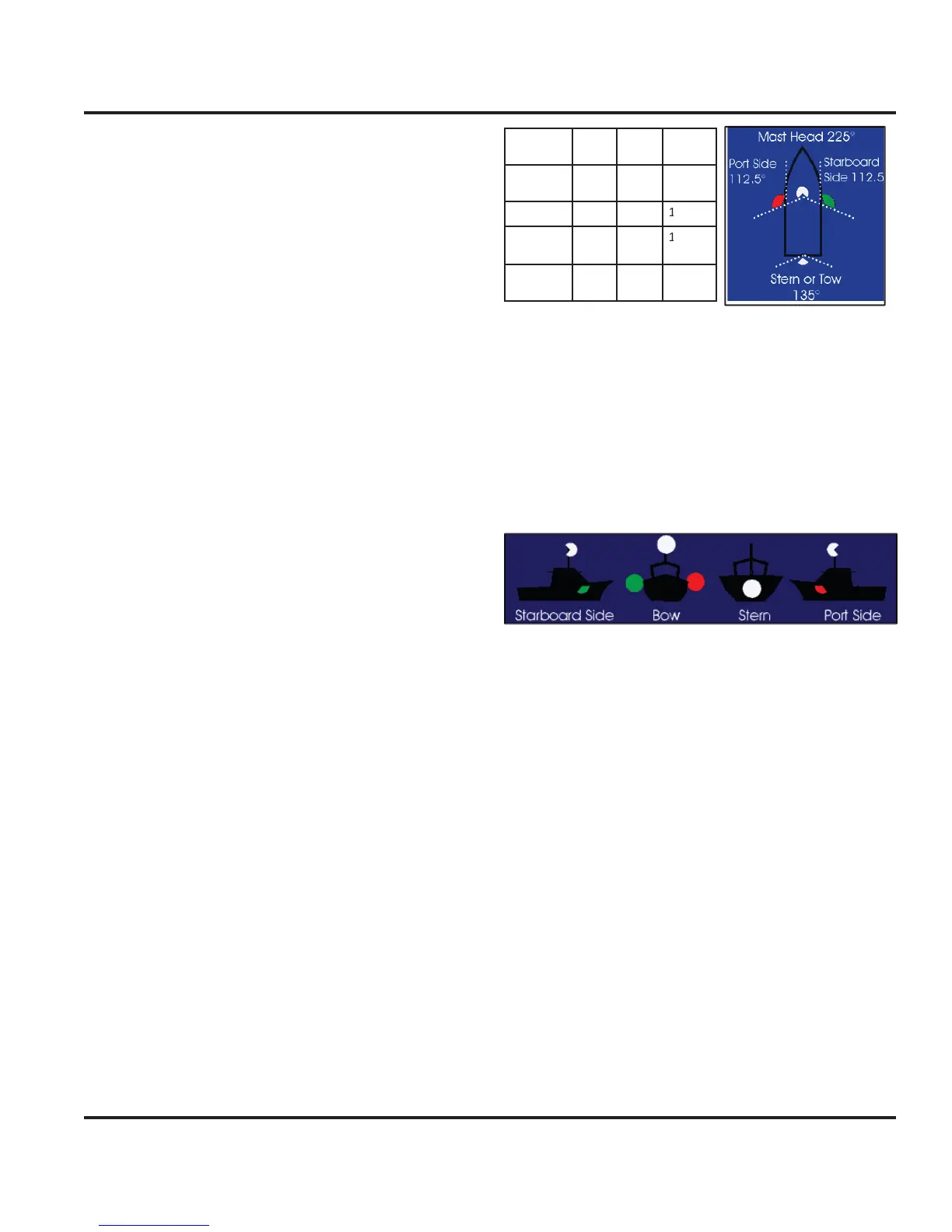
The arc o
the li
hts and color allows
ou to determine the
direction a vessel is movin
. How
ood are
our li
hts?
ou s
ou
test t
em to see
ow v
s
e
ou m
t
e
at ni
ht. Whether on a trailer or at the marina, switch
n
our li
hts and see how well the
can be seen. Walk
awa
from the boat or row awa
, if
ou are at anchor or
at a moorin
, and see how visible the li
hts are as
ou
move further awa
. How eas
are the
to see a
ainst the
back
round of li
hts on shore?
ou s
ou
a
wa
s c
ec
t
at
our mast
ea
t
sap-
pears at the same time each sideli
ht disappears and
the
both disappear when the stern li
ht appears.
heck
our sideli
hts
rom dead ahead. You should see
both red and
reen. However, b
movin
toward one side
b
1-3 de
rees,
ou should then see onl
one li
ht. If
ou
still see two li
hts, an approachin
vessel won’t be able
to tell which direction
ou are
oin
When boatin
at ni
ht, remember the
ollowin
:
When
two li
hts
ou see ahead, turn
our helm and show
our
r
.
.5.4 Sound Si
nalin
Devic
Your boat is provided with a horn which con
orms with
.
.
oast
uard requirements
or boats o
this size. All
ass
oats are recommen
e
to carr
a
an
, mout
,
r whistle, as well as a power operated horn. The device
should be used to promote sa
e passin
, as well as a
warnin
to other vessels in fo
, or confined areas, or as
a si
nal to operators o
locks or drawbrid
es. Followin
are standard whistle si
nals



 To Next Page