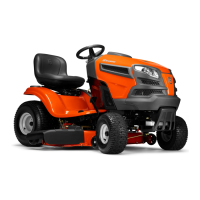
This document is an owner's manual for a Husqvarna YTH22V46 riding lawn tractor, providing comprehensive instructions for its safe operation, assembly, maintenance, and troubleshooting. The tractor is designed for mowing lawns and can also be used with various attachments.
Function Description:
The Husqvarna YTH22V46 is a ride-on lawn tractor primarily designed for mowing grass. It features an internal combustion engine that powers both the drive system and the mower blades. The tractor is equipped with a Reverse Operation System (ROS) that allows the mower or other powered attachments to operate while the tractor is moving in reverse, though this is strongly discouraged for safety reasons unless absolutely necessary. The tractor also includes a cruise control feature for maintaining a desired forward speed on smooth, straight surfaces. An attachment lift lever is used to raise and lower the mower deck or other mounted attachments, allowing for adjustment of cutting height. The transmission is hydrostatic, controlled by forward and reverse drive pedals, offering variable speed control.
Usage Features:
The tractor's controls are designed for ease of use and safety. The ignition switch is used for starting and stopping the engine, with a "STOP" position that should always be used when leaving the tractor to prevent unauthorized use and battery discharge. A throttle/choke control manages engine speed and facilitates starting in various temperatures. The clutch/brake pedal serves to brake the tractor and is essential for starting the engine, as the engine will not start unless this pedal is fully depressed. A parking brake lever locks the clutch/brake pedal in the brake position, a crucial safety feature that will shut off the engine if the operator leaves the seat without it being set.
For mowing, the attachment clutch lever engages and disengages the mower blades. The mower height can be adjusted using the attachment lift lever, offering a range of cutting heights suitable for different grass conditions. Gauge wheels on the mower deck help prevent scalping on uneven terrain. The tractor is equipped with headlights for operation in low-light conditions. A freewheel control allows the transmission to be disengaged for pushing or slowly towing the tractor when the engine is off. The service reminder/hour meter tracks engine runtime and indicates when maintenance is due.
Safety is paramount in the tractor's design and operation. The operator presence sensing switch ensures the engine shuts off if the operator leaves the seat while the engine is running and the parking brake is not set, or if the attachment clutch is engaged. The ROS system requires specific activation to operate attachments in reverse, emphasizing caution. Operators are advised to mow up and down slopes, not across them, and to avoid slopes greater than 15 degrees. Slow speeds, gradual turns, and careful attention to terrain are recommended when operating on slopes. The manual also stresses the importance of clearing the mowing area of debris, keeping bystanders away, and never carrying passengers.
Maintenance Features:
The manual outlines a comprehensive maintenance schedule to ensure the tractor's longevity and optimal performance. Regular checks include brake operation, tire pressure, operator presence and ROS systems, and for loose fasteners. The mower blades require frequent inspection for sharpness and damage, with instructions provided for removal and installation. The engine oil level should be checked before each use, and oil changes are recommended periodically, with specific instructions for draining and refilling. The engine oil filter and air filter also require regular replacement or cleaning, especially in dusty conditions. The air screen and engine cooling fins must be kept clean to prevent overheating. Spark plugs should be replaced at the beginning of each mowing season or after a specified number of hours.
The transaxle cooling system, including the fan and cooling fins, needs to be kept clean. The transaxle fluid is sealed and generally maintenance-free for the life of the unit, but any leaks or servicing require professional attention. V-belts for both the mower blade drive and motion drive systems should be checked for deterioration and wear and replaced as needed, with detailed instructions for belt removal and installation.
Battery maintenance involves keeping terminals clean, ensuring bolts are tight, and periodic recharging. Instructions are provided for cleaning the battery and terminals, as well as for emergency starting with jumper cables. The manual also covers procedures for removing and installing wheels, replacing headlight bulbs, and checking interlocks and relays. A deck washout port is included for easy cleaning of the mower deck after each use, helping to prevent grass buildup and maintain cutting performance. Proper storage procedures are detailed for both short-term and winter storage, including fuel system preparation to prevent gum deposits and cylinder lubrication.


 To Next Page
 General