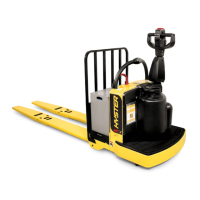
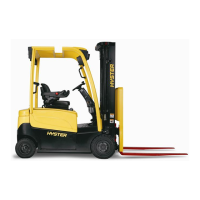
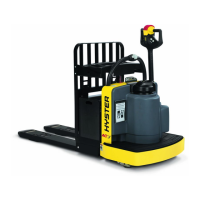
This document is a service and repair manual for the Hyster B218 (W40Z) and W45Z (C215) forklift models, specifically focusing on periodic maintenance.
Function Description:
This manual provides comprehensive instructions for the periodic maintenance, inspection, and repair of Hyster W40Z [B218] and W45Z [C215] forklift trucks. It outlines safety precautions, procedures for moving a disabled truck, battery maintenance, and detailed checks for various systems. The primary function is to ensure the safe and efficient operation of the forklift through regular upkeep and to guide technicians in performing necessary repairs and adjustments.
Important Technical Specifications (Derived from the manual's content):
- Models Covered: W40Z [B218] and W45Z [C215] forklifts.
- Battery Voltage: The manual refers to both 12 Volt and 24 Volt hydraulic tanks, indicating that these forklifts may operate on either 12V or 24V battery systems.
- Battery Specific Gravity (Fully Charged): 1.265 to 1.310 at 25°C (77°F).
- Maximum Battery Charging Temperature: Not to exceed 49°C (120°F).
- Hydraulic Oil Operating Temperature: 32 to 72°C (90 to 162°F).
- Hydraulic System: Features a screen on the pump inlet and a magnet in the bottom of the tank, but no filter.
- Load Wheel Lubrication: Recommended every 50 hours minimum or once per month. Bearings to be cleaned and repacked every 1000 hours or once per year.
- Towing Speed: Never faster than a normal walking speed.
- Creep Speed (Optional): Approximately 1.6 km/h (1 mph).
- Battery Charger (W40Z only): On-board charger, connects to 120 volt AC outlet.
Usage Features:
- Safety First: Emphasizes disconnecting the battery connector before maintenance on electric lift trucks and the battery ground cable on internal combustion lift trucks. It also stresses the importance of using correct blocks to prevent rolling or falling, wearing safety glasses, and using HYSTER APPROVED parts.
- Operational Checks: Details procedures for checking the key switch, brake switch, speed/direction control, lift and lower functions, traction reverse function, steering, and optional creep speed button. These checks are crucial for ensuring all controls operate correctly before use.
- Moving a Disabled Truck: Provides specific instructions for towing, including precautions for tow chain usage, battery disconnection, and brake release. It also outlines how to use another lift truck for towing, emphasizing capacity requirements and load distribution.
- Putting the Lift Truck on Blocks: Instructions for safely raising drive/steer tires and load wheels using hydraulic jacks, cranes, or other lift trucks, with clear warnings about surface stability and proper support points.
- Welding Repairs: Includes critical warnings regarding polyurethane paint decomposition (isocyanates), fire/explosion risks, and the need to disconnect the battery connector and ground clamp properly to prevent damage to circuit components and bearings.
- Battery Charging: Explains normal and equalizing charge procedures, specific gravity corrections, and cautions against overcharging or discharging the battery below minimum values. It highlights the importance of proper ventilation during charging.
- Battery Replacement: Provides a step-by-step guide for safely removing and installing batteries, emphasizing the weight of batteries and the need for appropriate lifting equipment and insulated straps. It also details precautions for battery fit, cable clearance, and securing the battery in its compartment.
Maintenance Features:
- Periodic Maintenance Schedule: The core of the manual, detailing checks and inspection procedures at various intervals:
- Every 8 Hours or Daily (A): Focuses on safety and operational checks performed by the operator, including hydraulic fluid leaks, tire condition, fork condition, load backrest, hydraulic hoses, safety warnings, battery water/electrolyte level, hydraulic tank fluid level, operating manual presence, nameplate, battery restraints, and control functions (brake, directional/speed, lift/lower, gauges, horn, fuses, steering).
- Every 350 Hours or 2 Months (B): Includes lubrication of chassis fittings, linkage, and load wheels, and checks for hydraulic pump noise, hydraulic control valve leaks, and relief valve settings. Also includes brake wear and adjustment, electric motor and drive unit mounting bolt checks.
- Every 2000 Hours or 1 Year (C): Involves cleaning and repacking load wheel bearings, draining and filling the hydraulic tank and drive unit oil, and checking all bolts, nuts, and cotter pins.
- Hydraulic System Maintenance: Instructions for checking hydraulic oil level, ensuring the oil temperature is at least 32°C (90°F), and warnings against overfilling. It also notes the absence of a filter and the need to clean the pump inlet screen and tank magnet when the tank is removed for repairs.
- Electrical and Battery Maintenance: Guidelines for checking vent caps, electrolyte level, and specific gravity. It also covers inspecting electrical connections, wires, cables, and the battery case for damage or corrosion. Emphasizes keeping the battery area clean and free of corrosion.
- Wheels and Tires Maintenance: Instructions for checking drive, caster, and load wheels for foreign material, cuts, and tears, and removing any damaging debris.
- Waste Oil Recycling: A recurring note throughout the maintenance schedules to "Recycle all waste oils."
- Qualified Personnel: Stresses that only qualified mechanics should correct problems identified during the 8-hour checks and that users should consult their authorized Hyster Industrial Truck Dealer for assistance with complex procedures or special applications.
- Documentation: Recommends having service manuals available for users who perform their own repairs.

 Need help?

 To Next Page
 General