8000 SRM 1009 General
General
WARNING
Do not make repairs or adjustments unless you
have both authorization and training. Repairs
and adjustments that are not correct can make
a dangerous operating condition.
WARNING
Do not operate a lift truck that needs repairs.
Report the need for repairs to your supervisor
immediately. If repair is necessary, put a DO
NOT OPERATE tag on the control handle. Re-
move the key from the key switch.
This section contains the instructions for periodic
maintenance and inspection and a Maintenance
Schedule.
The Maintenance Schedule has time intervals for in-
spection, lubrication, and periodic maintenance. The
time intervals are based on a normal operation. A
normal operation is considered to be one eight hour
shift per day in a relatively clean environment on
an improved surface. Multiple shifts, dirty operating
conditions, etc., will require a reduction in the recom-
mended time periods in the Maintenance Schedule.
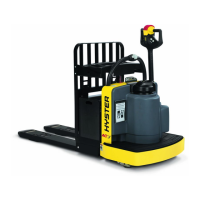
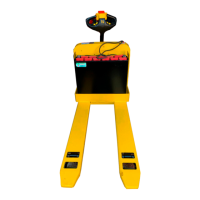
NOTE: The front end of the lift truck is the control
handle end. Forward travel is movement with the
forks trailing. Rear travel is movement in the direc-
tion of the forks. The right hand side of the lift truck
is to the operator’s right hand, facing the truck from
the control handle end in the position for operating
the controls.
Your Hyster lift truck dealer has the trained person-
nel and equipment to do a complete program of in-
spection, lubrication, and maintenance. This com-
plete program will help your lift truck operate better
over a longer period of time.
Some users have service personnel and facilities to
do the items listed in the Maintenance Schedule.
Service Manuals are available from your Hyster lift
truck dealer to help users who do their own repairs.
HOW TO MOVE A DISABLED TRUCK
This lift truck is not normally towed. If the traction
system will not operate, make repairs at the location
if possible. If the lift truck must be towed, refer to
the Maintenance Manual.
WARNING
Never carry a disabled lift truck unless the lift
truckMUSTbemoved. Thelifttruckusedto
lift the disabled lift truck MUST have a rated
capacity equal to or greater than the weight of
the disabled lift truck. The capacity must be
for a load center equal to half the width of the
disabled lift truck. See the capacity plate on
the disabled lift truck for the approximate total
weight. The forks must extend the full width
of the disabled lift truck. Put the weight of
the disabled lift truck at the center of the forks
and be careful not to damage the under side of
the disabled lift truck. Tilt the mast back and
travel slowly.
WARNING
Make sure no one except the driver is near the
lift trucks during towing. Both the tow truck
and the disabled truck can cause personal in-
jury during towing.
WARNING
To avoid personal injury, use extra care when
moving a lift truck during the following condi-
tions:
• Brake does not operate correctly
• Steering does not operate correctly
• Tire is damaged
• Traction conditions are bad
WARNING
Until rep
airs are complete, keep a DO NOT OP-
ERATE tag
on the control handle. Remove the
key.
CAUTION
Never carry the lift truck faster than the speed
of a person walking. Steering can be difficult
and motor damage can occur at higher speeds.
Always travel smoothly without sudden starts.
The electric brake must be released before the lift
truck can be moved. If there is not sufficient battery
power, placing the control handle in the operating
position will not release the electric brake. Refer to
Towing The Lift Truck of the Maintenance Manual.
Usethecontrolhandletosteerthelifttruckwhileit
is being towed. Use one hand and walk to one side
1


 To Next Page