Need help?
Do you have a question about the Hyster E40XL and is the answer not in the manual?
Overview of the hydraulic steering system and its operational principles.
Illustration and listing of power steering system components.
Detailed steps for removing the steering column assembly components.
Procedures for installing the steering column assembly components.
Location, function, and types of power steering motor and pump assemblies.
Steps to remove and disassemble the power steering motor and pump.
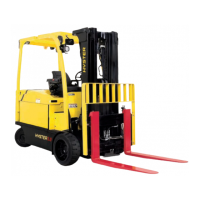
This document is a service and repair manual for the Hyster C108 (E40XL, E50XL, E55XL, E60XL) Electric Forklift, specifically focusing on its steering system. The manual, identified by PART NO. 897450 and 1600 SRM 485, covers various models of Hyster electric lift trucks, including:
The primary function of the device, as detailed in the manual, is to provide a comprehensive guide for the service, repair, and maintenance of the electric power steering system in these Hyster lift trucks. It outlines two main steering systems: Power Steering and Power Steering with On-Demand.
The steering system is a hydraulic system that lacks a mechanical connection between the steering wheel and the Master Drive Unit (MDU) or steering axle. Instead, control is achieved through a hydraulic circuit. An electric motor drives a hydraulic pump. For the system to operate, the key switch must be ON, and the seat switch must be closed. In Power Steering systems, the pump motor runs continuously after the initial start-up sequence. For On-Demand steering systems, the pump motor only operates when the steering wheel is turned.
When the steering wheel is rotated, hydraulic oil is directed to the steering motor (for units with an MDU) or the steering cylinder (for units with a steering axle). This oil flow controls the direction and degree of turn. On MDU-equipped units, a hydraulic motor with a sprocket rotates the MDU via a steering chain. On steering axle units, the steering cylinder moves the steering linkage to steer the wheels. Hydraulic oil then returns from the motor or cylinder to the steering control unit and finally to the hydraulic tank.
A notable feature of the On-Demand system is a delay (approximately 1 to 5 seconds, depending on the model) between the last steering wheel rotation and the system de-energizing. This delay ensures the system remains active during straight travel when the operator is not actively turning the wheel. In the event of a steering pump malfunction, a check valve allows the steering control unit to still operate the hydraulic motor or steering cylinder, enabling steering, albeit with increased effort.
The manual implicitly covers various components, including:
The manual provides detailed procedures for:
The manual is structured to guide technicians through each repair process, often advising to perform only necessary steps rather than a full overhaul. It also references other SRM (Service Repair Manual) sections for related components like the Master Drive Unit, Steering Axle, Steering Control Unit, Hydraulic System, Instrument Cluster, Instrument Panel Indicators and Senders, Electrical System, Periodic Maintenance, and DC Motor Maintenance, indicating a modular approach to service documentation.
 General
| Model | E40XL |
|---|---|
| Load Capacity | 4000 lbs |
| Power Source | Electric |
| Mast Type | Triplex |
| Battery Voltage | 36V |
| Tire Type | Pneumatic |
| Category | Forklift |
| Overall Width | 42 in (1067 mm) |


 To Next Page