Important information
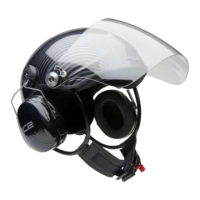
Pilots who are used to flying with just sunglasses or even with no eye protection at all may take a few flights
to get accustomed to the visor. If you don’t feel comfortable with the visor to start with, just lower and raise
the visor during your first flights with the helmet until you get used to it.
In conditions of high humidity and/or large temperature excursions, the visor may fog. On such occasions you
will immediately appreciate the difference between flying with sunglasses and with a visor: in the latter case,
you just have to open the visor slightly to obtain the complete clearance of any fogging.
• Never fly without a helmet
o Your life is too precious to risk losing it just because you have forgotten something.
• Use only a helmet with EN certification
o European EN certification was developed differently for all different activities to offer the best
possible protection
o All our helmets are constructed in accordance with the regulations contained in the EN
standard
o Never trust a helmet that has no label guaranteeing EN certification
• We recommend the use of a full-face helmet
o A full-face helmet offers improved protection in every situation.
• Never modify your helmet for whatever reason
o Modifications could reduce the level of protection, and could annul the helmet’s certification.
• Never use headphones under the helmet
o Any rigid components placed inside the helmet, between polystyrene lining and the head,
could become percussive and damaging elements.
• Always ensure that the chin strap is tightly fastened
o If you keep your helmet in your backpack, don’t sit on it.
o Ensure that the helmet never falls to the ground or the floor.
o Handle the helmet and visor with great care at all times.
o After an accident, even when the impact is minimal, the helmet should be replaced,
regardless of whether there is any visible damage or not.
Helmets and action cameras
Many pilots mount an action camera onto their helmets in order to record their adventures. It is
important to remember that any object projecting for more than 5 mm above the level of the
outer shell annuls the helmet’s certification, just as for any other modification that is not specified
in the user manual. The reason for this is that an object mounted onto the external shell could
become a percussive element that concentrates a percussive force onto a small area. Therefore, it is
potentially dangerous and reduces the level of protection that the helmet can provide.
Considering that even the most compact action camera projects at least 30/40 mm from the helmet’s
outer shell, there is no doubt that a helmet equipped with this sort of device can no longer be
considered as compliant with its respective certification.
For this reason, because we at Icaro 2000 wish to offer the highest possible level of protection for
our customers, we recommend not fitting action cameras or other devices onto the outer shell of a
helmet.
Icaro 2000 wishes you happy and safe flying.
Icaro 2000 is committed to the ongoing development of its technology, and therefore it reserves the right to modify the characteristics of
its products at any time and in any way, without prior notice.


 To Previous Page