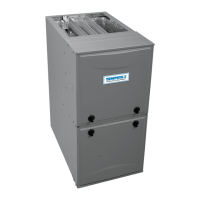
SERVICE AND TECHNICAL SUPPORT MANUAL Gas Furnace: (F/G)9MVE
Specifications subject to change without notice.
440 04 4800 00 30
Sequence of Operation
NOTE: Furnace control must be grounded for proper operation
or else control will lock out. Control is grounded through
green/yellow wire routed to gas valve and burner box screw.
Using the schematic diagram in Figure 16, follow the sequence
of operation through the different modes. Read and follow the
wiring diagram very carefully.
NOTE: If a power interruption occurs during a call for heat
(W/W1 or W/W1−and−W2), the control will start a 90−second
blower−only ON period two seconds after power is restored, if
the thermostat is still calling for gas heating. The amber LED
light will flash code 1+2 during the 90−second period, after
which the LED will flash a heartbeat (bright−dim), as long as no
faults are detected. After the 90−second period, the furnace will
respond to the thermostat normally.
The blower door must be installed for power to be conducted
through the blower door interlock switch ILK to the furnace
control CPU, transformer TRAN, inducer motor IDM, blower
motor BLWM, hot−surface igniter HSI, and gas valve GV.
1. Two−Stage Heating (Adaptive Mode) with
Single−Stage Thermostat
NOTE: The low−heat only switch SW1−2 selects either the
low−heat only operation mode when ON, (see item 2. below) or
the adaptive heating mode when OFF in response to a call for
heat. (See Figure 5) When the W2 thermostat terminal is
energized it will always cause high−heat operation when the
R−to−W circuit is closed, regardless of the setting of the
low−heat only switch. This furnace can operate as a two−stage
furnace with a single−stage thermostat because the furnace
control CPU includes a programmed adaptive sequence of
controlled operation, which selects low−heat or high−heat
operation. This selection is based upon the stored history of the
length of previous gas−heating periods of the single−stage
thermostat.
The furnace will start up in either low− or high−heat. If the
furnace starts up in low−heat, the control CPU determines the
low−heat on−time (from 0 to 16 minutes) which is permitted
before switching to high−heat.
If the power is interrupted, the stored history is erased and the
control CPU will select low−
heat for up to 16 minutes and then
switch to high−heat, as long as the thermostat continues to call
for heat. Subsequent selection is based on stored history of the
thermostat cycle times.
The wall thermostat “calls for heat”, closing the R−to−W circuit.
The furnace control performs a self−check, verifies the
low−heat and high−heat pressure switch contacts LPS and
HPS are open, and starts the inducer motor IDM in
high−speed.
a. Inducer Prepurge Period
(1.) If the furnace control CPU selects low−heat
operation the inducer motor IDM comes up to
speed, the low−heat pressure switch LPS closes,
and the furnace control CPU begins a
15−second prepurge period. If the low−heat
pressure switch LPS fails to remain closed the
inducer motor IDM will remain running at
high−speed. After the low−heat pressure switch
re−closes the furnace control CPU will begin a
15−second prepurge period, and continue to run
the inducer motor IDM at high−speed.
(2.) If the furnace control CPU selects high−heat
operation, the inducer motor IDM remains
running at high−speed, and the high−heat
pressure switch relay HPSR is de−energized to
close the NC contact. When sufficient pressure is
available the high−heat pressure switch HPS
closes, and the high−heat gas valve solenoid
GV−HI is energized. The furnace control CPU
begins a 15−second prepurge period after the
low−heat pressure switch LPS closes. If the
high−heat pressure switch HPS fails to close and
the low−heat pressure switch LPS closes, the
furnace will operate at low−heat gas flow rate
until the high−heat pressure switch closes for a
maximum of 2 minutes after ignition.
b. Igniter Warm−Up −At the end of the prepurge period,
the Hot−Surface Igniter HSI is energized for a
17−
second igniter warm−up period.
c. Trial−For−Ignition Sequence −When the igniter
warm−up period is completed the main gas valve
relay contact GVR closes to energize the gas valve
solenoid GV−M. The gas valve solenoid GV−M
permits gas flow to the burners where it is ignited by
the HSI. Five seconds after the GVR closes, a
2−second flame proving period begins. The HSI
igniter will remain energized until the flame is sensed
or until the 2−second flame proving period begins. If
the furnace control CPU selects high−heat operation,
the high−heat gas valve solenoid GV−HI is also
energized.
d. Flame−Proving − When the burner flame is proved
at the flame−proving sensor electrode FSE, the
inducer motor IDM switches to low−speed unless the
furnace is operating in high−heat, and the furnace
control CPU begins the blower−ON delay period and
continues to hold the gas valve GV−M open. If the
burner flame is not proved within two seconds, the
control CPU will close the gas valve GV−M, and the
control CPU will repeat the ignition sequence for up
to three more Trials−For−Ignition before going to
Ignition−Lockout. Lockout will be reset automatically
after three hours, or by momentarily interrupting 115
vac power to the furnace, or by interrupting 24 vac
power at SEC1 or SEC2 to the furnace control CPU
(not at W/W1, G, R, etc.). If flame is proved when
flame should not be present, the furnace control CPU
will lock out of Gas−Heating mode and operate the
inducer motor IDM on high speed until flame is no
longer proved.
e. Blower−On delay − If the burner flame is proven the
blower−ON delays for low−heat and high−heat are as
follows:
Low−heat − 45 seconds after the gas valve GV−M is
opened the blower motor BLWM is turned ON at
low−heat airflow.
High−heat
− 25 seconds after the gas valve GV−M is
opened the BLWM is turned ON at high−heat airflow.
Simultaneously, the humidifier terminal HUM and
electronic air cleaner terminal EAC−1 are energized
and remain energized throughout the heating cycle.
f. Switching from Low− to High−Heat − If the furnace
control CPU switches from low−heat to high−heat, the
furnace control CPU will switch the inducer motor
IDM speed from low to high. The high−heat pressure
switch relay HPSR is de−energized to close the NC
contact. When sufficient pressure is available the
high−heat pressure switch HPS closes, and the
high−heat gas valve solenoid GV−HI is energized.
The blower motor BLWM will transition to high−heat
airflow five seconds after the furnace control CPU
switches from low−heat to high−heat.
g. Switching from High− to Low−Heat −The furnace
control CPU will not switch from high−heat to
low−heat while the thermostat R−to−W circuit is
closed when using a single−stage thermostat.
h. Blower−Off Delay −When the thermostat is satisfied,
the R to W circuit is opened, de−energizing the gas



 To Next Page