Need help?
Do you have a question about the ICP MF08B1500A and is the answer not in the manual?
Defines DANGER, WARNING, and CAUTION signal words and their hazard levels.
Explains how WARNING and CAUTION are used within the installation manual.
Describes the combination of signal words, colors, and pictures on product labels.
Discusses selecting installation location, clearances, and humidity effects.
Warns about clearances from combustibles and plastic ducting near heaters.
Covers downflow, closet, horizontal installation types and requirements.
Mandates an auxiliary drain pan for installations over finished living space or per local codes.
Details supports, service access clearance, and drain pan support for suspended cabinets.
Covers supply/return duct attachment and field-supplied filter installation.
Emphasizes safety during electrical work, proper grounding, and code compliance.
Requirements for overcurrent protection and steps for installing the No Heat Kit.
Guidance for connecting line voltage wiring and grounding to the unit.
Covers 24V supply, transformer, wiring entry, and provides low voltage schematics.
Instructions for changing motor speed and setting the thermostat anticipator.
Explains how electric heater stages are controlled by thermostat or accessory.
Procedure to measure static pressure and reference airflow data tables.
Process to check temperature rise and related operational guidelines.
Covers filter cleaning, motor lubrication, and condensate drain checks.
Tables detailing airflow (cfm) based on voltage, static pressure, and tap settings.
Details how the unit operates in various modes with thermostat inputs and relays.
Explains how the temperature limit trips, causing soft and hard lockouts.
Provides detailed wiring diagrams for different electric heater kW sizes.
Lists all replacement parts with part numbers and visual identification in a diagram.
This document describes the installation, operation, and maintenance of a Modular Blower, also referred to as an Electric Furnace, designed for use with or without electric heat. The blower cabinet is compatible with cooling or heat pump operations and can be installed in upflow, downflow, or horizontal positions.
The Modular Blower serves as the indoor air handler for heating and cooling systems. When equipped with an accessory No Heat Kit, it functions as a cooling or heat pump air handler without electric heat. When electric heaters are installed, it provides electric heating in addition to air circulation for cooling or heat pump operation. The unit circulates air through the indoor coil and ductwork, ensuring proper airflow for the system.
Models and Compatibility: The manual covers models MF08B1500A, MF12F1900A, MF16J2200A, and MF20N2600A, all compatible with the AMF001NHA Accessory No Heat Kit. The unit is designed to use ONLY factory-listed electric heaters.
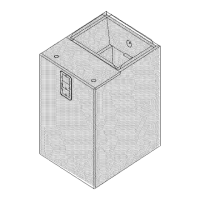
Dimensions and Clearances (Figure 1):
Electrical Specifications (Figure 6): The unit operates on 208V or 240V, single phase, 60 Hz.
Airflow Performance (Page 8): Airflow is measured in CFM (Cubic Feet per Minute) at various static pressures (SP IN, WG) and voltage settings (230V/208V) for different fan speed taps (LOW, MED, HIGH).
Installation Flexibility (Figure 3, 4):
Electrical Connections (Figure 6):
No Heat Kit Installation (Figure 6): If electric heat is not used, the accessory No Heat Kit must be installed. This involves attaching adapter and filler plates to a bracket and securing the kit with screws, then connecting its plug to the receptacle on the control board.
Motor Speed Adjustment: The blower motor comes factory-wired for medium or high speed. Speed can be changed by disconnecting the black wire at the blower motor terminal block and reconnecting to the desired speed tap.
Electric Heater Staging (Figure 8): Heater elements are turned on in increments. For heaters larger than 5KW, heat can be staged (1st & 2nd) via an indoor or outdoor thermostat. A 24V control signal from W1 on the indoor thermostat energizes the 1st stage, and W2 energizes the 2nd stage. W1 and W2 can be jumpered for simultaneous staging.
Sequence of Operation (Page 9): The manual details the control logic for various modes:
Limit Operation: The temperature limit responds to over-temperature conditions. If tripped, heater relays de-energize, and the fan relay energizes. Multiple trips can lead to soft or hard lockout, which disables heater relays. Power cycling clears the lockout.
Filters:
Lubrication: The bearings of the blower motor are permanently lubricated, requiring no field lubrication.
Condensate Drains:
Air Flow Check (Figure 9):
Temperature Rise Check:

 To Next Page
 General