
 Need help?
Do you have a question about the Ideal Boilers ESPRIT ECO 24 and is the answer not in the manual?
Visual guide to boiler controls and indicators.
Step-by-step instructions for initial boiler startup.
Explains how to select between winter and summer modes.
How to enable faster hot water delivery.
Adjusting domestic hot water and central heating temperatures.
Tips for optimizing boiler efficiency and gas consumption.
Using weather compensation for automatic temperature control.
How the boiler prevents freezing in cold conditions.
Procedure for resetting the boiler after a fault.
Method to disconnect the boiler's main electrical supply.
Understanding the system pressure gauge and low pressure issues.
How to clear a frozen or blocked condensate pipe.
Measures to prevent the condensate pipe from freezing.
Information regarding the boiler's internal pump.
Required spacing around the boiler for installation and servicing.
Immediate actions to take if a gas leak is suspected.
Recommended method for cleaning the boiler.
Guidelines for regular boiler servicing.
How to set the current time on the 24-hour timer.
Setting ON and OFF periods for timed heating control.
Using manual ON/OFF and TIMED settings for the timer.
A flowchart to diagnose and resolve common boiler operational issues.
The Esprit eco is a high-efficiency combination boiler designed to provide both central heating and instantaneous domestic hot water. It features full-sequence automatic ignition and fan-assisted combustion, ensuring efficient and reliable operation.
The boiler operates by burning gas to heat water, which is then circulated through a central heating system for radiators or supplied directly for domestic hot water use. Due to its high efficiency, the Esprit eco is a condensing appliance, meaning it extracts additional heat from the flue gases by condensing the water vapor within them. This process produces condensate, which is drained through a plastic waste pipe at the base of the boiler. A visible condensate 'plume' may be observed at the flue terminal during operation, indicating efficient heat recovery.
The boiler prioritizes domestic hot water demand, meaning that if both central heating and hot water are required simultaneously, the boiler will first supply hot water. Once the hot water demand is met, it will revert to providing heat for central heating.
The Esprit eco offers several user-friendly features to control and optimize its operation:
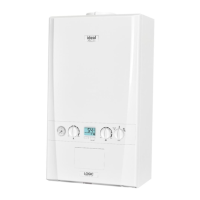
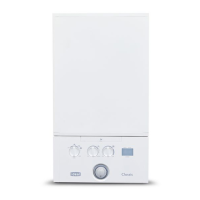
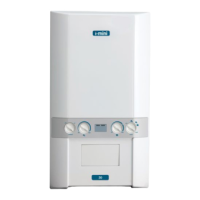
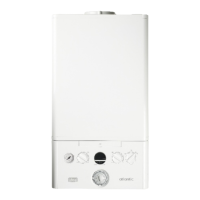
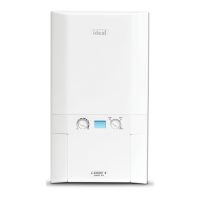
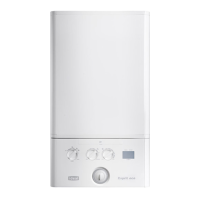
Controls Diagram: The boiler's front panel includes a mode knob (A), domestic hot water/preheat knob (B), central heating temperature knob (C), boiler status display (D), burner 'on' indicator (E), domestic hot water preheat on/off indicator (F), timer (G), pressure gauge (H), condensate drain (J), and central heating economy setting (K). These controls allow users to manage various aspects of the boiler's performance.
Starting the Boiler: To start the boiler, users must ensure the electricity supply is off, set the mode knob (A) to 'off', and set both the domestic hot water temperature knob (B) and central heating temperature knob (C) to 'max'. All hot water taps should be turned off. After switching on the electricity and ensuring external controls (like timers and room thermostats) are on, the mode knob (A) can be set to the desired operating mode (e.g., 'winter' for central heating and hot water). The boiler will then initiate its ignition sequence.
Operation Modes:
Preheat Domestic Hot Water: The boiler's internal heat exchanger can be kept preheated to ensure faster delivery of hot water. Preheat is enabled when the preheat indicator (F) is lit. To toggle preheat on or off, the domestic hot water preheat knob (B) is turned full clockwise and then returned to the desired temperature setting. The boiler will periodically operate to maintain the preheated condition, with an average interval of 90 minutes, though this can vary based on ambient temperature.
Control of Water Temperature:
Efficient Heating System Operation: The Esprit eco automatically adjusts its output to match heat demand, reducing gas consumption. For efficient operation, users can set the central heating temperature knob (C) to the 'e' (economy) position or lower. During colder periods, it may be necessary to increase this setting towards 'max'. Reducing the room thermostat setting by 1°C can save up to 10% on gas consumption.
Weather Compensation (Optional): If a weather compensation option is fitted, the central heating temperature knob (C) controls room temperature. Turning the knob clockwise increases room temperature, and anti-clockwise decreases it. Once the desired setting is achieved, the system will automatically maintain the room temperature regardless of outside weather conditions.
Boiler Frost Protection: The boiler has built-in frost protection that activates if the water temperature within the boiler drops below 5°C, preventing freezing. This feature operates in all modes, provided the boiler has a continuous power supply. However, it does not guarantee protection for all other parts of the heating system. If a system frost thermostat is installed, the boiler must be in 'winter' mode for it to function. If no system frost protection is present and frost is likely during a short absence, it's recommended to leave the heating controls or programmer on at a reduced temperature setting. For longer absences, the entire system should be drained.
Boiler Reset: In case of a fault code (see section 9), the boiler can be reset by turning the mode knob (A) to the 'reset' position and immediately back to the required setting. The boiler will then attempt its ignition sequence again.
System Water Pressure: The pressure gauge (H) indicates the central heating system pressure, which should ideally be between 1-2 bar. If the pressure falls below 0.3 bar, the boiler will not operate. Users can re-pressurize the system if needed.
Condensate Drain: The appliance includes a siphonic condensate trap system to reduce the risk of freezing. If the condensate pipe freezes, it can cause a blockage, leading to a gurgling noise and eventually an "L2" fault code. Instructions are provided for safely unblocking a frozen pipe using warm water or heat packs.
Mechanical 24 Hour Timer (if fitted):
Minimum Clearances: Specific clearances are required around the boiler for servicing: 165mm (6 ½") above, 100mm (4") below, 2.5mm (9 1/8") at the sides, and 450mm (17 ¾") at the front. The bottom clearance can be reduced to 5mm after installation if an easily removable panel allows visibility of the pressure gauge and provides the 100mm servicing clearance.
Boiler Pump: The boiler pump performs a brief self-check every 24 hours, regardless of system demand, ensuring its readiness.
Cleaning: For routine cleaning, a dry cloth can be used. For stubborn marks, a damp cloth followed by a dry cloth is recommended. Abrasive cleaning materials should NOT be used.
Regular Servicing: The appliance should be serviced at least once a year by a Gas Safe Registered Engineer (or a Registered Gas Installer in IE). This ensures the boiler continues to operate safely and efficiently. The Benchmark Service Interval Record must be completed after each service.
Troubleshooting Guide: The manual includes a troubleshooting guide to help users identify common problems related to no hot water, no central heating, or both. This guide helps determine if a service engineer visit is necessary, potentially avoiding unnecessary call-out charges for issues external to the boiler.
Normal Operation Display Codes: The boiler's status display (D) shows codes indicating its current operational state, such as '0' for standby, 'C' for central heating, 'd' for domestic hot water, 'P.' for preheat, and 'F' for frost mode.
Fault Codes: The manual provides a comprehensive list of fault codes (e.g., BCC Activation Fault, Low Water Pressure, Flame Loss, Fan Fault, Flow Thermistor, Return Thermistor, Outside Sensor Failure, Low Mains Voltage, Unconfigured PCB, Flow Temperature Overheat, 5 Boiler Resets in 15 minutes, False Flame Lockout) along with their descriptions and recommended actions, which often involve resetting the appliance or contacting a qualified engineer.
 General
| Boiler Type | Combi |
|---|---|
| Mounting | Wall-mounted |
| Output Rating | 24 kW |
| ERP Rating | A |
| Fuel Type | Natural Gas |
| Hot Water Flow Rate | 9.8 l/min |
| Central Heating Flow Rate | Unknown |
| Operating Pressure | 3 bar |

 To Next Page