13
Adjustment
There are two separate Analogue Signal Processing (ASP) matrix circuits that switch automatically between headphone and
loudspeaker use.
Note: XSpace Holographic for Headphones is not based on a standard cross-feed system, as found in some high-end headphone ampliers. Many
so called '3D systems' are usually DSP based. This articially eects the sound and adds unwanted reverb in order to simulate a spacious type of
sound.
For Headphones: (Headphone Outputs)
XSpace Holographic for Headphones® is an analogue matrix to ‘undo’ the negative sonic impact of headphone listening with
recordings that were originally made for loudspeakers (as is the case for >95% of recordings). When listening with
headphones this ‘In Head Localisation’ (sound is ‘located’ in the centre of one’s head) can often lead to listening fatigue and
possibly even a little nausea.
13.
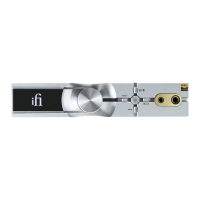
OFF: XSpace Holographic is disabled This allows the 'direct' sound to be enjoyed.
30˚ Loudspeaker Angle: This matrix simulates a narrow loudspeaker placement (e.g. loudspeakers either side of a large
computer monitor) and can also be used for recordings that have been articially enhanced for spaciousness or early
'Ping-Pong' type stereo recordings.
60˚ Loudspeaker Angle: This matrix simulates traditional 'textbook' loudspeaker placement in an equilateral triangle.
90˚ Loudspeaker Angle: This matrix simulates a wide loudspeaker placement favoured by some audiophiles. It may also
be used to enhance recordings that lack spaciousness (some minimalist 'single point' recordings fall into this group).
iv.
i.
ii.
iii.
OFF 30° 60° 90°



 To Next Page