ENGLISH
ENGLISH
will quickly ash every 8 seconds to indicate the iLoud
shouldbechargedassoonaspossible.
Positioning
iLoudisdesignedtositonaatsurface,andistiltedtooffer
anoptimizedlisteningangle.IfiLoudisplacednearaback
wallorinacorner,thebassfrequencieswillbeenhanced.
Forthemostaccurateresponse,alwaysplaceiLoudona
at surface, with its front panel pointing at you and your
ears.Thebass port (3) on the rear ofiLoudmovesalot
ofairandshould never be blockedbya wall or byother
objects.
If you want iLoud to be more stable on the surface it’s
placedon,justopenthefold-outstabilizer(4)onthebottom
ofiLoud.CloseitwhenputtingyouriLoudbackinyourbag.
Using iLoud
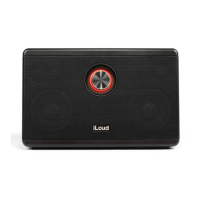
ToturniLoudON,justmovetheswitch(10)onthebacktothe
“ON”position.TheLED(9)onthebackwillturnGREEN,and
thevolumeknob(1)onthefrontofiLoudwillbesurrounded
byREDlight.You’re nowreadytoconnectthe1/8”stereo
cabletothelineinput(5)onthebackofiLoud,withtheother
endconnectedtoyourpreferredsoundsource.Nowyoucan
startlisteningtohigh-qualityaudiooniLoud.
Once the volume reaches its minimum or maximum, the
REDlightaroundtheknobquicklyashestoshowyouhave
reachedthelowerorupperlimit.
IfnomusicoraudioissenttoiLoudforafewminutes,the
unitwillautomaticallyswitchtostandbymodetosavebattery.
Inthiscase,thefrontREDlightwillslowlyglowtoindicate
standbystatus.
AssoonasmusiccomesbackiLoudwillautomaticallywake
upafterafewseconds.
Ifyou’renotusingiLoudforaperiodlongerthanafewhours,
we suggest turningitOFF from the rearpanel (move the
powerswitch(10)totheOFFposition)tosavebatterylife.
Bluetooth
TolistenmusiconiLoudviaBluetoothyoumust“pair”iLoud
toyourpreferredmusicplayer.
BluetoothPairing:
1. TurnONiLoudandshortlythereafterpressthe“Bluetooth
Pairing”button(8)onthebackpanel.
2. ThefrontREDlightwillstartashing.
3. OpentheBluetoothsettingspageonyourmusicplayer,
smartphone,ortablettoscanfornewBluetoothdevices.
4. Once“iLoud”appearsinthelist,selectit.
5. Afterafewseconds,thepairingprocesswillbecompleted
andiLoudwillbeconnected.
6. Oncethisisaccomplished,you’llbeabletostreammusic
fromyourdevicetoiLoud.
iLoud allows for two devices to be “paired” at the same
time.Topairtheseconddevice,justrepeatthestepslisted
previously,theseconddevicewillbepaired,andthepairing
informationfortherstonewillberetainedsoeitherdevice
canbeusedwithouthavingtore-pair.
PleasenotethatiLoudiscompatiblewiththeBluetoothA2DP
protocol,allowinghigh-qualitystereomusicstreaming.
Itisnotrecommendedtomonitorrealtimemusicsessionson
iLoudwhenconnectedviaBluetooth,becauseoftheinherent
latencycausedbytheBluetoothtechnology.Whenworking
onrealtimemusicproductions, orplayinglive instruments,
wesuggestusingthe1/8”TRRSanaloginput(5).
iRig Instrument or Dynamic
Microphone Input
iLoudsports a built-in iRig circuit, which lets you connect
instrumentslikeguitars,bassesordynamicmicrophones.
WhenconnectingiLoudtoaniOSdevicerunningAmpliTube,
VocaLive or other audio-processing applications, you’ll be
abletosendyourguitar’ssignaltotheappontheiOSdevice,
andthenlistentotheprocessedsoundoniLoud.
ToconnectyourguitarordynamicmicrophonetoiLoud,plug
thejackonyourguitar(ormicrophone)cableintotheiLoud
1/4”inputsocket(6).Note:iLoud’sinputdoesn’tacceptXLR
microphonejacks,only1/4”.
IMPORTANT: the instrument or microphone signal is
NOTdirectlysentto the iLoud speakers. To use the iRig
inputfeature,youneedtoconnectaniOSdevicerunning
AmpliTube,VocaLive or another audio-processing app to
theiLoud1/8”inputsocket(5)usingtheincluded1/8”TRRS
cable.
WhenusingtheiRigInputwithaninstrumentoradynamic
microphone,besuretoadjusttheGAINcontrol(7)toachieve
theoptimalsignallevelonyouraudio-processingapponthe
iOSdevice(ashighaspossiblewithoutoverloading).
Troubleshooting
iLoud doesn’t turn ON.
Charge your iLoud battery by connecting the included
charger.Afullchargetakes approximatelytwohours.Set
the power switch (10) on the back panel of iLoud to the
“ON”position.
iLoud is ON, but I get no sound.
Connectthe1/8”line-inputcabletoiLoud(5)fromyoursound-
sourcedevice.Rotatethefrontknob(1)clockwisetoincrease
thevolume.IfyouareusingBluetooth,repeattheBluetooth
pairingprocess.
iLoud is not listed in the Bluetooth devices on my
phone, tablet or computer.
PresstheBluetoothPairingbutton(8) on the back panel
of iLoud to make your device search for new Bluetooth
devices.Makesureyou’renotatadistancegreaterthan10


 To Next Page