IMER INTERNATIONAL S.p.A.
KOINE 4/5
7. MECHANICAL SAFETY
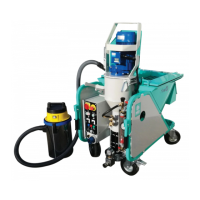
The hazardous points on the IMER plastering machine are
protected by means of suitable safety devices, which must remain
¿WWHGDWDOOWLPHVDQGNHSWLQSHUIHFWFRQGLWLRQVXFKDVWKHHOHFWULF
motor cooling fan guard and the grille on the hopper to prevent
contact with the cell wheel.
Also opening of the mixing chamber, either via the motor support
ÀDQJHRUWKHFRPSOHWHPL[LQJFKDPEHUVKXWVGRZQWKHURWDU\SDUWV
RIWKHPDFKLQHWKDQNVWRDVSHFL¿FVDIHW\PLFURVZLWFK
8. TRANSPORT
- Caution! Before moving the plastering machine, always
detach the power plug.
Before moving the plastering machine the water delivery hose and
material delivery line must be removed.
Only a minimal amount of the material should be in the hopper
when handling.
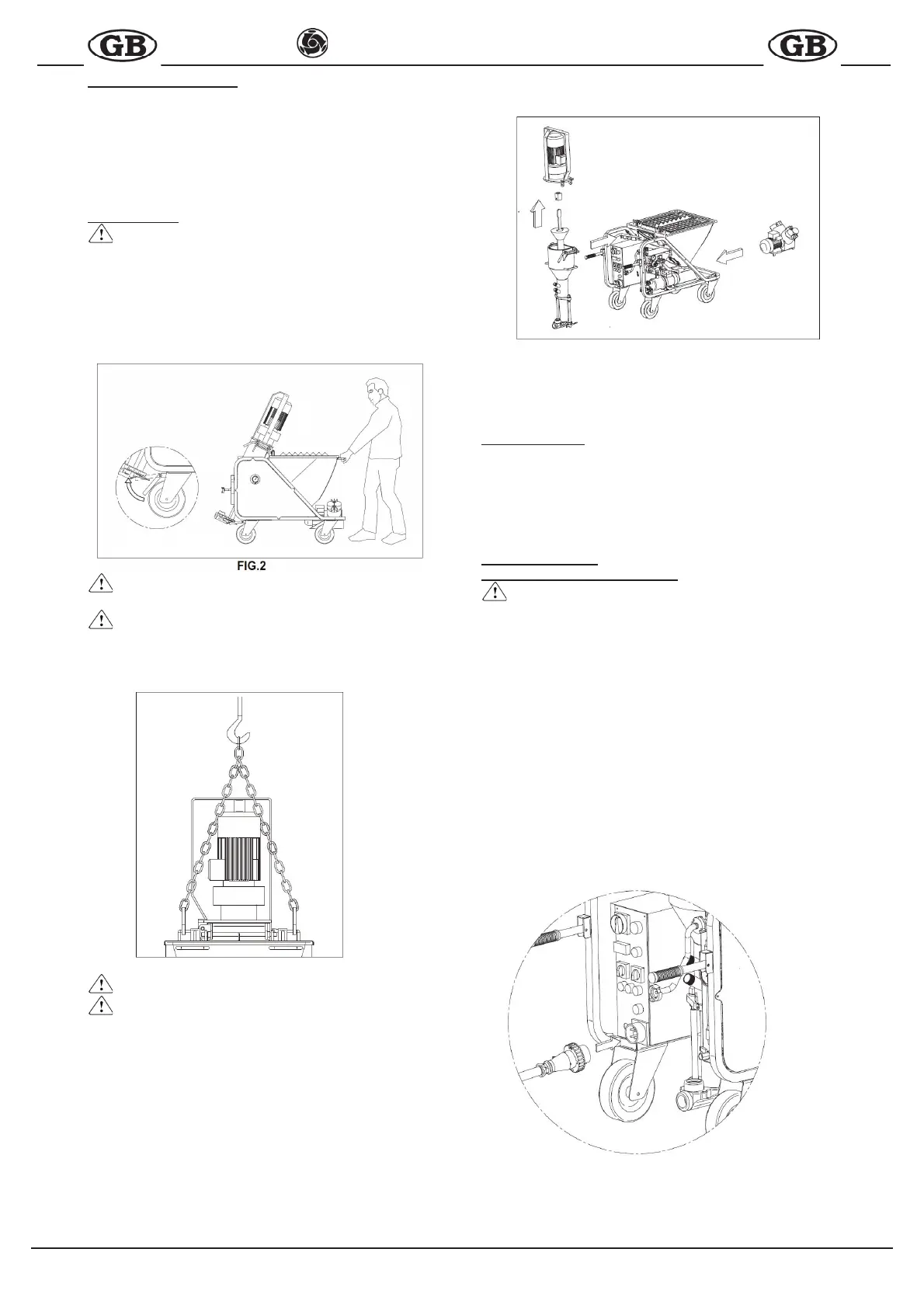
Release the wheel by means of the brake and move the mixer by
PHDQVRIWKHKDQGOHV¿J
FIG.2
- Caution! Before lifting the plastering machine, always
disassemble the comp
ressor for separate transport.
- Caution! Before lifting the machine, always check that
DOOPDFKLQH
FRPSRQHQWVDUHFRUUHFWO\VHFXUHGDQG¿WWHGLQ
place.
7ROLIWWKHPDFKLQHXVHWKHVSHFL¿FDWWDFKPHQWULQJV¿J
FIG.3
- Caution! Lift with care to avoid hazardous oscillations
&DXWLRQ1HYHUXVHSRLQWVRWKHUWKDQDVVSHFL¿HGLQ
¿JXUHWROLIWWKHPDFKLQHDQGLQSDUWLFXODUGRQRWKRRNXS
lifting equipment to the gearmotor guard.
Use lifting equipment suited to the overall weight of the machine
indicated in table 1.
To facilitate transport, the machine can be disassembled as
VKRZQLQ¿J
.
FIG.4
7KHZHLJKW
RIWKHVXEXQLWVVKRZQLQ¿JDUHVSHFL¿HGLQWDEOH
9. INSTALLATION
3RVLWLRQWKHSODVWHULQJPDFKLQHRQDÀDWVXUIDFHLQDQDUHDZKHUH
it does not constitute an obstruction either during use or cleaning
at the end of the work shift and where a minimum quantity of
pipelines is required.
Secure the machine in place by means of the wheel brake (ref.5
¿J
10. CONNECTIONS
10.1 ELECTRICAL CONNECTION
- Ensure that the power supply voltage, mains frequency
and electrical connection (socket, fuses, cable) correspond
WRVSHFL¿FDWLRQVLQWDEOH
7KH HOHFWULFDO SRZHU OLQH PXVW EH ¿WWHG ZLWK SURWHFWLRQ DJDLQVW
current overload (e.g. by means of fuses or a thermal magnetic
cut-out) and with current dispersion to earth (e.g. with a differential
circuit breaker). The electric cable wire size must take into account
the operating currents and length of the line to avoid excessive
voltage drops.
Avoid use of extension leads wound on drums. The power cable
must be suitable for frequent movements and with an abrasion
resistant sheath (e.g. type H07RN-F).
Before connecting the plastering machine to the electrical mains,
HQVXUHWKDWDOOVDIHW\GHYLFHVDUH¿WWHGDQGDUHLQSHUIHFWFRQGL-
tion, and check in particular that the hopper grille is secured in
place, that the extension in good condition and that the plugs and
sockets are not wet.
Connect the plastering machine socket on the electrical panel to
WKHPDLQV¿J
FIG.5


 To Next Page