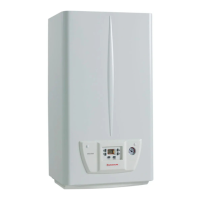
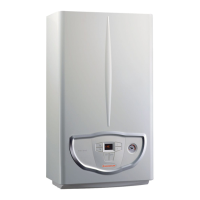
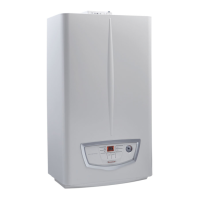
The Immergas NIKE MYTHOS 24 4 ERP boiler is a wall-mounted appliance designed for heating environments and producing domestic hot water. It is intended for domestic use and similar purposes.
Installation and General Use
The boiler must be installed by professionally enabled companies according to regulation standards, current legislation, and local technical procedures. The wall surface for installation should be smooth, without protrusions or recesses, and the boiler should not be installed on plinths or floors. Adequate space (at least 3 cm) between the boiler casing and cabinet sides, as well as above the boiler for water and flue connections, is required for servicing. Flammable objects should be kept away from the appliance, and household appliances should not be placed underneath it to prevent damage from safety valve intervention or hydraulic leaks.
These boilers are not suitable for installation in bedrooms, studio flats, bathrooms, or rooms with wood/solid fuel burning heat generators. Installation is prohibited in areas with fire risk (e.g., garages, closed parking stalls), on the vertical projection of cooking hobs, or in common parts of office condominiums unless in dedicated technical compartments. Type B open chamber boilers should not be installed in commercial, artisan, or industrial areas where volatile vapors, substances, or dusts harmful to components may be present. The installation room temperature must not fall below 0°C, and the boiler must not be exposed to weathering. Wall mounting must ensure stable and efficient support.
The instruction book is an essential part of the product and must be given to the new user. It contains important safety information for installation, use, and maintenance. In case of malfunctions or incorrect operation, the appliance should be turned off immediately, and an authorized company (e.g., Immergas Technical Assistance centre) should be contacted. Unauthorized modifications or repairs will invalidate the warranty.
The boiler is protected with suitable transport packaging and must be stored in dry environments, protected from bad weather. Before connecting the boiler, the heating system (pipes, radiators) should be cleaned with pickling or de-scaling products to prevent deposits that could compromise operation. A chemical treatment of the thermal system water is required to protect the system and appliance from limescale, slurry, or other hazardous deposits. The boiler safety valve outlet must be connected to an appropriate drain. An Immergas anti-backflow kit is recommended upstream of the cold water inlet to meet drinking water pollution regulations.
The electrical installation must correspond to maximum absorbed power specifications on the boiler data-plate. The boiler is supplied with an "X" type power cable without a plug, which must be connected to a 230V ±10% / 50Hz mains supply, respecting L-N polarity and earth connection. A multi-pole circuit breaker with class III over-voltage category is also required. For mains fuse replacement on the P.C.B., a 2A quick-blow fuse should be used. Adapters, multiple sockets, or extension leads should not be used for the main power supply.
The boiler is prepared for optional room chrono-thermostats or remote controls, connected with 2 wires. The On/Off digital chrono-thermostat allows setting two room temperature values (comfort and lower), a weekly program with four daily switch on/off times, and selection of operating modes (manual, automatic, forced automatic). The Comando Amico Remoto Remote Control Device V2 (CARV2) offers climate chrono-thermostat functionality, allowing control of appliance operation and heating system information, self-diagnosis, and precise adjustment of system flow temperature for energy savings. If a CARV2 is used, two separate lines should be arranged according to electrical system regulations, and boiler pipes must not be used for earthing or telephone lines.
The room where the boiler is installed requires adequate air flow for gas combustion and ventilation. Provisions for ventilation, flue ducts, chimneys, and caps are detailed in the manual. The wall-mounted boiler should not be exposed to direct vapors from a cooking surface. Use by unskilled persons or children is prohibited. For temporary shutdown, the heating system should be drained (if anti-freeze is not used), and all electrical, water, and gas supplies shut off. The appliance or connected parts should never be cleaned with flammable substances. Containers or flammable substances should not be left in the same environment as the appliance. Obstructing the air intake for room ventilation is prohibited and dangerous. Functioning simultaneously with suction devices, chimneys, or similar is prohibited unless additional air openings are dimensioned to satisfy the further air necessity.
Maintenance Features
The heating systems require periodical maintenance and regular energy efficiency checks to ensure optimal safety, performance, and operation. A yearly cleaning and maintenance contract with a zone technician is recommended.
Troubleshooting:
In case of an anomaly, the boiler backlight turns from green to red, and error codes flash on the display.
- Ignition block (code 01): Occurs if the burner does not ignite within 10 seconds. Reset by pressing the Reset button (1). Frequent occurrences require contacting an authorized company.
- Overheating thermostat block (code 02): Caused by excessive internal overheating. After cooling, reset by pressing the Reset key (1). Frequent occurrences require contacting an authorized company.
- Flue safety thermostat anomaly (code 03): Indicates improper flue evacuation. The boiler restarts automatically after 30 minutes if conditions normalize. If it intervenes 3 times in less than two hours, manual reset is required. Persistent anomaly requires a qualified technician.
- Electro-mechanical contacts (code 04): Occurs if safety thermostat, fume pressure switch, or system pressure switch malfunction. Reset the boiler. Persistent anomaly requires an authorized company.
- Delivery probe anomaly (code 05): Board detects a flow probe anomaly. The boiler will not start. Contact an authorized company.
- Insufficient system pressure (code 10): Water pressure in the heating system is insufficient (below 1 bar). Check that system pressure is between 1-1.2 bar.
- Parasite flame (code 20): Leak on the detection circuit or anomaly in the flame control unit. Reset the boiler. Persistent anomaly requires an authorized company.
- Insufficient water circulation (code 27): Boiler overheats due to insufficient water circulation in the primary circuit. Causes include low system circulation (check for closed shut-off devices, air in the system) or a blocked pump. Free the pump. Frequent occurrences require contacting an authorized company.
- Loss of Remote Control communication (code 31): Occurs 1 minute after communication loss between boiler and remote control. Reset by removing and re-applying voltage to the boiler. Frequent occurrences require contacting an authorized company.
Boiler Shutdown: Press button (2 Fig. 2-1) until the symbol (-) appears on the display. The boiler remains powered in this state. Disconnect the external omnipolar boiler switch and close the gas cock upstream of the appliance for prolonged unused periods.
Restoring Central Heating System Pressure: Periodically check system water pressure (1-1.2 bar). If below 1 bar (with a cool circuit), restore pressure via the filling cock (Fig. 2-2). Close the filling cock after operation. Pressure values around 3 bar may activate the safety valve. Frequent pressure drops require qualified staff to check for system leakage.
System Draining: Use the special draining valve (Fig. 2-2) after closing the filling valve.
Anti-freeze Protection: The boiler has an antifreeze function that ignites the burner when temperature falls below 4°C and stops at 42°C. This function is ensured if the appliance is in perfect working order, not blocked, and not in "off" mode. For prolonged absence, the system must be drained completely or antifreeze substances added to heating system water. The domestic hot water circuit must also be drained. Frequent draining requires suitably treated water to prevent limescale.
Case Cleaning: Use damp cloths and neutral detergent. Abrasive or powder detergents should not be used.
Decommissioning: For permanent shutdown, contact professional staff for procedures to shut off and disconnect electrical, water, and gas supply lines.
Yearly Appliance Check and Maintenance:
- Clean flue side of the heat exchanger and main burner.
- Visually check draught-breaker/anti-wind device for deterioration or corrosion.
- Check ignition and operation.
- Check correct calibration of the burner in domestic hot water and central heating phases.
- Check appliance control and adjustment devices, including main electrical switch, system control thermostat, and domestic hot water control thermostat.
- Check sealing efficiency of the gas circuit and internal system.
- Check intervention of the device against no gas ionisation flame control (intervention time less than 10 seconds).
- Visually check for water leaks or oxidation from/on connections.
- Visually check that water safety drain valves are not blocked.
- Check expansion vessel load (1.0 bar) after discharging system pressure.
- Check system static pressure (1-1.2 bar) after refilling.
- Visually check that safety and control devices have not been tampered with or shorted.
- Check condition and integrity of the electrical system, ensuring cables are inside fairleads and no traces of blackening or burning.
- Perform maintenance on the heating system according to regulations.
Converting to Other Gas Types:
If the boiler needs conversion, an authorized company must perform the operation using a specific conversion kit. Steps include disconnecting the appliance, replacing main burner injectors, re-powering, selecting the gas parameter type (P1) (LG for LPG, nG for Methane), adjusting nominal heat output for domestic hot water and heating phases, adjusting maximum heating power, and sealing gas flow rate regulation devices. After conversion, apply the sticker from the kit near the data-plate, canceling old gas type data. Adjustments must follow the table in Par. 3.16.
Checks Following Conversion:
After conversion, ensure the nozzle diameter is suitable, and settings are at correct pressure. Check for no flame in the combustion chamber, stable burner flame (not too high/low, not detaching), and closed/sealed pressure testers. Burner adjustment requires a differential "U" or digital pressure gauge connected to the gas valve outlet pressure point, following pressure values in Par. 3.16.
Possible Adjustments:
- Boiler nominal thermal heat output: Adjust with the domestic hot water adjustment button (+) (3 Fig. 2-1) to maximum operating temperature, open domestic hot water cock to prevent modulation, then adjust with the brass nut (3 Fig. 3-3) to maximum pressure values in Par. 3.16. Clockwise increases, anti-clockwise decreases.
- Boiler minimum heat output in domestic hot water phase: Only after calibrating nominal pressure. Adjust with cross plastic screws (2) on the gas valve, keeping brass nut blocked (3). Disconnect power supply to modulating coil, turn screw clockwise to increase pressure, anti-clockwise to decrease. Re-apply power supply to modulating coil. Minimum power must not be lower than stated in Par. 3.16. Remove plastic cap (6) to adjust gas valve, refit after adjustment.
Programming the P.C.B.:
The boiler allows programming of several operation parameters. To access programming, press buttons (1) and (2) for about 15 seconds. Use buttons (3) and (4) to select parameters from the table (P1-P9), adjust values with keys (5) and (6), and confirm with reset key (1) for 5 seconds. Pressing keys (3) and (4) simultaneously cancels the operation. The operation cancels automatically if no keys are touched for a period.
"Chimney Sweep Function":
Activates boiler at max. output for 15 minutes, excluding adjustments, with only temperature safety thermostat and limit thermostat active. Activate by pressing the Reset key for at least 10 seconds. Indicated by flashing symbols (8 and 11 Fig. 2-1). Allows checking combustion parameters. Disable by switching boiler off/on or pressing button (2 Fig. 2-1).
Heating Timer: Electronic timing device prevents frequent burner ignition in heating phase. Supplied with a 3-minute timer, adjustable via parameter (P7).
Pump Anti-block Function: In "summer" mode (7), the pump starts once every 24 hours for 30 seconds to prevent blockage. In "winter" mode (3), the pump starts once every 3 hours for 30 seconds.
Radiators Anti-freeze Function: If system return water is below 4°C, the boiler starts up until 42°C.
P.C.B. Periodical Self-check: Activates every 18 hours in heating mode or standby. In domestic hot water mode, it starts within 10 minutes after withdrawal ends, for approx. 10 seconds. During self-check, the boiler remains off.


 To Next Page
 General