14
STV50 ed 09/08 VICTRIX 50 Rev. 002
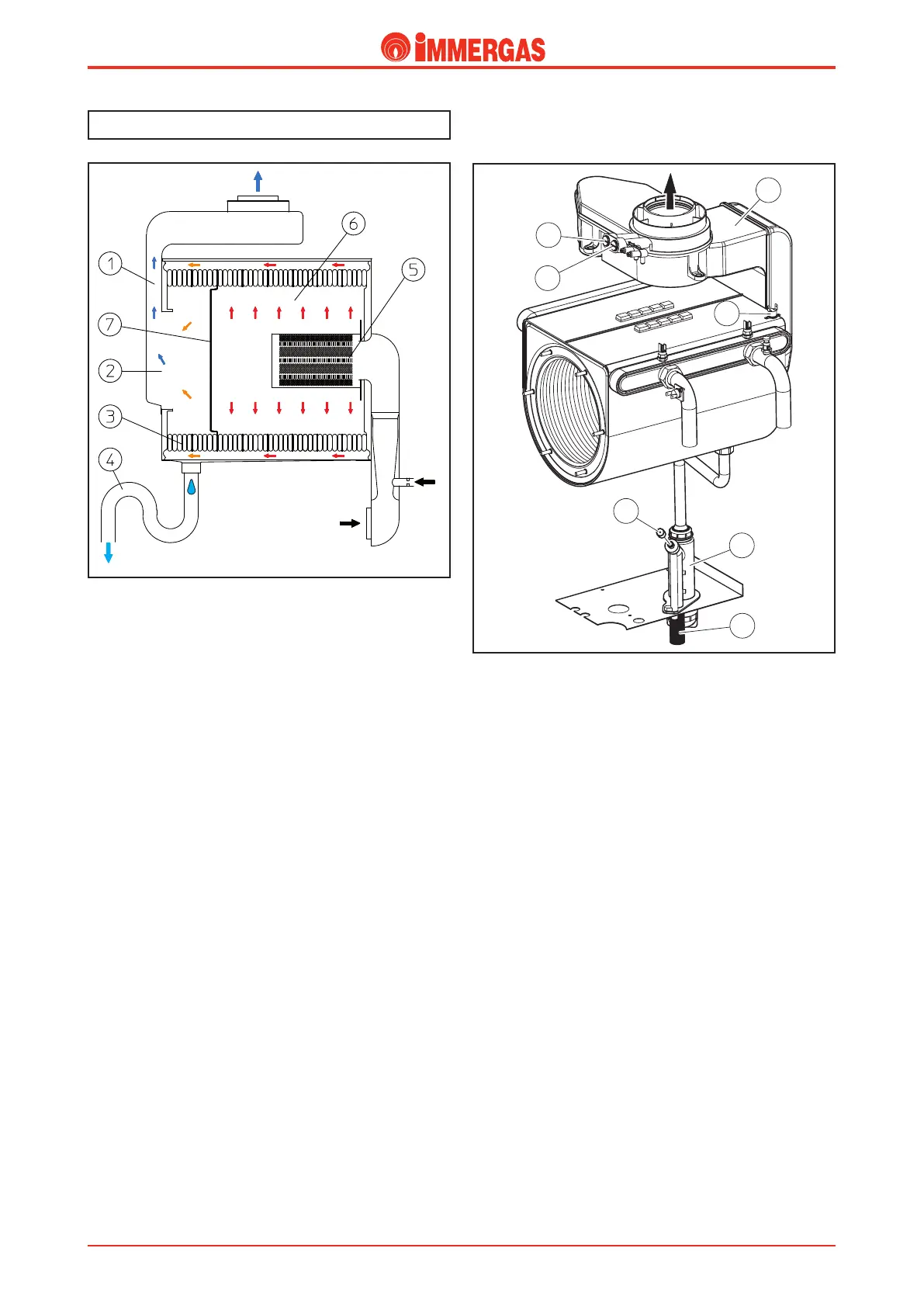
Condensate drain trap (4).
Collects the condensate that forms during boiler functioning
from the bottom of the module.
Its outlet is connected to the draining pipe (11) towards which
the passage of water is allowed but not the passage of fumes,
which could occur following obstruction of the evacuation
pipes.
e height of the column of water in the siphon is in fact
greater than the pressure detected inside the sealed chamber
(module) with the fan at maximum speed and the evacuation
pipes blocked at functioning limits.
is, however, prevents the draining of combustion products
into the sewers.
On commissioning fumes may escape from the exhaust pipe
(11) which disappear after a few minutes of functioning when
the condensate has reached a sucient height. If this should
take too long, ll the siphon with water after having removed
the cap (10), which must be re-positioned correctly at the end
of the operation.
Air-ue sample points (8-9).
ere are two sample points in the upper part of the boiler
with screw fastening, with front access, after having removed
the plastic cover and from where the combustion agent air (8)
and combustion products (9) can be withdrawn.
Flue circuit.
Operating.
e functioning of the fan positioned at the entry of the air-
gas mixing pipe, guarantees the fan-assisted expulsion of the
fumes produced by the cylindrical burner (5).
ese directly hit the rst eight elements of the primary heat
exchanger inserted in the sealed combustion chamber (6) which
has a sheet steel section on its base (7) that divides it from the
condensation chamber (2) and diverts the ow of fumes to the
outside of the module.
In this way the ue gases, before entering the condensation
chamber (2), hit the last three elements (3) of the heat exchan-
ger, inside which primary circuit return water runs.
is cools the combustion products further and makes their
condensation easier before escape from the ue hood (1).
e water condensate formed inside the heat exchanger, in
the ue hood and also in the evacuation pipes ows into the
lower part of the module from where, before being discharged,
is conveyed into a trap (4).
Flue hood (1).
It is connected to the rear part of the condensation module
and conveys the combustion products towards the drain tting
present in the upper part of the appliance.
It is aected by the passage of fumes and water condensate
formed inside it or in the exhaust pipes.
It is constructed in plastic, resistant to the corrosive eects of
the condensate and can work to a temperature of 130 °C (max.
ue temp with ow 85° C = 78° C).
A ue safety thermostat is inserted onto the condensation
module (12), to protect the ue hood (1) and which intervenes
when the temperature detected on the condensation module
exceeds110° C.
Gas
Air
Condensate drain
Flue exhaust
Technical DocumentationTechnical Documentation








 To Next Page