5-34 Selecting Functions
5
PID control (Feedback signal)
•
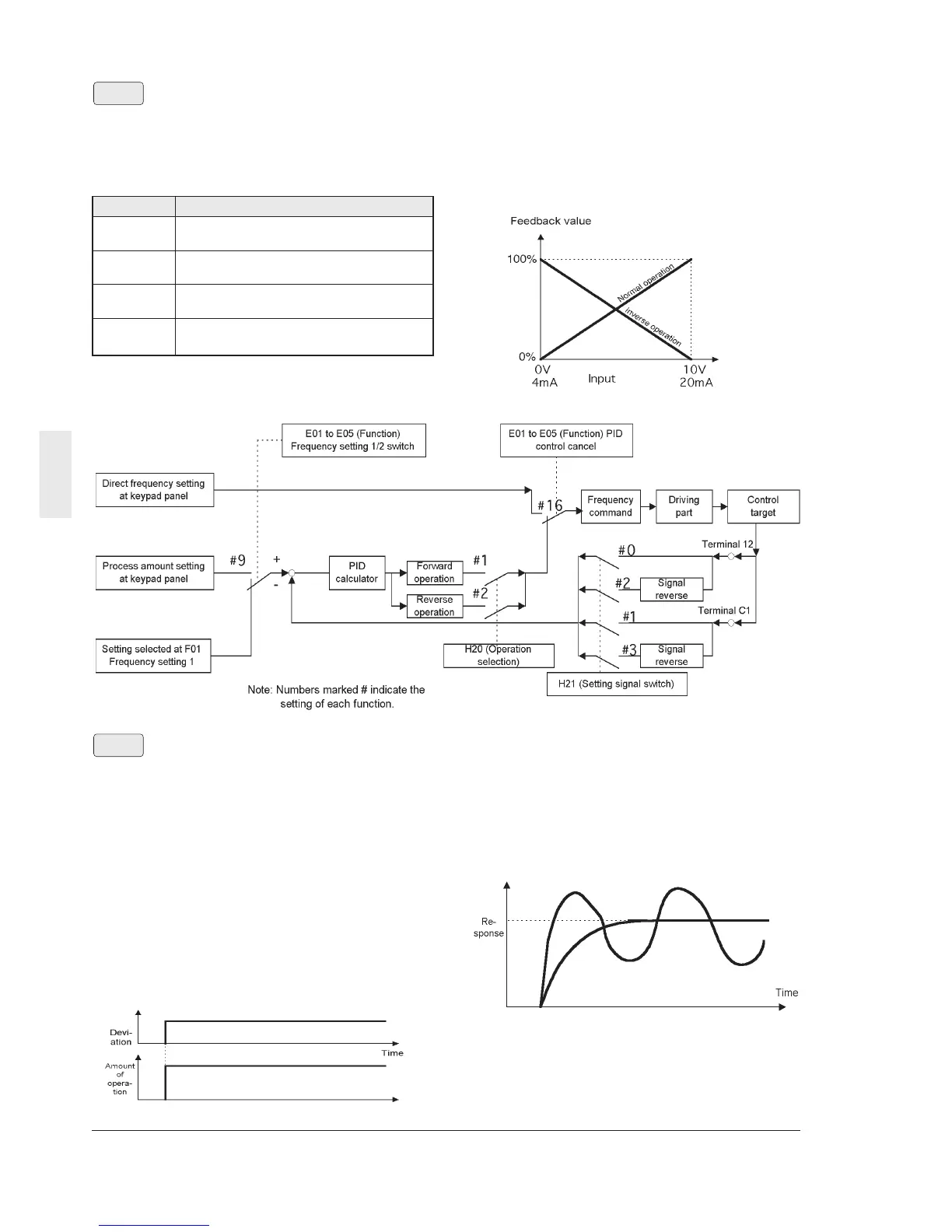
Select the feedback value input terminal and
electrical specification of the terminal. Select
one from the table below according to the
specifications of the sensor.
H21
Setting Selection item
0 Control terminal 12, normal
operation (voltage input 0 to +10V)
1 Control terminal C1, normal
operation (current input 4 to 20 mA)
2 Control terminal 12, inverse
operation (voltage input +10 to 0V)
3 Control terminal C1, inverse
operation (current input 20 to 4 mA)
PID control (P (P gain))
•
Generally speaking, P: gain, I: integral time
and D: differential time are not used alone.
Functions are combined like: P control, PI
control, PD control and PID control.
•
P action
An operation where there is proportional
relationship between the amount of operation
(output frequency) and deviation is called P
operation. Therefore the P action outputs an
operation amount proportional to the
deviation. However, the deviation cannot be
eliminated by only the P action.
Setting range: 0.01 to 10.00 times
H22
Note) The feedback value of the PID control
can be input only in the positive polarity.
The negative polarity (0 to -10 Vdc, -10
to 0 Vdc, etc.) cannot be input. Therefore
the control cannot be applied to
reversible operation using the analog
signal.
•
The P gain is a parameter which determines
the degree of response to the deviation of P
action. With a large gain, the response is
quick but hunting is likely to occur. With a
small gain, the response is stable but slow.



 To Next Page