To Next PageTo Next Page
 Need help?
Do you have a question about the Infiltrator Delta ECOPOD-N Series and is the answer not in the manual?
 General
| Brand | Infiltrator |
|---|---|
| Model | Delta ECOPOD-N Series |
| Category | Water System |
| Language | English |
Explains the process of breaking down domestic wastewater using aerobic bacteria and engineered plastic media.
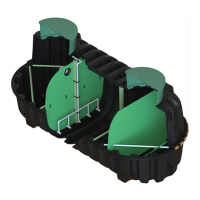
Details how the ECOPOD-N system houses engineered plastic media for treating wastewater in an oxygen-rich environment.
Observe warning device and air pump operation daily for any unusual noise or failure.
Check the treatment plant for offensive odors weekly and contact service provider if issues arise.
Includes inspection of mechanical/electrical components, air filter cleaning, and effluent quality checks.
Lists substances and materials to avoid, and recommends specific cleaning product types.
Details items not to discard, including chemicals, non-biodegradables, and excessive water.
Emphasizes avoiding power pole connections, extension cords, and ensuring compliance with electrical codes.
Explains when and how to pump out tank contents, including turning off the air pump.
Provides instructions for systems not in use for varying periods, with and without frost conditions. Includes critical air pump warnings.
Details how to take effluent samples, including flushing the line and sample handling for testing.
Guidelines for collecting and analyzing samples to measure BOD, noting potential degradation during storage.
Instructions for collecting TSS samples, recommending prompt analysis and refrigeration to minimize decomposition.
Best practices for ammonia nitrogen sampling, including chlorine destruction and sample preservation.
Guidelines for safely offloading, unpacking, and inspecting tanks and components upon delivery.
Steps for setting tanks, installing risers, and proper backfilling procedures according to manufacturer recommendations.
Instructions for connecting inlet and outlet piping to pretreatment and reactor tanks, ensuring proper slope.
Procedure for filling the reactor tank with clean water to the correct level during system setup.
Details on connecting the air distribution piping from the tank riser to the compressor location.
Recommendations for installing the air pump in a suitable location, considering water accumulation and ventilation.
Instructions for mounting the control panel, connecting electrical sources, and wiring components safely.
Steps for initiating system operation, including setting the high-level pressure switch and checking air piping.
Diagnosing issues related to air pump operation, air lines, and air distribution.
Identifying problems with internal piping, connections, seals, and gaskets within the system.
Solutions for hydraulic/biological overload and issues arising from improper installation or settling.
Guidance on what not to put in the system and troubleshooting related to water clarity and grease.
Steps to resolve issues with the air pump not running or alarm system malfunctions.
General advice including using factory-approved parts, contacting licensed haulers, and documenting issues.
Table detailing treatment capacity, tank volumes, media size, and air requirements for different models.
Describes the construction materials for reactor tank covers and media containers for different suffixes (FF, CA, IM).
Specifies compressor models, motor amps, operating watts, and voltage requirements for each ECOPOD-N model.
Provides dimensional data (A, B, C, D) for the reactor tanks of various ECOPOD-N treatment plants.
Diagram illustrating the dimensions (A, B, C, D) of the IM-1060 series ECOPOD-N tanks.
Diagram showing dimensions for concrete tanks, including access and drop details.
Illustrates the control panel layout, including fuses, switches, alarms, and pressure switches.
Details connecting the air line from the treatment plant to the compressor and the control panel.
Detailed schematic diagram for the CP2210 control panel, showing internal wiring and connections.
Table providing recommended fuse sizes based on motor full load current for the CP2210 panel.
Schematic diagram detailing the electrical connections and components for the CP2220 control panel.
Procedure for adjusting the high-level pressure switch to set the alarm point for high water levels.
Diagram illustrating the schematic for the CP20 series control panel, including wiring and components.
Performance curves and technical data for the SCL 06 MOR blower/exhauster, including pressure and flow rates.
Provides noise level measurements (dB(A)) for the blower at different operating frequencies and speeds.
Details construction, operation, options, and accessories for FPZ regenerative blowers.
Comprehensive table of specifications for K03-MS through K06-MS models, including flow, power, noise, and dimensions.
Graphical representation of blower capacity (CFM) versus differential pressure (psig) for different models and frequencies.
Graphs showing absorbed power (HP) as a function of differential pressure for various blower models.
Illustrates temperature increase of the blower as a function of differential pressure for different models.
Details the information found on the ECOPOD-N unit data plate, including model, NSF certification, and serial number.
Information presented on the data plate for the alarm malfunction electrical panel.
Describes the two-year initial service policy, including inspections and effluent quality checks.
Information on annually renewable service policies offering similar coverage to the initial policy.
Guidance on how to obtain replacement parts or components for the ECOPOD-N system.
Instructions for submitting complaints, requiring written details and the system's serial number.
Congratulates the homeowner and emphasizes the importance of regular maintenance for optimal performance.
Highlights the benefits of regular maintenance and cautious use to ensure the system functions for decades.
Instructions on disposing of grease, oils, and food scraps to prevent tank pumping and maintenance costs.
Recommends cleaning lint filters on washing machines and dryers before each load.
Suggests using environmentally friendly alternatives for common household cleaners and polishes.
Provides tips to conserve water, such as shorter showers and full loads, to avoid hydraulic overload.
Lists pharmaceuticals, chemicals, non-flushables, and other items that should not be put into the system.
Guidance on securing lids, planning landscaping, avoiding RV waste, and preventing surface water entry.
Details the two-year limited warranty for ECOPOD® products, covering defects and exclusions.
Outlines conditions under which the warranty is void, such as improper installation or external factors.