1
Attention
In order to obtain good measurement precision, you need to clear
away the rusty, sundry, grease, etc. on the working surface.
Please use the couplant on the working surface, measure
repeatedly around the target area and take average value.
Please clean the couplant on the transducer and working surface
after measure.
Please don’t pull the transducer cable when use the instrument.
2
Overview
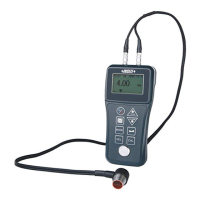
The Thickness Gauge is a digital ultrasonic thickness gauge. Base on the
same operating principles as SONAR is capable of measuring the
thickness of various materials with accuracy as high as 0.01mm or
0.001inch. It is suitable for a variety of metallic and non-metallic
materials.
1
3
2
Specification:
Resolution: 0.01mm (range<100mm), 0.1mm (range 100mm)
Accuracy: ±0.05mm (range < 10mm), ±(0.01+0.5%H)mm (range
10mm). H is the thickness to be measured.
Velocity: 1000~9999m/s
Structure:
Measuring principle:
The digital ultrasonic thickness gauge determines the thickness of a
part or structure by accurately measuring the time required for a short
ultrasonic pulse generated by a transducer to travel through the
thickness of the material, reflect from the back or inside surface, and
be returned to the transducer. The measured two-way transit time is
divided by two to account for the down and back travel path, and then
multiplied by the velocity of sound in the material. The result is
expressed in the wall-known relationship:
H is the thickness, v is the velocity, t is the time.


 To Next Page