11
1 Product Description
1.1 Overview
1.1.1 Feature Summary
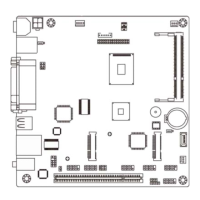
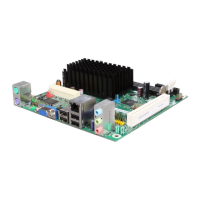
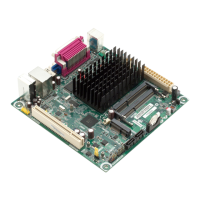
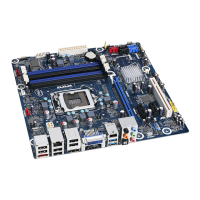
Table 1 summarizes the major features of the board.
Table 1. Feature Summary
Form Factor
4.0 inches by 4.0 inches (101.60 millimeters by 101.60 millimeters)
Processor
• Soldered-down Intel
Core™ i5-3427U processor with up to 17 W TDP
― Integrated graphics
― Integrated memory controller
Memory
• Two 204-pin DDR3 SDRAM Small Outline Dual Inline Memory Module
(SO-DIMM) sockets
• Support for DDR3 1600 MHz and DDR3 1333 MHz SO-DIMMs
• Support for 1 Gb, 2 Gb, and 4 Gb memory technology
• Support for up to 16 GB of system memory with two SO-DIMMs using 4 Gb
memory technology
• Support for non-ECC memory
• Support for 1.35 V low voltage JEDEC memory
Chipset
Intel
®
QS77 Express Chipset consisting of the Intel
®
QS77 Express Platform
Controller Hub (PCH)
Graphics
•
Integrated graphics support for processors with Intel
®
Graphics Technology:
― One High Definition Multimedia Interface* (HDMI*) back panel connector
― Two mini DisplayPort* back panel connectors
Audio Intel
®
High Definition Audio via the HDMI v1.4a and DisplayPort 1.1a interfaces
through the PCH
Peripheral
Interfaces
•
― Two front panel ports are implemented through one dual-port internal
header
― Two ports are implemented with vertical back panel connectors
― One port is reserved for the PCI Express* Half-Mini Card
― One port is reserved for the PCI Express Full-Mini Card
• One front panel USB 3.0 port is implemented through an external connector
(blue)
Expansion
Capabilities
• One PCI Express Half-Mini Card connector
• One PCI Express Full-Mini Card connector
Intel
®
Visual BIOS
• Intel
Visual BIOS resident in the Serial Peripheral Interface (SPI) Flash
device
• Support for Advanced Configuration and Power Interface (ACPI), Plug and
Play, and System Management BIOS (SMBIOS)
continued



 To Next Page