15
slanted upwards or downwards. After mounting the transducer
and actually using the Color Twinscope on the water, you may
need to readjust the transducer’s mounting for optimum
performance.
Thru-Hull Transducer Installation
The thru-hull transducer is the recommended choice for larger
boats with in-board engines. Thru-hull mounting is usually
required on larger power and sail craft in order to find a
mounting location free of forward looking hull obstructions.
The Color Twinscope must have a clear view of the water
ahead as it can not see through obstructions such as the vessel’s
hull. Please read the following carefully before starting the
thru-hull installation.
Normally, thru-hull installations are performed by a
professional in a boat haul-out facility. We suggest you seek
professional assistance before attempting to mount this
transducer.
Selecting the Best Location
The best location to mount the thru-hull transducer will vary
with the type of boat. Try to find a location with the smallest
dead rise angle to make installation easiest.
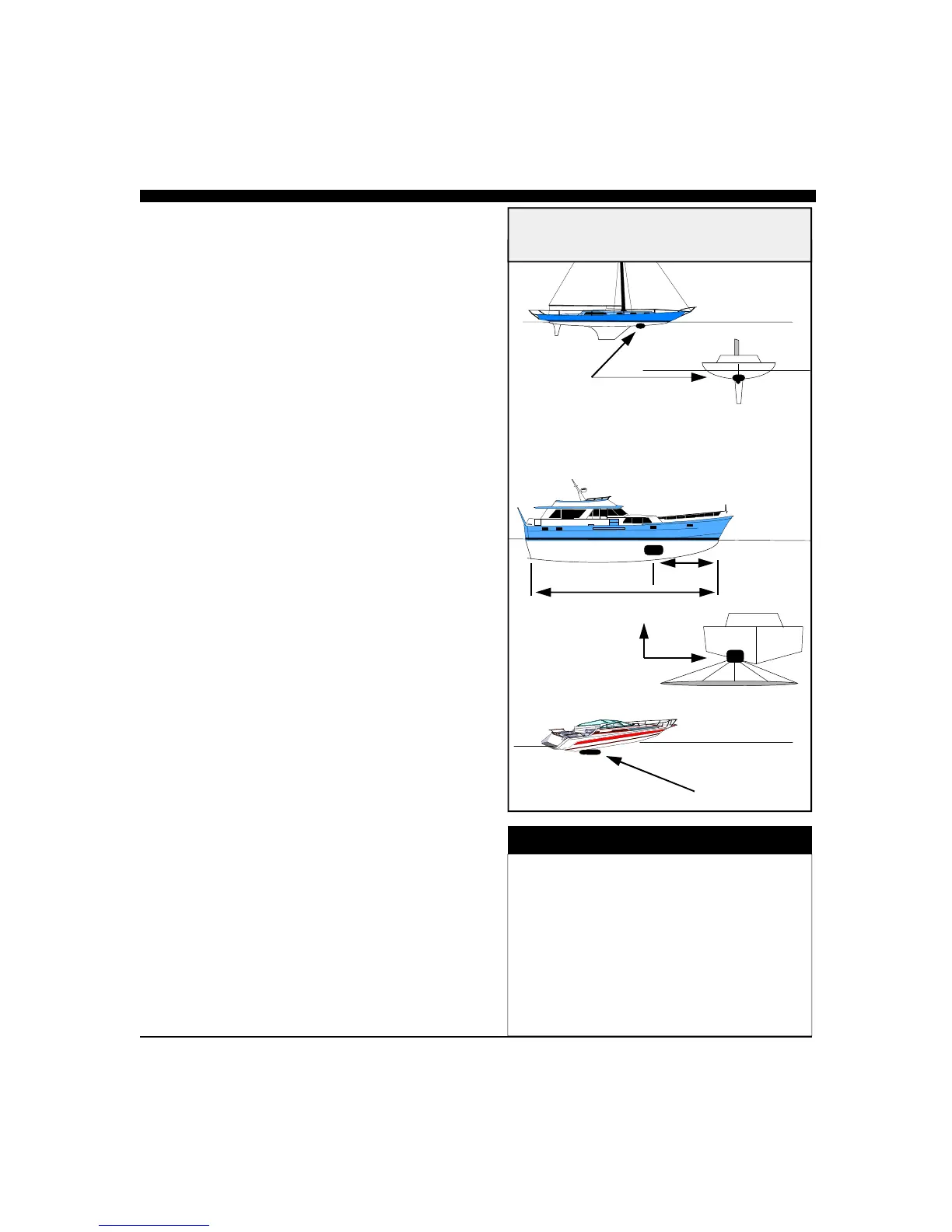
a. On displacement hulls (sailboats, trawlers, etc.) locate the
transducer about 1/3 aft along the waterline. Generally this
provides the best compromise between obtaining aeration-free
water and minimizing propeller noise. The Color Twinscope’s
transducer can not see through aerated water and water near the
bow and near the keel can be quite aerated. Aeration of the
transducer can be minimized by keeping the transducer
mounted away from the keel and by not mounting too far
forward. Because the Color Twinscope scans horizontally
from side to side, it is also important to find a location where
the beam will not be shaded by the keel. This can often be
accomplished by use of a fairing block to place the transducer
below the keel, or by mounting the transducer forward or
beside but at some distance from the keel.
b. On sailboats, the transducer should be mounted where the
acoustic beam will not be shaded by the keel. A spot forward
of a fin keel is usually best. Try to find an accessible spot with
a minimum dead rise angle.
c. On planing powerboat hulls, the transducer should be
mounted well aft and close to the keel to insure that the
transducer is in contact with the water at higher boat speeds.
On I/O’s, transducer mounting close to the
engine usually yields good results.
If you’re installation requires a fairing block, you
may either have one made locally, or purchase a
molded plactic unit from Interphase or your
Interphase distributor.
For the T1-I200-032 Thru-Hull transducer, the
molded Fairing Block Part Number is:
42-2005-000
MOLDED FAIRING BLOCK
Suggested Thru-Hull
Transducer Locations
Fin Keel
Planing Hull
Displacement Hull
L = waterline length
~ 1/3 L


 To Next Page