8
These Installation procedures are suggested for
typical furnace installations. Since each installation is
different, the sequence of instructions may differ from
the actual installation. Only qualified HVAC technicians
should install this furnace.
The installer must be familiar with and comply with all
codes and regulations applicable to the installation of
these heating appliances and related equipment. In
the absence of local codes, the installation must be in
accordance with the current provisions of one or more of
the following standards.
• Federal ManufacturedHome Constructions & Safety
Standard (H.U.D. Title 24, Part 3280.707[a][2])
• AmericanNationalStandard(ANSI-119.2/NFPA-501C)
for all recreational vehicle installations.
• AmericanNationalStandard(ANSI-Z223.1/NFPA-54)
and/or CAN/CSA B149 for all gas-fired furnace models.
• American National Standard (ANSI-Z95.1/NFPA-31)
and/or CSA B139 for all oil-fired furnace models.
• AmericanNationalStandard(ANSI-C1/NFPA-70)and/or
CSA 22.1 Canadian Electric Code Part 1 for all electrical
field wiring.
• UnitshavebeenresearchedunderstandardsUL307A
& B, UL727-1999, ANSI Z21.47b/CSA 2.3b-2008, and
CSA B140.10.
• Thefurnacemustbeleveledatinstallationandattached
to a properly installed duct system.
See page 7 for
circulating requirements.
• The furnace must be installed so that all electrical
components are protected from water.
• Thedimensionsoftheroomoralcovemustbeableto
accommodate the overall size of the furnace and the
installation clearances listed in Table 1, (page 6)
and Figure 1 (page 6)
• The furnace must be installed upstream from a
refrigeration system.
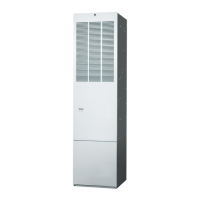
• The M1 Series gas and M5 Series oil furnace is
certiedforuseonwoodooringorsupports,butmust
be installed on top of a duct connector. This factory
suppliedaccessorymustbeinstalledintheoorcavity
and attached to the supply air duct before the furnace
is installed.
Floor cut-outs and fuel line holes must be carefully located
to avoid misalignment of the furnace, and vent piping.
To locate standard ducts see Figure 6 (page 9). For
round ducts, see Figure 7.
1. Measure 10” from the rear wall or alcove and mark the
centerlineofthecut-outontheoor.
2. Using the centerline as a starting point, draw the rest
of the duct cut-out to the dimensions shown in Figure
6 or Figure 7.
3.Cutouttheooropening1/16”largerthantheactual
cutout drawn. This will allow some clearance when
installing the duct connector.
4.Measurefromthetopoftheoordowntothetopofthe
supplyairducttoobtainthedepthoftheoorcavity.
Thedepthoftheoorcavityshownas“X”in
Figure 9 (page 9) will determine the correct duct
connector.
5. Determine which duct connector to use from Table 3
(page 9).
6. Measure and drill gas hole and cut out for cooling coil
(if applicable). See Figure 6 or Figure 7.
Standard Duct Connector Installation
The standard duct connector is designed for use on ducts
12” in width. However ducts narrower than 12” may not
allow sufficient clearances for this type of installation. For
an alternate installation method, see page 9.
1.Center the duct connector in the oor opening with
bottom tabs resting on top of the supply air duct.
2. Mark the cut-out area on the supply air duct by tracing
around the connector tabs of the duct connector. See
Figure 8 (page 9).
3. Remove the duct connector and cut out the marked
area of the supply air duct 1/4” larger the actual cutout
drawn.
4.Installtheductconnectorbackintheooropeningwith
the bottom tabs extending into the supply air duct.
5. Install the mounting plate under the back side of the
duct connector as shown in Figure 8. Align the screw
holes in both components.
6. Secure the duct connector and the mounting plate to
thewoodoorwithappropriatesizescrews.
7. Bend the connector tabs on the bottom of the duct
connector upwards and as tight as possible against
the supply air duct.
8. Bend both tabs up 90° on the mounting plate. See
Figure 10 (page 10).
9. Seal all connections with industrial grade sealing tape
or liquid sealant.
Requirements for sealing ductwork vary
from region to region. Consult with local codes for
requirements specific to your area.


 To Next Page