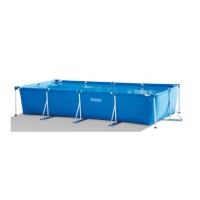
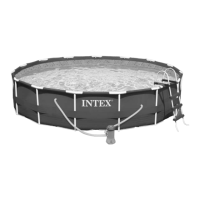
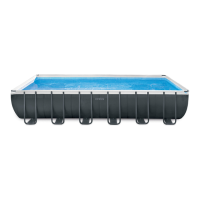
This document provides user manuals for two Intex products: the INTEX 28241EH Metal Frame Above Ground Swimming Pool Set and the Intex 28003E Deluxe Pool Maintenance Kit.
This is an above-ground swimming pool designed for outdoor use, offering a recreational water experience. The pool set includes a metal frame, a pool liner, a filter pump, a removable ladder, a pool cover, and a ground cloth. It is designed for assembly and disassembly by adults only.
Usage Features:
- Site Selection: The pool must be set up on an absolutely flat, level, and compacted ground surface that can withstand the weight of a filled pool. It should not be placed on a deck, balcony, or platform. A minimum of 4 feet of space around the pool is required for safety and access. Aggressive grasses should be eliminated from under the pool liner as they can grow through it. The area should also facilitate proper drainage of pool water.
- Assembly: A team of 2-3 people is recommended for pool setup, and no tools are required for assembly. The liner should be spread out on the ground cloth with the drain valve directed towards the draining area. It's important to allow the sun to warm up the liner before inserting the horizontal beams into the sleeve openings. Talcum powder can be sprinkled on the horizontal beams to ease their removal during disassembly. The horizontal beams and T-joints should be connected in a circular fashion, starting from one location and working in the same direction. For larger pools (10' and above), vertical legs are inserted into belt loops on the liner before connecting to the T-joints. The last joint connection may require simultaneously raising the joint and beam slightly to facilitate insertion.
- Filling: Before filling, ensure the drain plug inside the pool is closed and the drain cap on the outside is tightly screwed on. The pool should be filled with no more than 1 inch (2.5 cm) of water initially to check for levelness. If the water flows to one side, the pool is not completely level, and the pool must be drained, the area leveled, or the pool moved to a level area before refilling. Wrinkles in the bottom liner should be smoothed out from inside or outside the pool. The pool should be filled up to just below the sleeve line.
- Safety: Continuous and competent adult supervision of children and disabled individuals is required at all times. Safety barriers (fencing, locked doors/windows) should be installed to prevent unauthorized access. Never dive, jump, or slide into the pool. Do not lean, straddle, or exert pressure on the inflatable ring or top rim. All toys and flotation devices should be removed from the pool area when not in use to avoid attracting young children. Rescue equipment (ring buoy, rigid pole) and emergency numbers should be kept by the pool. Never swim alone. The pool floor must be visible at all times from the outside barrier. If swimming at night, proper artificial lighting is necessary. Avoid alcohol or drugs when using the pool. Keep children away from pool covers. Pool covers must be completely removed before use. The pool area should be kept clean and clear to prevent slips and falls.
- Electrical Safety: The filter pump must only be connected to a grounding type receptacle protected by a ground-fault circuit interrupter (GFCI). Extension cords, timers, plug adapters, or converter plugs should not be used. The power cord should be located where it cannot be damaged by lawn mowers, hedge trimmers, or other equipment.
- Aquatic Safety Signs: A "Danger No Diving or Jumping" sign should be posted in a highly visible area near the pool. It is recommended to hold a family meeting to establish pool rules, including safety guidelines, and review them regularly with all users and guests.
Maintenance Features:
- Water Quality: Maintaining proper water balance with sanitizers is crucial for maximizing liner life and ensuring clean, healthy, and safe water. Consult a pool professional for chemical, test kits, and testing procedures. Never let undissolved chlorine come into contact with the liner; dissolve granular or tablet chlorine in a bucket of water first. Never mix chemicals together; add them separately and dissolve each thoroughly.
- Cleaning: An Intex pool skimmer and vacuum (available separately) can assist in maintaining clean pool water. Do not use a pressure washer to clean the pool.
- Excessive Rain: Immediately drain rainwater that causes the water level to exceed the maximum to prevent damage and overfilling.
- Long Term Storage:
- Drain the pool completely by attaching a garden hose to the drain connector. Lift the pool from the side opposite the drain to empty any remaining water.
- Disconnect the hose and adapter, re-insert the drain plug, and replace the drain cap.
- Disassemble the pool by reversing the setup instructions.
- Ensure the pool and all parts are completely dry before storage. Air dry the liner in the sun. Sprinkle talcum powder on the liner to prevent sticking and absorb residual moisture.
- Fold the liner into a square shape: fold one-sixth of the liner in on itself twice from one side, then repeat from the opposite side. Fold the two opposing folded sides over each other like closing a book, then fold the two long ends to the middle, and finally compact the liner.
- Store the liner and accessories in a dry, temperature-controlled location (between 32°F/0°C and 104°F/40°C). The original packaging can be used for storage.
Intex 28003E Deluxe Pool Maintenance Kit for Above Ground Pools
This kit provides tools for cleaning and maintaining above-ground swimming pools, including a pool vacuum, a hand-held skimmer net, and a hand-held brush. It is designed for adult use only.
Usage Features:
- Filter Pump Requirement: The kit requires a filter pump with a flow rate between 800 - 4000 gallons/hour (3028 - 15140 liters/hour) for optimal operation of the pool vacuum.
- Telescoping Aluminum Handle: The kit includes a telescoping aluminum shaft that can be adjusted in length by unlocking, extending, and locking each section. This handle is used with all three cleaning accessories.
- Skimmer Net Assembly & Operation:
- The skimmer net (12) connects to the telescoping handle (10) by aligning the plastic spring inside the net with the pre-drilled holes in the handle. Gently squeeze the spring tips to allow the handle to slip onto the net until the spring "pops" into place.
- Use the skimmer net to sweep the surface of the pool and remove floating leaves and other debris.
- Hand-held Brush Assembly & Operation:
- The brush head (11) connects to the telescoping handle (10) in the same manner as the skimmer net, using the internal plastic spring.
- Use the brush to sweep the entire side and bottom surfaces of the pool liner to remove dust and dead algae.
- Pool Vacuum Assembly & Operation:
- Debris Bag Installation: Insert the debris bag (4) into the vacuum body (3).
- Vacuum Body Cover: Install the vacuum body cover (5) onto the vacuum body (3) and turn it clockwise to securely lock it.
- Cleaning Head Attachment: Attach the desired cleaning head accessory to the vacuum body cover.
- The flat vacuum nozzle (8) is used for picking up heavy and/or mid-large particles (sand, stones) and for maneuvering around tight corners or pool edges.
- The vacuum head brush (6) is used for picking up fine and/or small debris (dust, dead algae) from the pool floor.
- Ensure the ridge on the vacuum body cover's attachment end matches the groove on the nozzle or brush head.
- Hose Connection: Attach one end of the vacuum hose (13) to the vacuum body (3), ensuring the hose end covers the hose seal (2).
- Handle Attachment: Squeeze the spring tips (1) and attach the telescoping aluminum shaft (10) onto the vacuum body (3), ensuring the spring "pops" into the pre-drilled holes. Adjust the shaft length as needed.
- Adaptor Connection: Screw the adaptor (9) to the threaded strainer connector from inside the pool.
- Hose Priming: Place the assembled vacuum into the water. Fill the vacuum hose (13) with water by slowly submerging it vertically, section by section, starting from the end closest to the vacuum body. This removes entrapped air.
- Final Hose Connection: Once the hose is filled with water and water flows out the other end, quickly attach that end to the adaptor (9).
- Pump Operation: Turn on the filter pump. To eliminate air trapped in the hose or pump system, turn the air release valve (if any) 1-2 turns counter-clockwise. Refer to the pump owner's manual for details. Never run the pump dry. Keep the vacuum body submerged at all times during use.
- Vacuuming: Use soft, gentle strokes to "sweep" the entire bottom surface of the pool liner until it is clear of debris.
- Low Suction Troubleshooting: If suction is low, check that all air has been removed from the hose. If the problem persists, review the filter pump's troubleshooting guide for "Filter pump does not pump water or flow is very slow" and check if the debris bag and filter pump cartridge are clean.
Maintenance Features:
- Cleaning Debris Bag: If the debris bag (4) is full or suction is low, turn off the pump, remove the vacuum assembly from the water, and empty the debris bag by reversing the assembly steps. Ensure the debris bag and vacuum body are clean before reassembling.
- Post-Use Cleaning: After each use, turn off the pump and disconnect the power cord. Remove the pool vacuum from the pool. Disassemble the vacuum cleaner, clean the debris bag if necessary, and clean all components.
- Long Term Storage:
- Turn off the filter pump and disconnect the power cord.
- Disassemble the pool vacuum, hand-held skimmer, or hand-held brush by reversing the setup instructions.
- Clean and air dry all accessories and parts thoroughly.
- Store the original packaging in a dry, cool storage location.
General Safety for Both Products:
- Adult Supervision: Continuous and competent adult supervision is required for children and disabled individuals around the pool.
- No Diving/Jumping: Never dive, jump, or slide into an above-ground pool or any shallow body of water.
- Electrical Safety: Connect filter pumps only to a GFCI-protected grounding type receptacle. Do not use extension cords, timers, or adapters. Keep electrical lines, radios, speakers, and other electrical appliances away from the pool.
- Suction Hazard: If a drain or suction outlet cover is missing or broken, do not use the pool. Keep hands, hair, and jewelry away from suction openings when the filter pump is operating.
- Pool Covers: Keep children away from pool covers to avoid entanglement and drowning. Completely remove pool covers before use. Do not cover the pool while anyone is in it.
- Water Quality: Keep pool water clean and sanitized to prevent recreational water illnesses. Do not swallow pool water.
- Emergency Preparedness: Keep a working phone and emergency numbers near the pool. Consider becoming certified in CPR.
- Product Integrity: All pools are subject to wear and deterioration. Proper maintenance is essential to prevent operational failure and water loss.
- Outdoor Use: These pools are for outdoor use only.
- Storage: When not in use for a longer period, empty the pool completely and store it safely to prevent water collection from rain or other sources.
- Chemical Handling: Always follow chemical manufacturer's directions and hazard warnings. Do not add chemicals if the pool is occupied. Concentrated chlorine solutions can damage the pool liner.
- Filter Cartridges: Keep spare filter cartridges on hand and replace them every two weeks.


 To Next Page
 General