EasyManua.ls Logo

Intex ECO7111 - User Manual

Intex ECO7111
29 pages
Print Icon
To Next Page IconTo Next Page
Loading...
249
PO
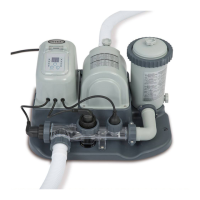
(249PO) MODEL ECO7111 Cartridge Filter Pump & Saltwater System with E.C.O. ENGLISH 7.5” X 10.3” PANTONE 295U 04/06/2017
English
OWNER’S MANUAL
Cartridge Filter Pump &
Saltwater System with E.C.O.
(Electrocatalytic Oxidation)
Model ECO7111
IMPORTANT
SAFETY RULES
Read, understand, and follow
all instructions carefully before
installing and using this product.
IMPORTANT!
DO NOT RETURN PRODUCT TO STORE
To purchase parts and accessories or to obtain non-technical assistance, Visit
www.intexcorp.com
For technical assistance and missing parts call us toll-free (for U.S. and Canadian Residents):
1-800-234-6839
Monday through Friday, 8:30am to 5:00pm Pacific Time
Don’t forget to try these other fine Intex products: Pools, Pool
Accessories, Inflatable Pools and In-Home Toys, Airbeds and
Boats available at fine retailers or visit our website listed below.
Due to a policy of continuous product improvement, Intex
reserves the right to change specifications and appearance,
which may result in updates to the instruction manual without
notice.
249-*PO-R0-1804
For illustrative purposes only.

Questions and Answers

Summary

Important Safety Rules

General Safety Instructions

Provides comprehensive safety rules, warnings, and precautions for operating the saltwater system.

Parts Reference

Detailed Parts List

Lists all components of the saltwater system with their corresponding reference numbers and spare part numbers.

Product Functionality and Specifications

Sanitizer Generation and E.C.O. Process

Explains how the system generates sanitizer and the E.C.O. mechanism for pool water sanitation.

Technical Specifications

Lists key technical specifications including power, amperage, salt level, and output.

Setup Instructions

Pool Outlet Valve Setup

Guides for installing strainer and plunger valve at the pool outlet for water return.

Pool Inlet Valve Setup

Guides for installing nozzle and plunger valve at the pool inlet for water circulation.

System Installation and Connection

Salt and Water Management

Salt Levels and Addition Procedures

Guidance on ideal salt levels, adding salt, and procedures for reducing salt if over-added.

Intex Pools Salt Table

Intex Pools Cyanuric Acid Table

Intex Pools Operating Time Table

Non-Intex Pool Calculations and Operation

Filter Pump Operation

Saltwater System Operation

Setting and Locking Controls

Instructions for setting operating hours and locking the control panel for the saltwater system.

Boost Cycle and Power Saving Modes

Details on activating the boost cycle and using the system's stand-by and power saving modes.

LED Code Interpretation

Maintenance Procedures

Cleaning Flow Sensor and Electrodes

Guides for cleaning the flow sensor and the titanium/E.C.O. electrodes for optimal performance.

Electrolytic Cell Cleaning

Detailed steps for cleaning the electrolytic cell, including immersion in vinegar.

Filter Cartridge Maintenance

Water Testing and Long-Term Storage

Using Test Strips and Storage

Instructions for using test strips to monitor water chemistry and guidelines for storing the unit.

Pool Chemistry Definitions

Troubleshooting Common Issues

Motor, Flow, and Pump Issues

Addresses issues like motor failure, slow flow, pump not working, leaks, and air locks with solutions.

Hose and Connector Leaks

Covers problems related to hose leaks, air locks, and leaking inlet/air connectors.

Water Chemistry and Display Problems

Troubleshoots insufficient chlorine, white flakes, and no LED display issues.

LED Codes and System Errors

Interprets LED panel codes and provides solutions for circulation, sensor, and power-related system errors.

General Aquatic Safety Guidelines

Limited Warranty Information

Summary

Important Safety Rules

General Safety Instructions

Provides comprehensive safety rules, warnings, and precautions for operating the saltwater system.

Parts Reference

Detailed Parts List

Lists all components of the saltwater system with their corresponding reference numbers and spare part numbers.

Product Functionality and Specifications

Sanitizer Generation and E.C.O. Process

Explains how the system generates sanitizer and the E.C.O. mechanism for pool water sanitation.

Technical Specifications

Lists key technical specifications including power, amperage, salt level, and output.

Setup Instructions

Pool Outlet Valve Setup

Guides for installing strainer and plunger valve at the pool outlet for water return.

Pool Inlet Valve Setup

Guides for installing nozzle and plunger valve at the pool inlet for water circulation.

System Installation and Connection

Salt and Water Management

Salt Levels and Addition Procedures

Guidance on ideal salt levels, adding salt, and procedures for reducing salt if over-added.

Intex Pools Salt Table

Intex Pools Cyanuric Acid Table

Intex Pools Operating Time Table

Non-Intex Pool Calculations and Operation

Filter Pump Operation

Saltwater System Operation

Setting and Locking Controls

Instructions for setting operating hours and locking the control panel for the saltwater system.

Boost Cycle and Power Saving Modes

Details on activating the boost cycle and using the system's stand-by and power saving modes.

LED Code Interpretation

Maintenance Procedures

Cleaning Flow Sensor and Electrodes

Guides for cleaning the flow sensor and the titanium/E.C.O. electrodes for optimal performance.

Electrolytic Cell Cleaning

Detailed steps for cleaning the electrolytic cell, including immersion in vinegar.

Filter Cartridge Maintenance

Water Testing and Long-Term Storage

Using Test Strips and Storage

Instructions for using test strips to monitor water chemistry and guidelines for storing the unit.

Pool Chemistry Definitions

Troubleshooting Common Issues

Motor, Flow, and Pump Issues

Addresses issues like motor failure, slow flow, pump not working, leaks, and air locks with solutions.

Hose and Connector Leaks

Covers problems related to hose leaks, air locks, and leaking inlet/air connectors.

Water Chemistry and Display Problems

Troubleshoots insufficient chlorine, white flakes, and no LED display issues.

LED Codes and System Errors

Interprets LED panel codes and provides solutions for circulation, sensor, and power-related system errors.

General Aquatic Safety Guidelines

Limited Warranty Information

Overview

This document describes the Intex Cartridge Filter Pump & Saltwater System with E.C.O. (Electrocatalytic Oxidation), Model ECO7111. This product is designed for above-ground pools and serves to destroy bacteria, oxidize bather organics, and control algae, ensuring a safe, clean, and comfortable swimming pool environment.

Function Description:

The system operates by generating sanitizer from common salt (sodium chloride) dissolved in the pool water. The pool water flows through the saltwater system's electrolytic cell, which produces hypochlorous acid (HCLO). HCLO then dissolves in the water, destroying bacteria and algae and oxidizing other organic materials. Additionally, the system incorporates Electrocatalytic Oxidation (E.C.O.), an Advanced Oxidation Process (AOP). When direct current is applied to the electrocatalytic oxidation electrodes, water is discharged to generate "hydroxyl radicals." These hydroxyl radicals are powerful oxidants that further oxidize organic contaminants and destroy bacteria and algae. The combination of hydroxyl radicals and free available chlorine provides strong and safe pool water sanitation.

The device includes a filter pump for water circulation and filtration. The filter cartridge is designed to prevent large objects from jamming or damaging the pump. Plunger valves are integrated to control water flow, allowing for maintenance without significant water loss.

Important Technical Specifications:

  • Power: 110-120 Volt
  • Amperage: Saltwater System - 0.6 A; Filter Pump - 1.5 A
  • Ideal Salt Level: 3000 ppm (parts per million)
  • Maximum Sanitizer Output/hour: 5 grams/hour
  • E.C.O. Cell Output Current: 500 mA
  • Filter Cartridge Replacement: Recommended every 2 weeks.
  • Water Chemistry Readings (Preferred):
    • Free Chlorine: 0.5 - 3.0 ppm (Ideal)
    • Combined Chlorine: 0 ppm (Ideal)
    • pH: 7.4 - 7.6 (Ideal)
    • Total Alkalinity: 80 ppm (Ideal)
    • Calcium Hardness: 100 - 250 ppm (Ideal)
    • Stabilizer (Cyanuric Acid): 20 - 40 ppm (Ideal)

Usage Features:

  • Salt Type: Only sodium chloride (NaCl) salt that is at least 99.8% pure is recommended. Water conditioning salt pellets are also acceptable but take longer to dissolve. Iodized or yellow-colored salt should not be used.
  • Salt Level Management: The ideal salt level is between 2500-3500 ppm, with an optimal level of 3000 ppm. Low salt levels reduce efficiency, while high levels (above 3500-4000 ppm) can cause a salty taste, damage the power supply, and corrode metal fixtures. The manual provides a "Salt Table" for correct salt dosage based on pool size.
  • Adding Salt: Salt should be spread evenly around the pool perimeter, avoiding the skimmer, and brushed to speed dissolution. The filter pump should run for 24 consecutive hours to thoroughly dissolve the salt before activating the saltwater system.
  • Removing Excess Salt: If salt levels are too high (indicated by "code 92"), partially draining and refilling the pool with fresh water is necessary.
  • Cyanuric Acid: Cyanuric acid helps reduce chlorine loss due to UV rays. The recommended level is approximately 1% of the salt level (e.g., 1 Lbs for every 100 Lbs of salt). A "Cyanuric Acid Table" is provided for dosage.
  • Operating Time: The system features a built-in timer for setting daily operating hours (1 to 12 hours maximum per cycle). An "Operating Time Table" helps determine the required hours based on pool size and ambient temperature.
  • Keypad Lock: Controls can be locked to prevent unauthorized changes to the operating cycle. The system automatically locks after 1 minute if not manually locked.
  • Boost Cycle: A "BOOST" function (LED display "80") can be activated for 5 seconds to increase chlorine sanitizer production, useful for initial installation, after heavy rain, or when the pool is dirty. The boost cycle runs for 8 times the programmed operating hours.
  • Stand-by/Power Saving Mode: After a cycle ends, the system enters Stand-By mode (LED display "93") and then Power Saving mode, automatically restarting its daily cycle after 24 hours.
  • Filter Pump Only Operation: The pump can be run independently of the saltwater system by pressing and holding both the "ON" and "TIMER" buttons until "FP" is displayed.
  • GFCI Protection: The unit is equipped with a ground-fault circuit interrupter (GFCI) for electrical safety. Users are instructed to test the GFCI regularly.
  • Air Lock Prevention: Instructions are provided to prevent air lock during setup by opening plunger valves and air release valves, and lifting/lowering hoses until water flows out.

Maintenance Features:

  • Flow Sensor Cleaning: The flow sensor (11) should be periodically inspected and cleaned. It can be unscrewed from the electrolytic cell conduit and washed with a garden hose. A plastic brush can be used for stubborn deposits, but metal brushes are prohibited.
  • Titanium and E.C.O. Electrodes Cleaning: The electrodes have a self-cleaning function, but manual cleaning may be required monthly, especially with hard water. The process involves:
    1. Switching off and unplugging the unit.
    2. Closing plunger valves to prevent water flow.
    3. Disconnecting the hose from the saltwater system and assembling the cell cover (30).
    4. Unscrewing and removing the E.C.O. electrode (14) from the electrolytic cell (13) housing.
    5. Pouring kitchen-grade vinegar into the electrolytic cell to immerse the electrodes for 1 hour.
    6. Draining the vinegar and flushing the cell housing with pool water.
    7. Reconnecting the electrolytic cell by reversing the steps.
  • Filter Cartridge Cleaning/Replacement: The filter cartridge should be replaced at least every 2 weeks. The process involves:
    1. Turning off and unplugging the unit.
    2. Closing plunger valves.
    3. Gently turning air release valves (1 & 7) to remove the housing cover (4).
    4. Removing the filter housing collar (3) and the used filter cartridge.
    5. Inspecting the housing for dirt/sediment; if present, unscrew the sediment valve (1) and flush with water.
    6. Placing a new cartridge filter, replacing the housing cover and collar.
    7. Opening plunger valves and reconnecting power.
    8. Retightening air release valves once trapped air has escaped.
  • Test Strips: Intex Test Strips (packed with the product) are used to test Free Chlorine, pH, Calcium Hardness, and Total Alkalinity levels. Weekly testing is recommended, maintaining chlorine concentration at 0.5-3 ppm.
  • Long Term Storage: For storage, the unit should be disconnected, air-dried, visually inspected, and cleaned. It should be stored in a dry place between 32°F (0°C) and 97°F (36°C). The original packaging can be used for storage.

Intex ECO7111 Specifications

General IconGeneral
BrandIntex
ModelECO7111
CategorySwimming Pool Filter
LanguageEnglish

Related product manuals