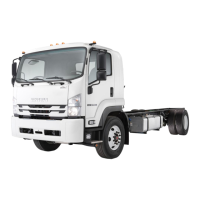
Diagnostic system check-air suspension controls
1. Diagnostic system check-air suspension controls
description of function
The air suspension control system check is the starting
point for trouble diagnosis. Before using these
procedures, visually inspect the air suspension control
unit and grounding. If there is dirt, clean it completely, or
check whether the connector or terminal is disconnected.
It is also necessary to check at the same time for air leaks
coming from the air piping. There must be a minimum of
20 V of input voltage from the battery in order for the air
suspension control unit to operate normally. If there are
parts installed on the air suspension control unit power
supply circuit that cause a drop in voltage, such as
commercially available horns, illumination, audio system
or vehicle wireless radios, and the voltage drops to 20 V
or less, the diagnosis control will not operate normally,
even though the battery voltage is normal. Visually
inspect the area to check the power supply of commercial
parts. The engine control system must be running
normally in order for the air suspension control unit to
operate normally. If problems are found in both the air
suspension system and the engine control system, it is
necessary to place priority in inspecting the engine
problem and repairing.
2. Diagnostic system check-air suspension controls
Inspection for determining the failure location in the air
suspension control unit
1. Turn ON the ignition switch.
2. Check the air suspension warning light.
Note:
・ The warning light goes off or on after blinking
for 3 seconds.
・ If there is any abnormality in warning light
display, inspect the air suspension warning
light circuit system.
3. Use a scan tool to check the Air Suspension Data
display.
4. If Air Suspension Data is not displayed, inspect the
battery voltage.
Standard: 20 V or more
5. Inspect the air suspension control unit fuse.
6. Inspect the air suspension control unit GND circuit.
Note:
・ There should be no open circuit.
7. Inspect the air suspension control unit power supply
circuit.
Note:
・ There should be no open circuit.
8. Inspect a scan tool communication circuit.
Note:
・ There should be no open circuit.
9. Replace the air suspension control unit.
Refer to "2.Suspension 2C.Rear Suspension(All
models) Air suspension control unit removal".
Refer to "2.Suspension 2C.Rear Suspension(All
models) Air suspension control unit installation".
10. Check for a DTC using a scan tool.
Note:
・ If a DTC has been detected, inspect the
applicable DTC.
・ When multiple DTCs are set, start diagnosing
from a DTC with a smaller number unless
otherwise instructed in the diagnostic step.
11. Use a scan tool to check the Air Suspension Data
display.
12. Compare the Air Suspension Data display and
typical values.
Note:
・ Inspect the applicable part if the display value
is dramatically outside of the typical value
range.
16C-2 Functional Inspection (All models)



 To Next Page