EasyManua.ls Logo

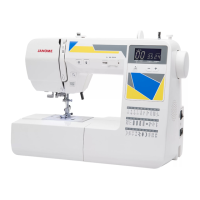
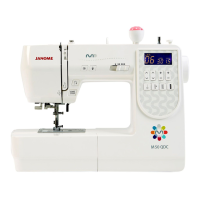
Janome M50QDC - User Manual

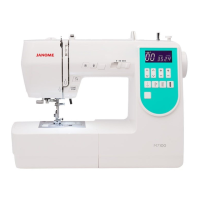
Janome M50QDC
56 pages
Print Icon
To Next Page IconTo Next Page
Loading...
Instruction Book

Table of Contents

Questions and Answers

  • N
    Nicole RobertsonAug 14, 2025
    Why does the needle thread break on my Janome Sewing Machine?
    • L
      Linda YoungAug 14, 2025
      The needle thread may break due to several reasons: * The needle thread is not threaded properly. * The needle thread tension is too tight. * The needle is bent or blunt. * The needle is incorrectly inserted. * The needle threads is not set under the presser foot when start sewing. * The thread is either too heavy or too fine for the needle.
  • M
    Melissa MartinAug 18, 2025
    Why does my Janome M50QDC Sewing Machine skip stitches?
    • J
      Joanna VangAug 18, 2025
      Skipped stitches can occur if: * The needle is incorrectly inserted, bent, or blunt. * The needle and/or threads are not suitable for the fabric. * A blue tip needle is not being used for sewing stretch, very fine fabrics, and synthetics. * The needle thread is not threaded properly. * A poor quality needle is used. If so, change the needle.
  • M
    Martha BlackAug 21, 2025
    Why is my Janome M50QDC so noisy?
    • M
      melanieserranoAug 21, 2025
      Your sewing machine might be noisy because thread has been caught in the hook race, or lint has built up in the hook race or bobbin holder.
  • J
    Jennifer FinleyAug 25, 2025
    Why does the bobbin thread break on my Janome M50QDC Sewing Machine?
    • D
      Dawn JimenezAug 25, 2025
      The bobbin thread may break if: * The bobbin thread is not threaded properly in the bobbin holder. * Lint has collected in the bobbin holder. * The bobbin is damaged and does not turn smoothly. If this is the case, change the bobbin. * The thread is wound loosely on the bobbin.
  • K
    Kaitlyn CraigAug 28, 2025
    What to do if the fabric is not feeding smoothly on my Janome Sewing Machine?
    • G
      George GrossAug 28, 2025
      If the fabric isn't feeding smoothly, it could be that the feed dog is packed with lint, the stitches are too fine (make stitch longer), or the feed dog is not raised after “drop feed” sewing.
  • R
    Raymond HensleyAug 31, 2025
    What to do if the needle breaks on my Janome M50QDC?
    • V
      vwilliamsAug 31, 2025
      If the needle breaks, it could be due to: * Incorrect insertion of the needle. * A loose needle clamp screw. * Failure to draw the threads to the rear after sewing. * Using a needle too fine for the fabric. * Using an inappropriate presser foot. In this case, use the correct foot.
  • M
    Mary GuzmanSep 4, 2025
    Why is my Janome M50QDC not sewing buttonholes properly?
    • A
      Adam JohnsonSep 4, 2025
      If buttonholes aren't sewing properly, the stitch density may not be suitable for the fabric, interfacing hasn't been used for stretch or synthetic fabrics (apply an interfacing), or the buttonhole lever isn't lowered.
  • R
    Rebecca SchwartzSep 7, 2025
    Why does my Janome M50QDC Sewing Machine have loops on the seams?
    • F
      Fernando KirkSep 7, 2025
      Loops on the seams can appear if the needle thread tension is too loose, or the needle is too thick or too fine for the fabric.
  • A
    Alexis FosterSep 10, 2025
    Why is my Janome M50QDC Sewing Machine seam puckering?
    • F
      freemanbenjaminSep 10, 2025
      Seam puckering may occur if the needle thread tension is too tight, the needle thread is not threaded properly, the needle is too heavy for the fabric, the stitch length is too long for the fabric (make stitch shorter), or a stabilizer is not used when sewing very fine fabrics (apply a stabilizer).

Summary

Safety Instructions

Essential Safety Guidelines

Essential safety guidelines for operating the sewing machine.

Machine Components and Accessories

Names of Parts

Identifies and labels all parts of the sewing machine.

Standard Accessories

Lists all accessories provided with the sewing machine.

Getting Started

Extension Table and Stitch Chart

Attaching the extension table and using the stitch chart.

Getting Ready to Sew

Connecting Power and Initial Setup

Connecting the machine and initial use procedures.

Start;Stop Button Operation

Using the start/stop button instead of foot control.

Controlling Sewing Speed and Foot Control

Adjusting speed and using the foot pedal.

Extension Table and Free-arm Sewing

Using extension table and free-arm features.

Machine Operating Buttons Overview

Explanation of the function of each button.

LCD Display and Function Keys

Understanding the LCD screen and function keys.

Presser Foot Operations

Presser Foot Lifter and Pressure Dial

Adjusting presser foot height and pressure.

Changing and Attaching Presser Feet

Procedures for changing presser feet and foot holder.

Needle Thread Tension Adjustment

Straight Stitch Tension Balancing

Achieving balanced tension for straight stitches.

Troubleshooting Thread Tension Issues

Diagnosing and fixing tension issues (too tight/loose).

Zigzag Stitch Tension

Zigzag Stitch Tension Guide

Adjusting tension for optimal zigzag stitches.

Feed Dog and Needle Stop Position

Feed Dog Control

Lowering and raising the feed dog for specific stitches.

Needle Stop Position Setting

Setting the needle to stop up or down.

Needle Management

Changing the Sewing Needle

Step-by-step guide to replacing the needle.

Fabric and Needle Compatibility Chart

Guide to selecting needles for various fabrics.

Thread and Bobbin Setup

Setting the Spool of Thread

Placing and securing the spool of thread.

Bobbin Winding Preparation

Removing the bobbin holder for winding.

Winding the Bobbin

Bobbin Winding Procedure

Detailed steps for winding a bobbin.

Inserting the Bobbin

Inserting Bobbin into Holder

Correctly placing the bobbin in the bobbin holder.

Threading the Machine

Threading the Upper and Lower Thread

Step-by-step guide to threading the machine.

Needle Threader Operation

Using the Automatic Needle Threader

Detailed instructions for using the needle threader.

Drawing Up Bobbin Thread

Bringing Bobbin Thread to Top

Steps to bring the bobbin thread up through the needle plate.

Basic Sewing Techniques

Straight Stitch Sewing

Performing a basic straight stitch.

Changing Sewing Direction

Pivoting fabric for corner turns.

Sewing Thick Fabrics

Techniques for sewing thick materials.

Seam Measurement and Corners

Using Seam Guides

Utilizing seam guides for accurate seam allowances.

Turning Square Corners

Techniques for sewing precise square corners.

Stitch Adjustments

Altering Needle Drop Position

Adjusting the needle's horizontal position.

Altering Stitch Length

Adjusting the length of the stitches.

Specialty Stitches - Part 1

Lock-a-matic Stitch

Securing seams with the Lock-a-matic stitch.

Locking Stitch

Sewing an invisible locking stitch.

Triple Stretch Stitch

Sewing a strong, elastic triple stretch stitch.

Specialty Stitches - Part 2

Stretch Stitch

Sewing a narrow stretch stitch for knit fabrics.

Sculpture Stitches

Creating decorative patterns with sculpture stitches.

Zigzag Stitch

Zigzag Stitch Overview and Use

Versatile uses of the zigzag stitch.

Adjusting Zigzag Stitch Width

Modifying the width of the zigzag stitch.

Adjusting Zigzag Stitch Length

Modifying the length of the zigzag stitch.

Edge Finishing Stitches

Overcasting with Zigzag Stitch

Overcasting fabric edges using a zigzag stitch.

Multiple Zigzag Stitch

Finishing stretch fabrics to prevent puckering.

Overedge Stitch

Seaming and overcasting simultaneously.

Stitches for Fabrics and Elastic

Knit Stitch

Stitch for fray-prone fabrics like linen.

Double Overedge Stitch

Reinforcing seams on extensible fabrics.

Attaching Elastic

Sewing elastic onto fabric.

Buttonhole Types

Buttonhole Overview

Introduction to the three available buttonhole types.

Specific Buttonhole Types

Square, round-end, and keyhole buttonhole descriptions.

Sewing Square Buttonholes

Square Buttonhole Procedure

Step-by-step guide to sewing square buttonholes.

Buttonhole Adjustments

Adjusting Buttonhole Width and Density

Modifying buttonhole size and density.

Specialty Buttonholes

Round-end and Keyhole Buttonholes

Sewing round-end and keyhole buttonholes.

Corded Buttonhole

Sewing a Corded Buttonhole

Creating decorative corded buttonholes.

Darning Stitch

Darning Stitch Operation

Performing the darning stitch for repairs.

Adjusting Darning Evenness

Fine-tuning the darning stitch for evenness.

Tacking Stitch

Tacking Stitch for Reinforcement

Using the tacking stitch for reinforcement.

Eyelet Stitch

Sewing Eyelets

Creating eyelets for belt holes.

Adjusting Eyelet Shape

Modifying the shape of the sewn eyelet.

Zipper Sewing - Part 1

Zipper Sewing Setup

Attaching the zipper foot and fabric preparation.

Zipper Sewing - Part 2

Starting Zipper Insertion

Step-by-step guide to begin sewing a zipper.

Zipper Sewing - Part 3

Completing Zipper Insertion

Finishing the zipper sewing process.

Blind Hemming

Blind Hemming Technique

How to create a blind hem.

Adjusting Needle Drop for Blind Hem

Fine-tuning needle position for blind hemming.

Specialty Sewing Operations

Button Sewing

Instructions for sewing buttons.

Gathering Fabric

Techniques for gathering fabric.

Decorative Stitching - Part 1

Shelltuck Stitch

Creating a decorative shell tuck.

Applique Stitching

Sewing decorative appliqués.

Adjusting Applique Stitch Width

Modifying stitch width for appliqué.

Decorative Stitching - Part 2

Pintucking Stitch

Creating decorative pintucks.

Fringing Stitch

Adding decorative fringe effects.

Decorative Stitching - Part 3

Drawn Work Stitch

Creating decorative drawn work patterns.

Cross Stitch

Sewing cross stitch designs.

Decorative Stitching - Part 4

Fagoting Stitch

Joining fabric with fagoting stitch.

French Knots

Sewing decorative French knots.

Scallop Stitch

Creating decorative scallop edges.

Decorative Stitching - Part 5

Smocking Stitch

Creating decorative smocking effects.

Clasp Stitches

Closing quilt layers with clasp stitches.

Decorative Stitching and Adjustments

Satin Stitches

Sewing satin stitches for decorative effects.

Correcting Deformed Stitch Patterns

Adjusting feed balancing for stitch patterns.

Machine Care and Maintenance

Cleaning Hook Race and Feed Dog

Instructions for cleaning key internal parts.

Installing the Bobbin Holder

How to install the bobbin holder.

Troubleshooting and Error Signals

Interpreting Warning Signs and Signals

Guides for interpreting error signs and buzzer sounds.

Janome M50QDC Specifications

General IconGeneral
Stitch Options50
Maximum Stitch Width7mm
Maximum Stitch Length5mm
DisplayLCD
Foot ControlYes
Sewing Speed820 stitches per minute
Needle ThreaderYes
Start/Stop ButtonYes
Speed Control SliderYes
Free ArmYes
Presser Feet7

Related product manuals