Page 10
Ceiling penetration
clearances
5. Flue & chimney requirements cont...
Existing chimneys should be inspected and cleaned by a qualied
professional prior to installation. The chimney must not have cracks,
loose mortar or other signs of deterioration and blockage. Jetmaster
recommends a certied professional or a technician, under the
direction of a certied professional.
Single skin ue (stainless steel) must be completely enclosed with
single skin brickwork, concrete, or autoclaved aerated concrete
block. A chimney plate will be used to weather seal the chimney.
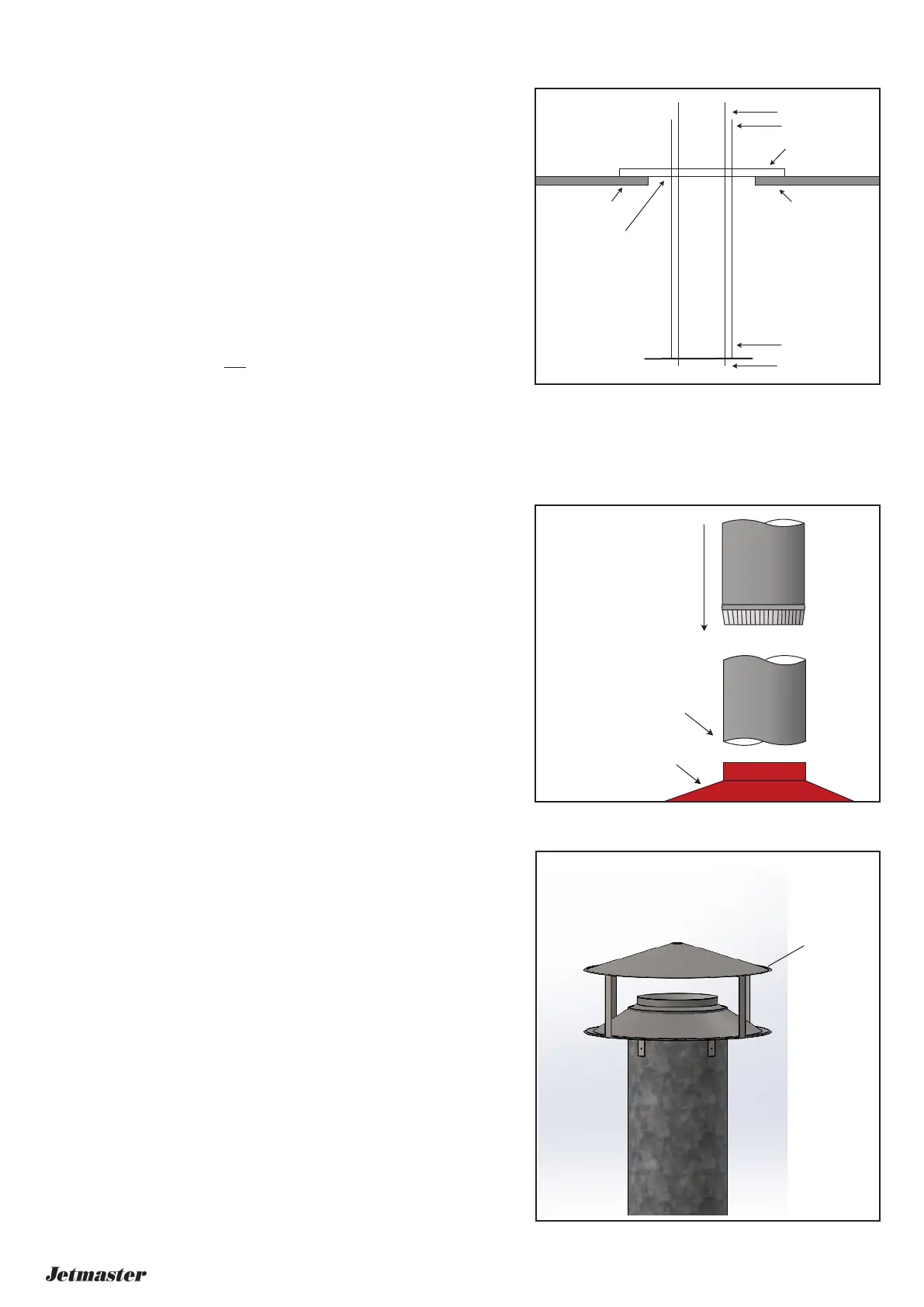
Twin skin ues (stainless steel inner, and galvanised outer) can
either be left exposed or enclosed with stud walls and sheet plaster
or timber. A minimum of 50mm clearance must be maintained
between the outer ue and any combustibles within the chase or
ceiling cavity. (Fig 5.1)
Position an active starter ue with two female ends to gather to
allow second length to have crimp facing down. (Fig 5.2)
Glass
tape
may
be
required
to
ensure
a
snug
t.
The outer ue is then installed outside active ue with crimp facing
up to ensure water penetration on ue above roof runs out.
Rivet active ues together at crimped joins.
Fix outer non-active ues to active inner ues use 3 x 25mm self-
tapping screws through outer ue at bottom at each join and on top
at each join. As an alternative, rivet 4 x 25mm conduit saddles at
each join top and bottom.
Cowl
For
solid
fuel
applications
only
, a double cone cowl will assist in
preventing the effects of downdraft. (Fig 5.3)
Other solid fuel cowls may be desired to achieve a visual design
and such cowls can be used but must not restrict airflow from
the flue pipe casings.
For
gas
applications
an AGA approved cowl must be used.
Fig 5.2
Fig 5.3
Fig 5.1
Combustible ceiling
Combustible ceiling
Support angles
50mm gap from
Combustible materials
Outer Gal casing
Active stainless steel
Active stainless steel
Outer Gal casing
Crimped end down
From second length
Gather
Trim the crimp off first
length stainless pipe
Double cone
cowl



 To Next Page