113372-16 Telephone: 01422 822282 15
Vertical Venting:
When single dryer venting is used, the length of the ductwork from the dryer to the outside exhaust outlet
must not exceed 15 feet (4.57 meters). The minimum diameter of this ductwork must be at least
8-inches (20.32 cm). The shape of the ductwork is not critical so long as the minimum cross-sectional area
is provided. It is suggested that the use of 90° turns be avoided; use 30° and/or 45° bends instead. The
radius of the elbows should preferably be 1-1/2 times the diameter of the duct.
ALL ductwork should
be smooth inside with no projections from sheet metal screws or other obstructions, which will collect lint.
When adding ducts, the duct to be added should overlap the duct to which it is to be connected. ALL
ductwork joints must be taped to prevent moisture and lint from escaping into the building. Inspection
doors should be installed at strategic points in the exhaust ductwork for periodic inspection and cleaning of
lint from the ductwork.
NOTE: As per the National Fuel Gas Code, “Exhaust ducts for type 2 clothes dryers shall be
constructed of sheet metal or other noncombustible material. Such ducts shall be equivalent in
strength and corrosion resistance to ducts made of galvanized sheet steel not less than 26
gauge (0.0195-inches [0.50 mm]) thick.”
IMPORTANT: Exhaust back pressure measured by a manometer/magnehelic in the exhaust duct
must be no less than 0 and must not exceed 0.7 in WC (1.74 mb).
NOTE: It is recommended that exhaust or booster fans not be used in the exhaust ductwork system
except where necessary to maintain exhaust back pressure (in the exhaust duct) between zero
and 0.7 inch water column. Where employed, booster fans must not activate the dryer airflow
proving switch (sail switch) when the dryer is not in operation.
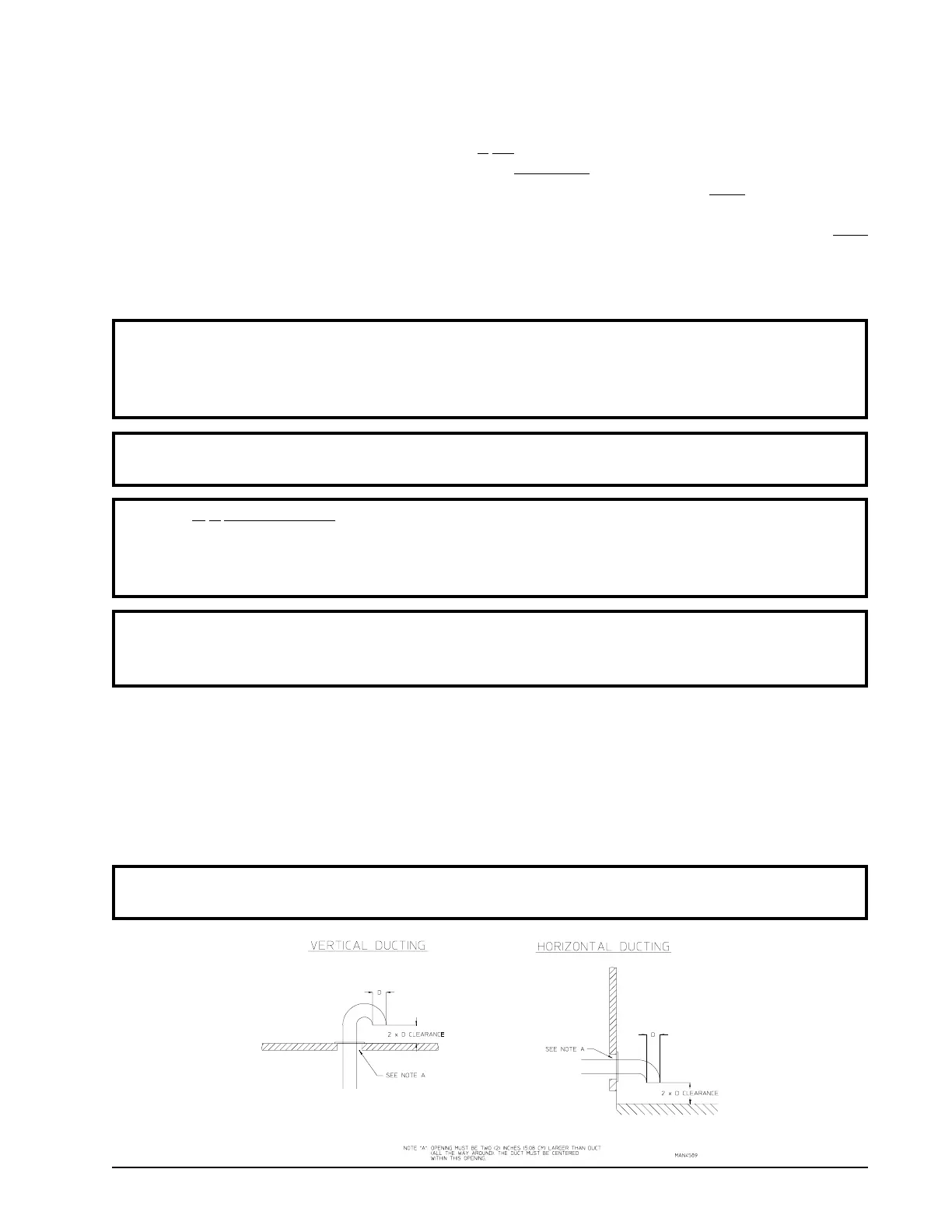
NOTE: When the exhaust ductwork passes through a wall, ceiling, or roof made of combustible
materials, the opening must be 2-inches (5.08 cm) larger than the duct (all the way around).
The duct must be centered within this opening.
a. Outside Ductwork Protection
1) To protect the outside end of the horizontal ductwork from the weather, a 90° elbow bent downward
should be installed where the exhaust exits the building. If the ductwork travels vertically up
through the roof, it should be protected from the weather by using a 180° turn to point the opening
downward. In either case, allow at least twice the diameter of the duct between the duct opening
and the nearest obstruction.
IMPORTANT: DO NOT use screens, louvers, or caps on the outside opening of the exhaust
ductwork.



 To Next Page