42
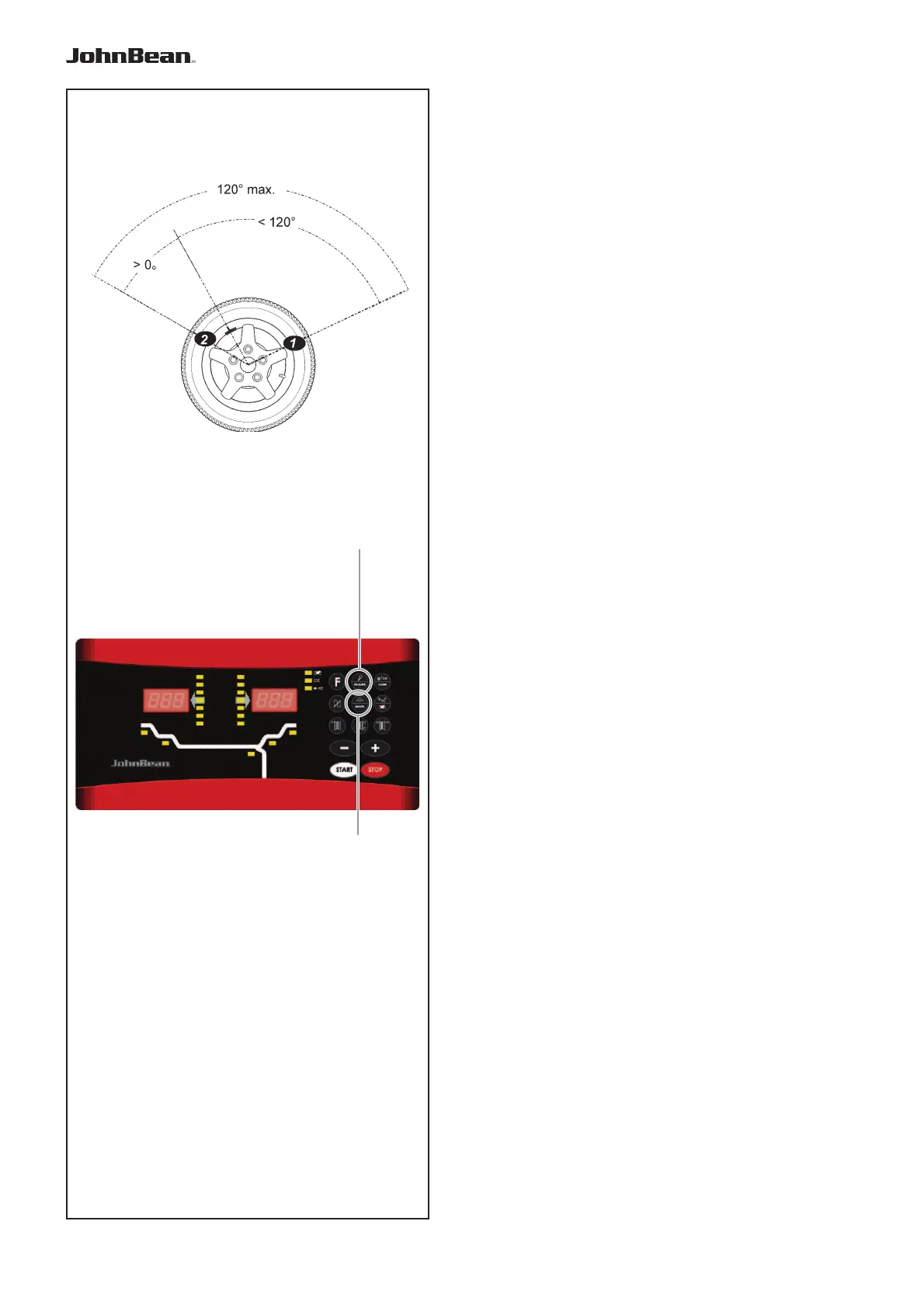
5.4.1-1
5.4.1-2
Operation
5.4 Special modes
Selecting the F key enables the operator to scroll the
following modes in sequence:
- Split Weight Mode (SWM),
- Minimisation mode.
5.4.1 Split Weight Mode
Selecting is possible only after balancing a HWM wheel
that has an imbalance
≥ 10 grams in the right plane.
Note: The “fine” read-out accuracy is not
available with this mode.
Select this mode to “hide” the right plane weights split
into two parts behind the two spokes that are nearest
to the calculated weight application position. That way,
the weights are not visible from “outside”.
Take into account the following limitations (refer to
Figure 5.4.1-1):
- The whole enclosed angle is limited to 120°.
- both angles (from “visible weight position” and
“hidden weight position”) must be greater than 0°.
• Apply the weight in the left plane of the wheel.
• Don’t apply the weight on the right plane but in the
recommended application point press SWM (2)
fi gure 5.4.1-2. S1 appears.
• Turn the wheel until one of the spokes is in the 12
o’clock position, near the application position.
• Press SWM (2 Fig. 5.4.1-2). S2 appears.
• Turn the wheel until the adjoining spoke is in the
12 o’clock position.
•
Press
SWM
(2 Fig. 5.4.1-2). The weight is now split.
The machine can now indicate the two weights and
the relative application points.
5.4.2 Balancing optimisation / Weight
minimisation
Note: even if the optimisation procedure can be
carried out on truck wheels, it is mainly
used for car wheels.
General
Optimisation is a refi ned form of matching.
For optimisation the tyre is mounted relative to the
rim in a position selected according to the results of
various measurements. This normally further reduces
any radial and axial run-out as well as lateral and radial
forces, making the wheel run as silently as possible. In
addition, the correction weights needed for balancing
can also be reduced.
.
2
1


 To Next Page