Need help?
Do you have a question about the John Bean B400 and is the answer not in the manual?
Crucial instructions for safe operation, emphasizing reading the manual and exercising caution.
Emphasizes the operator's responsibility to understand and follow all safety precautions for machine operation.
Explains text styles used to highlight important information, warnings, and cautions in the manual.
Lists the documentation provided with the unit, including operator's and spare parts manuals.
Detailed technical specifications including power, measurements, wheel dimensions, and unit dimensions.
Specifies the operating and storage temperature and humidity ranges for the wheel balancer.
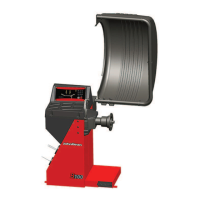
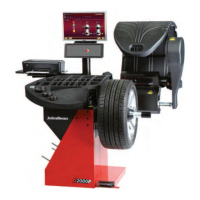
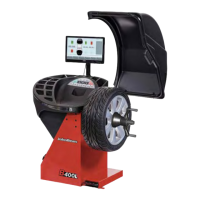
Overview of the wheel balancer's advanced features, user-friendly operation, and its purpose.
Describes the intended use for dynamic and static balancing of passenger car and light-truck wheels.
Lists and illustrates the standard accessories provided with the wheel balancer.
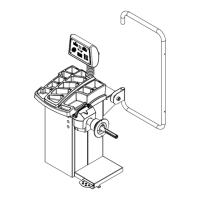
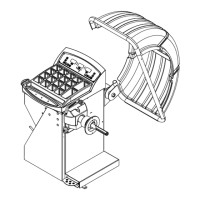
Provides a functional description and identification of the unit's main components with diagrams.
Details the screen's display fields, information fields, and menu fields for operation.
Describes the function of each key on the control panel for operating the wheel balancer.
Explains the operation of the main shaft lock pedal for securing the wheel during correction.
Describes the gauge arms used for measuring distance and rim diameter, and their components.
Details the ultrasonic detector used for measuring wheel width.
Explains the function of the laser pointer for indicating precise weight application points.
Instructions on how to access and use help information for current actions and error code remedies.
Procedure for performing an emergency stop and actions to take after an unexpected stop.
Chapter overview on operating the unit for wheel balancing.
Instructions on how to clamp a wheel onto the balancer using different adaptors and methods.
Steps to prepare the operator and the unit before powering up and starting operations.
Explanation of different modes for applying balance weights (Normal, ALU, Hidden, Static).
How the unit detects wheel dimensions using gauges or manual input.
User settings for vehicle type, rim width, offset, and diameter.
Automatic recognition of wheel type and dimensions using the gauge arm.
Detailed steps for performing the wheel balancing procedure, including measuring imbalance.
Instructions on how to apply different types of balance weights (clip-on, adhesive).
Procedure for applying hidden balance weights behind wheel spokes.
Advanced procedures for optimizing wheel running conditions and minimizing weights.
General information on unit maintenance and when it is required.
Procedure for performing an electrical compensation run for residual unbalance.
How to perform user calibration to electronically calibrate rotating masses.
Instructions for storing the unit properly when not in use.
Steps for safely replacing the main fuse.
Guide to identify and resolve common problems with the wheel balancer.
Troubleshooting steps for when the unit does not power on.
Troubleshooting for a configuration error indicated by a beep.
Steps to resolve issues with a frozen or locked display screen.
Explains system messages, including error codes (E-codes), warnings (H-codes), and hardware problems (X-codes).
Lists and explains specific error and warning codes encountered during operation.
Information on how to contact customer support and find local agents for assistance.
Guide to changing operating modes or states using specific codes.
Setting factory-adjusted modes of operation for the unit.
Selecting the resolution for unbalance readings in grams or ounces.
Selecting the suppression of minor unbalance readings.
Selecting display units for unbalance readings (grams or ounces).
Electrical compensation of residual unbalance in clamping means.
Configuration for automatic wheel braking when the guard is opened.
Setting the number of revolutions per measuring run.
Selecting limit values for suppressing minor unbalance readings.
Storing selected operating modes in permanent memory.
Displaying readings of measuring run counters.
Configuration for starting measuring runs via wheel guard.
Readjustment of the machine by the operator.
Displaying program version and model number.
Selecting and clearing error codes from memory.
Selecting the user interface language for the machine display.
Information on how to dispose of the unit responsibly, especially in EU countries.
Contains additional information and references for unit configuration.
Specifies the necessary space and floor conditions for safe and accurate installation.
Details on how to transport, unpack, and check the contents of the wheel balancer shipment.
Step-by-step guide for physically installing the wheel balancer, including connecting components.
Procedures for verifying the correct installation and calibration of the unit.
Guidelines for training operators on unit operation, safety, and basic functions.
 General
| Rim Diameter | 10" - 24" |
|---|---|
| Rim Width | 1.5" - 20" |
| Max. Wheel Weight | 154 lbs (70 kg) |
| Wheel Width Range | 1.5" - 20" |
| Balancing Accuracy | ±1 g |
| Wheel Diameter Range | Up to 44" |
| Power Supply | 115–230 V, 1 Ph, 50/60 Hz |

 To Next Page