This document is an installation manual for R-410A Outdoor Split-System Air Conditioners, specifically covering the YC2D, TCD2, RAC134, YC2F, TCF2, and RAC150 Series. It provides comprehensive instructions for the proper installation, operation, and maintenance of these units.
Function Description:
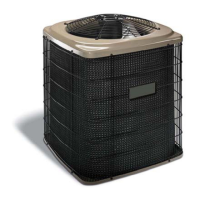
The devices described are outdoor condensing units designed to be connected to a matching indoor coil to form a complete R-410A split-system air conditioning system. They are responsible for rejecting heat to the outdoors, thereby cooling the indoor space. Units with quick-connect coupling connections are factory-charged with refrigerant, designed to match pre-charged refrigeration piping and indoor coils. The manual emphasizes that these units must be installed with a filter-drier in the liquid line, which is packaged and shipped with the outdoor unit.
Important Technical Specifications:
- Refrigerant: R-410A. The manual explicitly states that R-410A systems operate at higher pressures than R-22 systems, and R-22 service equipment or components must not be used. All service equipment (gauge sets, hoses, refrigerant containers, recovery systems, leak detectors) must be rated for R-410A and POE type oils.
- Operating Temperatures:
- Minimum outdoor coil ambient air temperature: 55°F. Operation below 55°F requires an approved low ambient operation accessory kit.
- Maximum outdoor coil ambient air temperature: 115°F (for YC2D/TCD2B/RAC134) or 125°F (for YC2E/YC2F/TCE2B/TCF2B/RAC143/RAC150/TCD2B 3 phase).
- Minimum indoor coil air temperature: 57°F.
- Maximum indoor coil air temperature: 72°F.
- Line Length: The maximum allowable line length for this product is 80 ft. For longer lengths, the Piping Application Guide (P/N 247077) must be consulted.
- Piping Material: Field-supplied refrigerant grade (ACR) copper tubing, internally clean and dry. Phosphorous-copper alloy material (e.g., Silfos-5) or equivalent must be used for brazing. Soft solder is not permitted.
- Insulation: Vapor lines must be insulated with a minimum of 3/8 in. foam rubber insulation (Armaflex or equivalent). Liquid lines exposed to direct sunlight, high temperatures, or excessive humidity also require insulation.
- Electrical: All field wiring must conform to national and local electrical codes. Outdoor wiring must be weatherproof, and copper conductors must be used. Control wiring is 24 V (NEC Class 2), minimum 18 GA wire.
- Filter-Drier: A liquid line filter-drier (part S1-401021 for all AC models) is mandatory and should ideally be installed at the indoor coil before the metering device.
- Charging: The factory charge includes enough refrigerant for the unit, 15 ft (4.6 m) of interconnecting piping, and the smallest indoor coil match-up. Additional charge may be required for specific indoor coil matches or longer piping. Charging is based on subcooling for TXV indoor units.
- Compressor Protection: Outdoor unit models ending with an 'H' have a factory-installed hard start kit, required when a TXV kit is installed. Units without 'H' do not require a hard start kit unless local regulations dictate. A crankcase heater is equipped to prevent refrigerant migration to the compressor during the OFF cycle.
Usage Features:
- Installation Flexibility: Provides guidelines for various installation scenarios, including clearances for air entrance, discharge, and service access. Specific instructions are given for multiple unit installations and installations on hot sun-exposed roofs or paved ground areas.
- Refrigerant Line Connections: Detailed steps for connecting refrigerant lines, including precautions for brazing (using dry nitrogen flow, wet rags for heat protection) and proper valve operation.
- Metering Device Installation: Instructions for installing a Thermostatic Expansion Valve (TXV), including bulb placement and insulation.
- System Evacuation: Emphasizes the importance of evacuating the system to 500 microns or less to prevent moisture and contaminants.
- System Charging: Step-by-step procedure for determining and adding the correct refrigerant charge, including measuring indoor airflow and using subcooling charging for TXV indoor units. Specific guidance for cold weather charging is provided.
- Electrical Connections: Clear instructions for connecting power and control wiring, ensuring compliance with electrical codes and proper grounding.
- User Instruction: Installers are required to instruct the user on correct operation, maintenance, temperature setting, and the function of the crankcase heater.
Maintenance Features:
- Coil Cleaning: Outdoor coils and other air circuit parts should be cleaned regularly with a brush, vacuum cleaner, or clean water. Important: Do not use coil cleaners containing hydrogen fluoride (HF), hydroxides, chlorides, and sulfates, as these can damage micro channel coils.
- Fan Motor: The outdoor fan motor is permanently lubricated and does not require periodic oiling.
- Filter and Blower Motor: Users should refer to furnace or air handler instructions for filter and blower motor maintenance.
- Indoor Coil and Drain Pan: Regular inspection and cleaning of the indoor coil and drain pan are necessary to prevent odors and ensure proper drainage.
- Refrigerant Handling: Emphasizes that refrigerant charging and any repairs must be carried out by a qualified air conditioning contractor. It is unlawful to knowingly vent, release, or discharge refrigerant into the open air. Recovery and weighing of system charge into appropriate recovery cylinders are required for maintenance or service involving evacuation.

 Need help?
 General

 To Next Page