EasyManua.ls Logo

Johnson Controls YEWS130 - User Manual

Johnson Controls YEWS130
88 pages
Print Icon
To Next Page IconTo Next Page
Loading...
Supersedes:
EN
AP1105
-IOM01(0316)
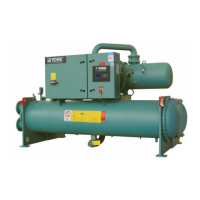
YEWS Water Cooled Screw Chiller
(Water Source Heat Pump)
Installation, Operation and
Maintenance
Form No:AP1105-IOM01(1216) EN
YEWS High Efficiency Chiller With Single Compressor
STYLE E
Warning
The System is charged with refrigerant with a certain pressure
Improper operation during maintenance may cause serious damage to the system. All
maintenance shall be done by York authorized technician, following the guide in York
installation, operation and maintenance manual.

Table of Contents

Questions and Answers

  • L
    Lisa BrownAug 15, 2025
    Why is my Johnson Controls Chiller experiencing high discharge pressure?
    • P
      Patrick HoweAug 15, 2025
      High discharge pressure in your Johnson Controls Chiller can occur due to several reasons. The cooling water temperature might be too high, requiring you to reduce the condenser water inlet temperature by checking the cooling tower and water circulation. The condenser tubes could be dirty or scaled, so cleaning them and checking water conditioning is recommended. Insufficient condenser water flow could also be the cause; increase the quantity of water through the condenser to the proper value. Other potential issues include a faulty compressor discharge valve (check the valve), a faulty discharge pressure sensor (replace the sensor), or air in the condenser (purge the unit).
  • J
    Joshua SosaAug 21, 2025
    What causes Johnson Controls Chiller to have high discharge temperature?
    • P
      Paula SmithAug 22, 2025
      High discharge temperature in your Johnson Controls Chiller can be attributed to a few key factors. The cooling water temperature may be too high; in this case, reduce the condenser water inlet temperature by checking the cooling tower and water circulation. Another cause could be dirty or scaled condenser tubes, which would need to be cleaned. Finally, insufficient load for system capacity may be the issue, so increase the compressor minimum operation current set.
  • M
    Marcia GordonAug 25, 2025
    What to do if Johnson Controls YEWS130 motor over current?
    • A
      adamwatsonAug 26, 2025
      If your Johnson Controls Chiller's motor is experiencing over current, it could be due to the compressor load increasing too rapidly. Try adjusting the compressor loading time setting. Alternatively, the “CUR.OFFSET” value might be incorrect; adjust the current offset to the proper value.
  • A
    Amanda SchroederAug 28, 2025
    Why does Johnson Controls YEWS130 show oil level switch trip?
    • R
      Robert KennedyAug 29, 2025
      An oil level switch trip in your Johnson Controls Chiller can occur for several reasons. The system might be overcharged with refrigerant; recover refrigerant to achieve the correct discharge superheat and subcooling. A faulty oil level switch could be the culprit, requiring replacement. Similarly, a faulty oil heater should be replaced. If the oil filter (outside the compressor) is clogged, clean it. The compressor not starting from minimum load can also cause this issue; check the compressor slide valve and slide valve solenoid valve, and set the compressor unloading time to the proper value. Finally, insufficient load for system capacity may be the cause, so increase the compressor minimum operation current set.
  • A
    Alison BurkeAug 31, 2025
    What causes insufficient oil supply pressure in Johnson Controls Chiller?
    • M
      Mrs. Nicole Turner MDSep 1, 2025
      Insufficient oil supply pressure in your Johnson Controls Chiller can be caused by a cooling water temperature that is too low; increase the condenser water temperature. Alternatively, a faulty oil pressure or evaporation pressure sensor could be the issue, so change the pressure sensor.
  • L
    lfernandezSep 4, 2025
    What causes low chilled water temperature in Johnson Controls Chiller?
    • C
      Charles DunnSep 4, 2025
      Low chilled water temperature in your Johnson Controls Chiller can occur if the slide valve fails to unload; check the compressor slide valve and slide valve solenoid valve, and set the compressor unloading time to the correct value. Also, the “LOW LELT” value might be incorrect; adjust the water temperature set value.
  • L
    Lori RojasSep 7, 2025
    What to do if the difference of discharge pressure and oil pressure is too high in Johnson Controls Chiller?
    • S
      singhandrewSep 7, 2025
      If the difference between discharge pressure and oil pressure is too high in your Johnson Controls Chiller, it could be due to a clogged oil filter (inside the compressor); change the oil filter. Another potential cause is a faulty discharge pressure or oil pressure sensor, so change the pressure sensor.
  • H
    Heather MorganSep 12, 2025
    How to fix low discharge superheat in Johnson Controls Chiller?
    • A
      andrew59Sep 12, 2025
      Low discharge superheat in your Johnson Controls Chiller can be caused by a few things. It could be that the system is overcharged with refrigerant, in which case you should adjust the charge. Another cause might be refrigerant saturated with oil; perform oil recovery and check oil levels. Finally, the system might be overcharged with oil, so adjust the oil charge.
  • D
    Dana CarrilloNov 17, 2025
    What to do if Johnson Controls YEWS130 Chiller shows low suction pressure?
    • C
      Chase MoralesNov 17, 2025
      Low suction pressure in your Johnson Controls Chiller can stem from several issues. It could be due to a faulty pressure sensor, which would require you to change the pressure sensor. A faulty chilled water temperature sensor could also be the problem, so replace it. Check for dirty or scaled evaporator tubes and clean them, ensuring proper water conditioning. Insufficient evaporator water flow can also cause this; increase the water flow through the evaporator to the correct level. Additionally, verify that the “LOW LELT” or "LEP SHUN DOWN" settings are correct and reset them if needed. Other potential causes include the compressor not starting from minimum load or a slide valve malfunction, both requiring inspection of the compressor slide valve and slide valve solenoid valve. A slide va...

Summary

GENERAL SAFETY GUIDELINES

2 PRODUCT DESCRIPTION

2.2 COMPRESSOR

Details the semi-hermetic screw compressor, its rotors, bearings, motor cooling, and starting method.

2.12 FUNCTIONAL DESCRIPTION

Explains the refrigeration cycle, including refrigerant flow through components like the compressor and condenser.

4 INSTALLATION

4.4 PIPING CONNECTIONS

Provides recommendations for satisfactory operation, including flow rate, pressure drop, and flexible connections.

4.9 ELECTRICAL CONNECTION

Provides recommendations for safe electrical connections, avoiding noise interference and hot surfaces.

5 CONTROL CENTER

5.1 SAFETY NOTICE FOR THE OPERATION OF THE CONTROLLER

Emphasizes following safety notices, correct wiring, and avoiding unauthorized maintenance of the controller.

5.2 INITIALIZATION OPERATIONS

Details procedures for initializing the HMI and control board, including DIP switch settings for older firmware.

5.3 INSTRUCTIONS ON THE OPERATION

Explains the operation of the HMI keypad, including function keys and parameter input.

5.4 INSTRUCTIONS OF DISPLAY INTERFACE

Describes various display interfaces: initialization, home, status displays, and parameter setting.

5.5 GENERAL PARAMETERS SETTING AND DEFULT VALUES

Provides a comprehensive list of adjustable parameters, their default values, setting ranges, and access levels.

5.6 FAULT IMFORMATION

Lists common faults, their reasons, and the appropriate reset methods (manual or auto).

5.7 MODBUS PROTOCOL

Outlines Modbus protocol specifications and provides a node list for system communication and control.

6 COMMISSIONING

6.1 PREPARATION

Lists essential checks before commissioning, including power, inspection, refrigerant charge, valves, and control panel.

6.2 FIRST TIME START-UP

Provides step-by-step instructions for the initial start-up, emphasizing heat load and safety checks.

7 OPERATION

7.2 START-UP

Details pre-check procedures before starting, including power, valves, flow rates, and keypad operation.

7.5 RUNNING DETECTION

Guides on periodical checks (daily, weekly, quarterly, biannually) for monitoring unit performance and preventing faults.

8 MAINTENANCE

8.1 GENERAL REQUIREMENTS

Stresses regular maintenance, service inspections, and owner responsibility for upkeep.

8.2 DAILY MAINTENANCE

Lists daily checks for unit status, refrigerant leaks, and specific component inspections.

8.3 COMPRESSOR OIL

Advises on oil analysis, changing oil, oil types, and charging procedures for compressors.

8.6 CHECKING SYSTEM FOR LEAKS

Covers leak testing during operation, R-134a pressure tests, and checking evaporator/condenser vents.

9 TROUBLE SHOOTING

9.1 SYSTEM TROUBLE SHOOTING ANALYSIS

Provides a structured approach to troubleshooting by identifying symptoms, causes, and remedies.

12 DECOMMISSIONING,DISMANTLING AND DISPOSAL

Johnson Controls YEWS130 Specifications

General IconGeneral
BrandJohnson Controls
ModelYEWS130
CategoryChiller
LanguageEnglish

Related product manuals