Page Issue A
Chapter - Health and Safety
7:3
CN101 - Maintenance
Jump starting procedure:
Always follow this procedure when connecting a booster battery.
Take care not to cause sparking which could ignite hydrogen gas being given off by the
batteries.
1. Apply the park brake, turn off ignition, lights and other electrical loads.
2. If the slave battery is mounted on another vehicle, ensure that the vehicles are not
touching.
3. Ensure that the donor battery voltage is compatible with the vehicle battery.
4. Ensure that adequate ventilation is available to the vehicle and slave batteries.
5. Connect positive terminal of the donor battery group to positive terminal of the
discharged battery group.
6. Connect negative terminal or slave battery group to chassis earth of the
discharged battery group.
7. Attempt to start the casualty vehicle.
8. Once the vehicle has started, remove the negative lead from the chassis and then
the slave battery.
9. Remove positive lead from discharged chassis and then the donor chassis.
If the vehicle will not start with a booster battery, contact your local Johnston Service
Network.
Chemical materials:
Chemical materials such as solvents, sealers, adhesive, paints, resin foams, battery
acids, anti-freezes, brake fluids, oils and grease should always be used with caution and
stored and handled with care.
Chemical materials may be toxic, harmful, corrosive, irritant or highly flammable and give
rise to hazardous fumes and dust.
Always consult the appropriate safety standards for handling such materials.
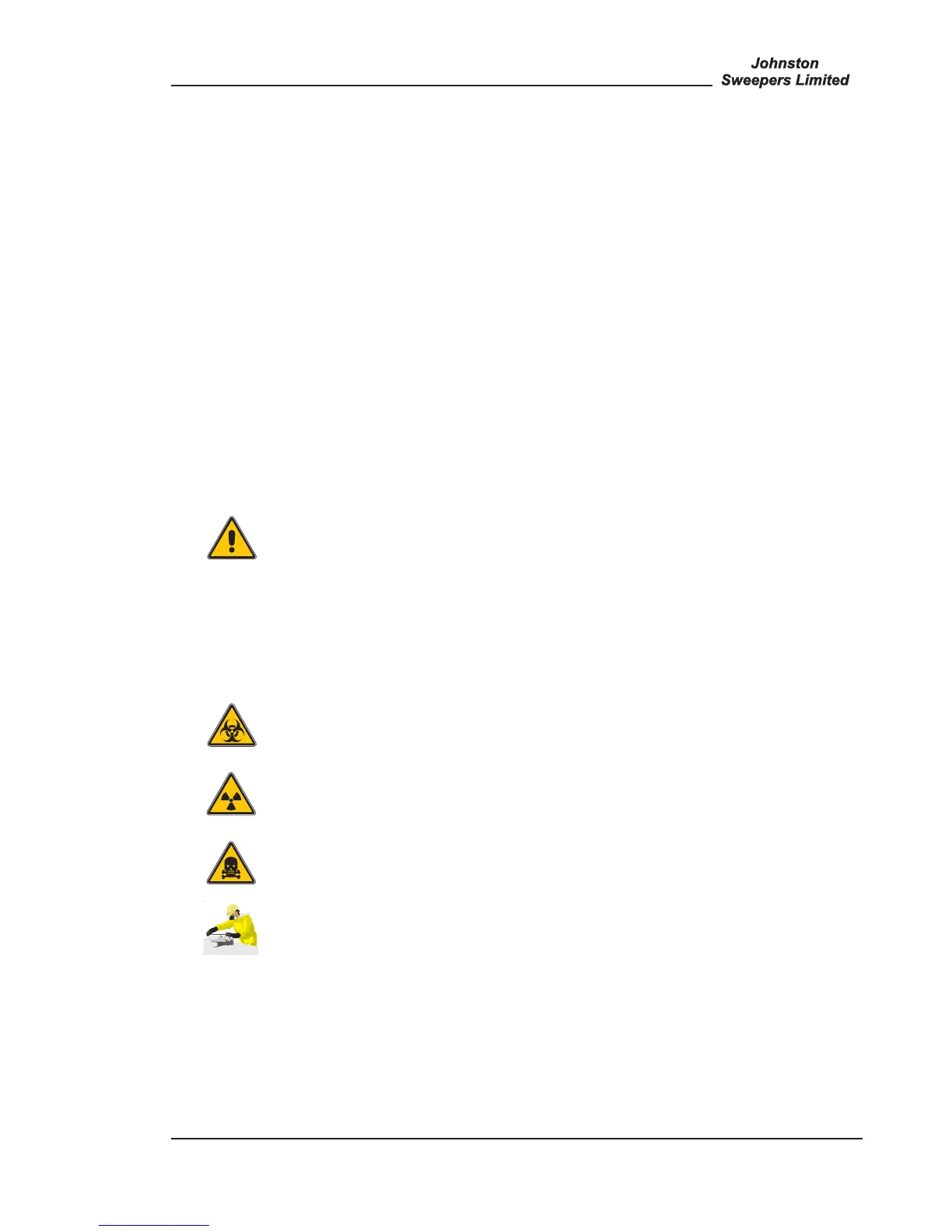
Typical biohazard symbol
Typical radioactive material symbol
Typical poison symbol
Always use appropriate protective clothing



 To Next Page