Need help?
Do you have a question about the JOPIX AN-2 and is the answer not in the manual?
Features a Thin-Film Transistor Liquid Crystal Display for visual output.
Allows user customization of key functions for enhanced operation.
Optional Tone and Digital Coded Squelch for selective communication.
Optional accessory for wireless audio input.
Optional feature enabling control via a mobile phone.
Supports operation across different radio standards and country regulations.
Provides access to device configuration and adjustment options.
Dual-Tone Multi-Frequency encoding and transmission capability.
Noise Blanker/Automatic Noise Limiter for reducing unwanted signals.
High-Cut filter for voice clarity, reducing high-frequency distortion.
Internal circuitry to protect against over/under voltage conditions.
Stores up to 8 frequently used channels for quick recall.
Limits continuous transmission to prevent overheating or channel hogging.
Adjusts the brightness of the LCD display.
Feature to automatically power on the device upon receiving power.
Prevents accidental key presses by locking the keypad.
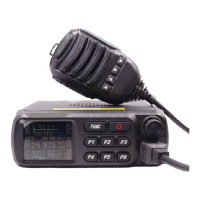
Identifies and describes the controls and indicators on the front of the transceiver.
Identifies and describes the connections and ports on the rear of the transceiver.
Instructions for turning the transceiver on, off, and using the mute function.
How to use the knob for channel tuning, fast adjustment, and key locking.
Usage of the FUNC key to switch functions and access the backlight menu.
Explains the use and functions of the six programmable keys F1 through F6.
How to switch between Amplitude Modulation (AM) and Frequency Modulation (FM) modes.
How to adjust the Radio Frequency gain for optimal reception.
Accessing emergency channels 9 and 19 directly.
How to adjust the audio output volume level using the channel selector knob.
Controls for Squelch level (SQL) and Automatic Squelch (ASQ) to filter noise.
How to switch between channel number and frequency display modes.
How to activate scanning and add/delete channels from the scan list.
How to use, store, and recall channels from memory.
Monitoring two channels simultaneously.
Transmitting DTMF codes, valid when CALL is set with a DTMF group.
Activating the Noise Blanker/ANL filter to reduce interference.
Enables a beep tone at the end of transmission.
Activating the High-Cut filter to improve audio clarity.
Setting up optional CTCSS/DCS codes for selective communication.
Customizing the audible beep sound for key presses.
Configuring the maximum continuous transmission time.
Adjusting the brightness level of the LCD display.
Setting the desired audio output volume level.
Adjusting the threshold for the squelch to block background noise.
Setting the level for the automatic squelch function.
Configuring the RF gain level for reception sensitivity.
Selecting how channel numbers and frequencies are displayed.
Customizing the functions assigned to specific keys.
Choosing the method for channel scanning (Squelch or Time).
Configuring the duration before the scan function stops.
Enabling or disabling the automatic power-on feature.
Performing a Standing Wave Ratio test to check antenna performance.
Resetting the transceiver to its original factory settings.
Configure global settings like AM/FM mode, NB/ANL, HI-CUT, and Roger Beep for all channels.
Enable or disable specific settings for all channels.
Add or delete the current channel from the scan list.
Configure CTCSS/DCS codes for receiving signals.
Prevent transmission on an occupied channel.
Configure specific call settings like DTMF transmission timing and triggers.
Basic DTMF code configuration and editing.
Configure CTCSS/DCS codes for transmitting signals.
Set the AM or FM mode for the current channel.
Enable or disable NB/ANL function for the current channel.
Enable or disable HI-CUT function for the current channel.
Enable or disable Roger Beep for the current channel.
Setting the duration for DTMF signal transmission.
Configuring the timing for the first digit of a DTMF code.
Setting the pre-loading time for DTMF code transmission.
Adjusting the delay time between DTMF code elements.
Assigning DTMF functions to specific keys.
Controlling whether DTMF codes are displayed on the LCD during transmission.
Customizing the functions assigned to the programmable keys (F1-F6).
General operational parameters like frequency range, voltage, and dimensions.
Technical details of the transmitter's output power and frequency response.
Technical details of the receiver's sensitivity and selectivity.
 General
| Frequency Range | 26.965 - 27.405 MHz |
|---|---|
| Microphone connector | 6-pin |
| Type | FM |
| Channels | 40 |
| Power output | 4 W |

 To Next Page