The JW Fishers SFP-1 (Single Frequency Pinger) and MFP-1 (Multifrequency Pinger) are acoustic signal generators designed for underwater use, primarily to mark underwater sites or equipment for divers using a pinger receiver.
Function Description
Pingers emit a continuous series of acoustic pulses (sound waves) from their transducer (black end) when turned on, either manually or automatically when submerged in water. These pulses are of very short duration, measured in milliseconds (ms), and radiate in all directions. Divers use a pinger receiver to detect these signals and locate the exact position of the pinger. The MFP-1 offers user-selectable frequencies, allowing multiple pingers to be deployed in the same area without interference. The SFP-1 has a factory-set frequency.
Important Technical Specifications
General for both SFP-1 and MFP-1:
- Material: High impact PVC
- Color: Yellow
- Depth Rating: 1,000 feet
- Weight: 20 oz air (negative 1 oz water)
- Size: 2.4 in diameter x 9 in long
- Extended Battery Option Weight: 34 oz air (negative 2 oz water)
- Extended Battery Option Size: 2.4 in diameter x 14 in long
- Batteries: Two 9-volt Alkaline or Lithium batteries (standard); six 9-volt Alkaline or Lithium batteries (extended operations option). Batteries are installed "terminal end" first.
SFP-1 Specifics:
- Frequency: Factory-set at 22, 32, 40, or 50 kHz (specified at time of order).
- Power Output (adjustable): .1, .5, 2, 8 watts
- Pulse Length (adjustable): 1, 3, 5 ms
- Rep Rate (adjustable): 2, 1, .5 seconds
- Battery Life: From days to months, depending on battery type and output power. Extended battery option adds four more batteries, yielding 3 times the battery life.
MFP-1 Specifics:
- Frequency: User-selectable from 20 to 50 kHz in 500 Hz increments (60 different frequencies).
- Power Output (adjustable): .1, .5, 2, 5 watts
- Pulse Length (adjustable): 2, 3, 4 ms
- Rep Rate (adjustable): 2, 1, .5 seconds
- Battery Life: From days to months, depending on battery type and output power. Extended battery option adds four more batteries, yielding 3 times the battery life.
Battery Life Tables (Approximate, with two Alkaline batteries):
Single Frequency Pinger (5 ms Pulse Length):
| Power Output |
2 sec rep rate |
1 sec rep rate |
.5 sec rep rate |
| 8 w |
1 day |
2 days |
4 days |
| 2 w |
3 days |
6 days |
12 days |
| .5 w |
12 days |
22 days |
40 days |
| .1 w |
40 days |
75 days |
140 days |
| Note: Extended case (6 batteries) 3 times the time. Lithium batteries double the times shown. 3 ms Pulse Length then 1 1/2 times the time. 1 ms Pulse Length then 3 times the time. |
|
|
|
Multifrequency Pinger (4 ms Pulse Length):
| Power Output |
2 sec rep rate |
1 sec rep rate |
.5 sec rep rate |
| 5 w |
1 day |
2 days |
4 days |
| 2 w |
3 days |
6 days |
9 days |
| .5 w |
9 days |
14 days |
20 days |
| .1 w |
21 days |
24 days |
27 days |
| Note: Extended case (6 batteries) 3 times the time. Lithium batteries double the times shown. 3 ms Pulse Length then 1 1/2 times the time. 2 ms Pulse Length then 2 times the time. |
|
|
|
Usage Features
- Adjustable Parameters: Operators can adjust pulse repetition rate, pulse length, and output power using "push on" jumpers on the electronics board before deployment. The MFP-1 also allows selection of transmission frequency.
- Pulse Length: Longer pulses travel further but consume more power, shortening battery life.
- Repetition Rate: A shorter rep rate (e.g., .5 sec between pulses) makes it easier to locate but consumes twice the battery power compared to a 1-sec rep rate. It does not increase range.
- Power Output: Higher output power increases detection distance, but doubling output power reduces battery life by half.
- Activation: Pingers can be manually forced "On" or set to "Water" activation mode, where they turn on when water touches the metal contacts on the transducer. For long-term deployments, the "On" position is recommended to prevent corrosion of contacts.
- Deployment:
- The signal is strongest from the top and sides of the transducer.
- When marking a target on the ocean bottom, a flotation collar (included) should be installed under the Retaining Cap to keep the transducer pointed up, ensuring the signal radiates upward and to the sides. The pinger is tied to the target from its bottom.
- For marking an anchor line, the pinger is tied 6-10 feet up from the anchor.
- For marking a boat or surface target, the flotation collar is removed, and the pinger is tied to the boat, allowing the transducer to point down.
- Pre-Deployment Checks:
- Always record the pinger frequency for future reference.
- Test pingers and receivers on land or in shallow water before open water deployment. Pingers can be detected 5-10 feet away in air (a "clicking" noise can be heard from the transducer).
- Ensure the electronics and seals are fully pushed into the housing, and the cap is screwed snug, but not overtightened.
- Use fresh batteries for each deployment.
- When swimming towards a signal, double-check other directions to confirm the strongest signal and avoid reflected signals.
Maintenance Features
- Corrosion Resistance: Constructed of corrosion-resistant materials.
- Cleaning: Rinse in fresh water after use and store in a cool, dry place. The transducer should be kept clean with soap and water and protected from damage. The two screw-heads on the transducer should be free of debris.
- O-ring Lubrication: If the unit is disassembled, the o-ring (below the Retaining Cap) can be lubricated with a silicon-based lubricant. Keep the o-ring clean and free of damage.
- Battery Removal: Remove batteries when storing the pinger for more than a few weeks to prevent damage.
- Heat Protection: Do not expose the pinger to excessive heat (direct sunlight, closed vehicle) as it can damage electronics and waterproof seals.

 Need help?
 General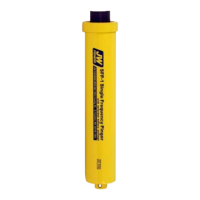

 To Next Page