Remember that three logs will burn just as quickly as one
The quantity of firewood determines the heat emission - the more heat you require, the more
wood you should add at each refueling.
Types of fuel and heating values
All the stoves are constructed and approved for burning wood.
Combustion involves conversion of the fuel from solid form into gases, water vapor and
charcoal. The heating value is an expression of the content of combustible gases - stated
in kcal/kg. All wood has roughly the same heating value per kilogram. The lighter the
wood, the more that must be used to achieve the same heating value as with a heavier
species of wood.
Type of wood Dry wood - Lbs./ft3 (Kg/m3) Compare to beech
Beech and oak 36.2 (580) 100%
Ash 35.6 (570) 98%
Maple 33.7 (540) 93%
Birch 31.8 (510) 88%
Mountain pine 30.0 (480) 83%
Fir 24.3 (390) 67%
Poplar 23.7 (380) 65%
As mentioned, air-dried wood contains around 20% water, corresponding to a heating value
of approx. 4 kWh/kg equivalent to approx. 3440 kcal/kg (1 kW = 860 kcal.)
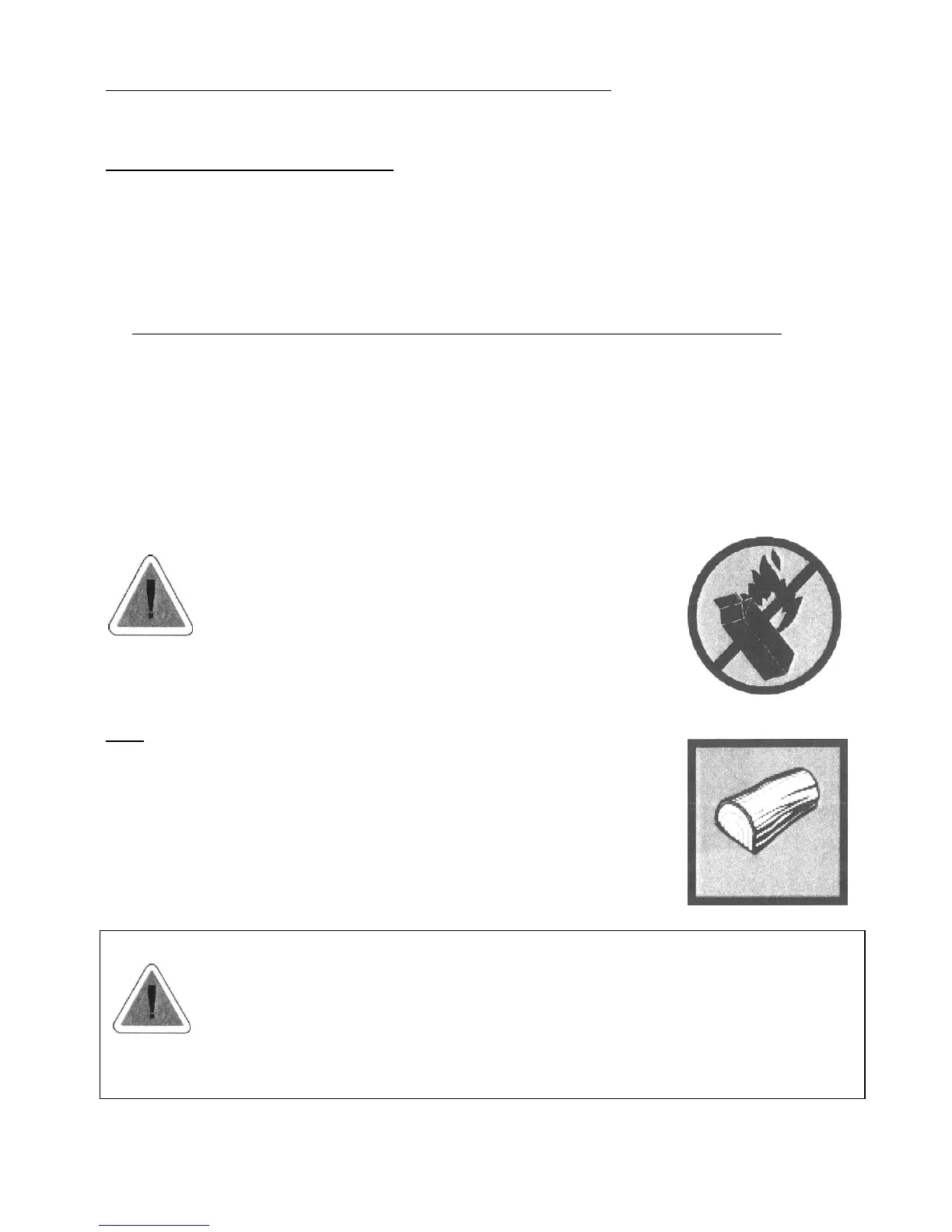
WARNING! NEVER burn impregnated wood, painted
wood, laminated plastic, plywood, chipboard, refuse, milk
cartons, printed matter, charcoal, or similar. Use of such
materials will invalidate your warranty, as this may emit
toxic, corrosive and hazardous fumes when burned. They
may also cause a buildup of the toxic gas dioxin or carbon
monoxide, which is damaging to the stove and the
environment and may cause bodily harm or death.
Fuel
Recently-felled wood contains 60-70% water and must therefore be
seasoned before it can be used in a wood-burning stove. It must be
cut, split, and air dried, and must contain no more than approx. 25%
water before use. This equates to the wood being left in the open for
approx. 1 year - covered only to protect against rain.
It is very important to always use pure, dry wood. Damp wood requires a
lot of air for combustion, as extra energy in the form of heat is needed to
dry it out. Heat emission is therefore minimal.
Creosote - Formation and Need for Removal
When wood is burned slowly, it produces tar and other organic vapors, which
combine with expelled moisture to form creosote. The creosote vapors condense in
the relatively cool chimney flue of a slow-burning fire. As a result, creosote residue
accumulates on the flue lining. When ignited, this creosote makes an extremely hot
fire. The chimney and chimney connector should be inspected at least once every
two months during the heating season to determine if a creosote buildup has occurred. If
creosote has accumulated, it should be removed to reduce the risk of a chimney fire.
If a significant layer of creosote has accumulated (3 mm or more), it should be removed to
reduce the risk of a chimney fire. In case of chimney fire shut down all air regulations.


 To Next Page