33
VEHICLE INTERIOR
Safety belt protects the passengers and the
driver from an injury when a collision occurs.
Always make sure your and your passenger’s
safety belts are properly fastened while the
vehicle is in motion.
Failure to follow safety belt warnings may result
in serious personal injury.
•
Safety belts must be positioned on the body
so as to restrain the upper body and lap from
sliding forward. Improperly positioned safety
belts can cause serious personal injury in
case of an accident.
•
The shoulder belt should always rest on your
upper body. It should never be worn behind
your back or under your arm.
•
For maximum effectiveness, the lap belt
should be worn low across the hips.
• Belts should not be worn twisted.
•
One safety belt can only be used by one
person.
3.2 Safety Belt
General
Proper Wearing of Safety Belts
Use of Safety Belt
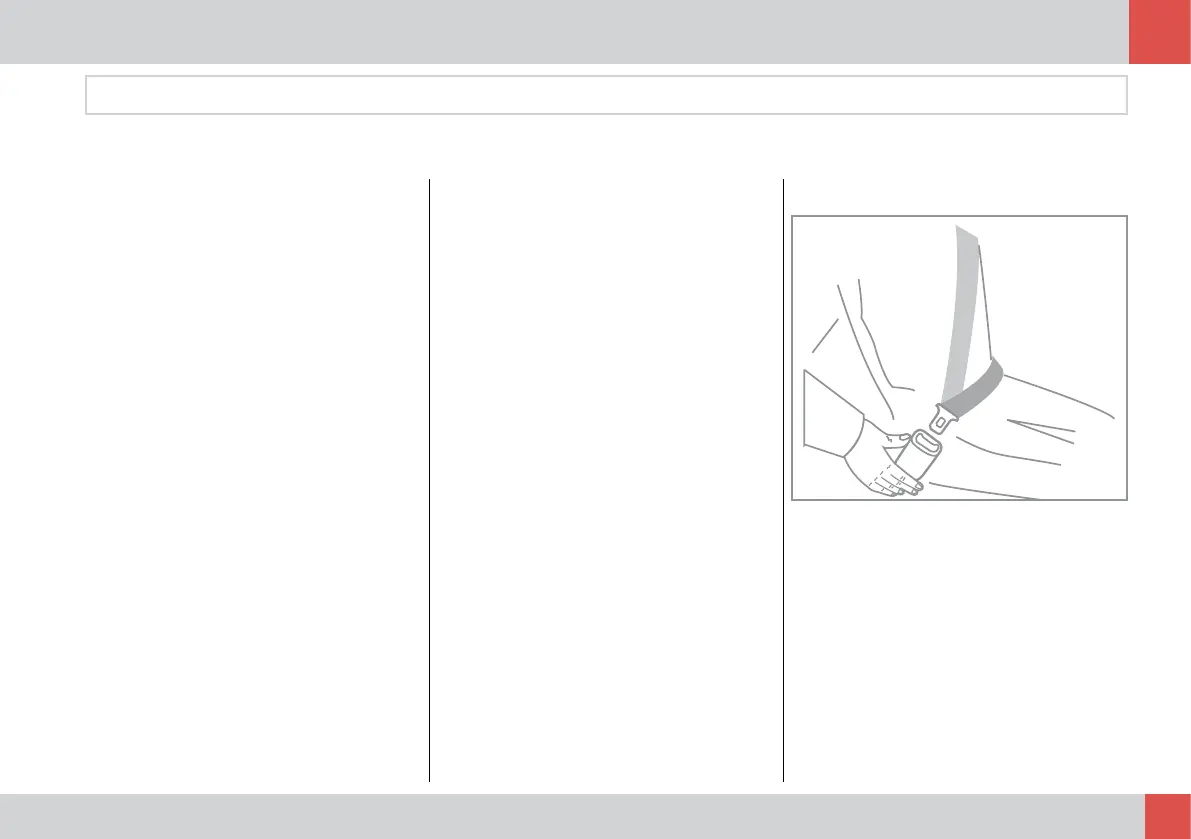
Fastening
•
Insert belt tongue into buckle on inboard
side of seat. Push down until it securely
locks with audible click. Pull the belt to
check.
• Pull shoulder section to make sure belt ts
snugly across the pelvis.
•
Belts should t snugly across the pelvis and
chest. Make sure there is no slack in the
belt.
•
Three point xed belts are not suitable for
the person smaller than 150cm.
•
Don’t take the shoulder side of the belt
under your arms.
•
Ensure that the seat backside is vertically
positioned. When the seat is adjusted in
inclined position, there may be a slippage
from the belt if the collision occurs.
• Fix the safety belts with the proper buckle.
•
Don’t hold any fragile materials between
your body and the safety belt. In case of an
accident, these materials can be broken and
give harm to your health.
•
Depending on the force of an impact,
fastened safety belts are tightened in an
accident.
•
Several layers of heavy clothing may
interfere with proper of positioning of belts.
•
The belts must be kept clean otherwise
retractors may not work properly.


 To Next Page