Need help?
Do you have a question about the Kawai CA49 and is the answer not in the manual?
Specifies requirements for the initial software update stage.
Instructions for downloading the Kawai PianoRemote app.
Steps to launch the PianoRemote application on a mobile device.
Process for connecting the app to the digital piano via Bluetooth.
How to start the software update within the PianoRemote app.
Final steps to complete the initial update stage.
Lists necessary requirements for the main software update.
Guidance on preparing files and tools for the update.
Procedure to activate the piano's update mode.
Instructions for connecting the piano to a computer via USB.
How to start the DP Updater software on a computer.
Steps to select the software file and MIDI device in the updater.
How to initiate the main software update procedure.
Final steps to complete the main update and verify success.
Details and features of software version 1.10.
Details and features of software version 1.00.
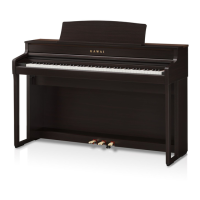
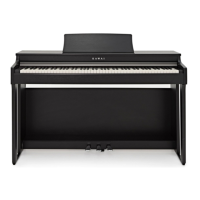
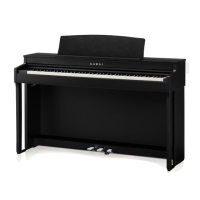
The Kawai CA49 is a digital piano designed for a rich musical experience, offering a range of features for both performance and maintenance. This device is capable of receiving software updates to enhance its functionality and ensure compatibility with modern applications.
The Kawai CA49 serves as a sophisticated digital piano, providing a realistic piano playing experience through its advanced sound engine and keyboard action. It is designed to be a versatile instrument for musicians of all levels, from beginners to experienced players. The core function of the CA49 is to produce high-quality piano sounds, replicating the nuances and expressiveness of an acoustic grand piano. Beyond its primary role as a musical instrument, the CA49 also incorporates features that facilitate its integration with digital ecosystems, allowing for expanded control and interaction through smart devices. This includes support for dedicated applications that can extend the piano's capabilities, such as remote control and access to additional musical content. The instrument's internal ROM stores its system software, which governs all its operations, from sound generation to user interface interactions. Regular software updates are a key aspect of maintaining and improving the CA49's performance, ensuring it remains current with technological advancements and user needs.
The Kawai CA49 is designed for intuitive and user-friendly operation. To begin using the instrument, a simple power-on sequence is required. The device features an LCD display that provides visual feedback on its current status, including the software version. This display is crucial for navigating settings and confirming operational parameters. For musical performance, the CA49 offers a responsive keyboard and a range of sound options, allowing players to explore various musical styles. The instrument includes physical buttons such as [SOUND SELECT], [DOWN], [POWER], [1], [2], and [METRONOME], which are used for both playing and accessing system functions.
One of the key usage features is the ability to connect with smart devices via Bluetooth MIDI. This connectivity enables users to control the piano remotely and access additional features through dedicated applications like the Kawai PianoRemote app. This app allows for a more interactive experience, providing a graphical interface for adjusting settings, selecting sounds, and potentially accessing educational content or recording functions. The process of connecting to the app involves launching it on an iOS or Android device, ensuring Bluetooth is enabled, and then selecting the CA49 from the list of available Bluetooth MIDI devices. Once connected, the app can serve as an extended control panel for the piano.
The CA49 also supports an "update mode," which is a special operational state designed specifically for software updates. This mode is activated by a specific button combination during power-on, indicated by flashing LED indicators on certain buttons. In update mode, the piano is ready to receive new software from a connected computer. This process typically involves using a USB type "B" to USB type "A" cable to establish a physical connection between the piano and a computer. The computer then runs a dedicated updater tool, such as the Kawai DP Updater tool, which facilitates the transfer of the new software to the piano. During the update process, the updater tool provides progress feedback, and the piano's LED indicators continue to flash, signifying that the update is in progress. It is important to avoid interrupting the update once it has begun to ensure successful completion. After a successful update, the instrument can be turned off and then on again to load the newly installed software.
Software updates are a primary maintenance feature for the Kawai CA49, ensuring the instrument remains up-to-date and performs optimally. The manual outlines a clear, two-stage process for these updates, catering to different initial software versions.
Checking Current Software Version: Before any update, users are instructed to check the current software version. This involves a specific button sequence: holding [SOUND SELECT] and [DOWN] buttons simultaneously while pressing [POWER] to turn the instrument on. The version number is then displayed on the LCD. This diagnostic step is crucial for determining which update stage (Stage 1 or Stage 2) is necessary. After checking, the instrument should be turned off and on again to return to normal operation.
Stage 1: Initial Update using PianoRemote App (for v1.00 software): This stage is specifically for CA49 units with the initial v1.00 software. It leverages the Kawai PianoRemote app on an iOS or Android device. The requirements for this stage include an internet-connected smart device with Bluetooth enabled. The process involves downloading the PianoRemote app, launching it, and connecting it to the CA49 via Bluetooth MIDI. Once connected, the app will indicate that a software update is necessary. To initiate the update, users must tap a specific area of the smart device screen 10 times, followed by confirming the update. The app then guides the user through the update process, which takes approximately 3 minutes. If this stage is unsuccessful, users are advised to restart from the beginning.
Stage 2: Main Update using DP Updater Tool (for v1.10 or higher, or after Stage 1): This is the primary update stage, performed using a Windows or macOS computer and the Kawai DP Updater tool. This stage requires a computer with internet access and a USB type "B" to type "A" cable. The maintenance process begins by downloading the software update zip file and extracting its contents into a temporary folder. This folder contains the system software file (ca49****.dat), update instructions (ca49_update_en.pdf), and the updater tools for macOS (kawai_dp_updater.app) and Windows (kawai_dp_updater.exe).
To prepare the piano for this update, it must be turned on in "update mode." This is achieved by holding the [1], [2], and [METRONOME] buttons simultaneously while pressing the [POWER] button. The flashing LED indicators on these buttons confirm that the piano is in update mode. Next, the piano is connected to the computer using the USB cable.
On the computer, the Kawai DP Updater tool is launched. Within the tool, users must select the ca49****.dat update file and then choose the correct USB-MIDI device from the list. Once these selections are made, clicking the [Update] button initiates the software transfer. This process takes approximately 8 minutes, during which the updater tool displays progress. It is critical to ensure the computer remains undisturbed, and no other applications are launched during this time. The piano's LED indicators will continue to flash, but the piano should not be turned off.
Upon successful completion, the updater tool will display an "Update complete!" message. The final steps involve disconnecting the USB cable and then pressing and holding the [POWER] button to turn the instrument off. After turning it back on, the updated software will be automatically loaded. A crucial maintenance step after any update is to perform the software version check again (as described on the first page of the instructions) to confirm that the update was successful. If this stage of the update is unsuccessful, users are advised to restart from step 1 of Stage 2.
These detailed maintenance procedures ensure that the Kawai CA49 can be kept current, benefiting from bug fixes, performance improvements, and new features as they are released, thereby extending the instrument's lifespan and enhancing the user experience.
 General
| Sound Source | Harmonic Imaging XL (HI-XL) |
|---|---|
| Polyphony | 192 notes |
| Metronome | Yes |
| Piano Sounds | Shigeru Kawai SK-EX, Kawai EX |
| Internal Sounds | 19 |
| Speakers | 20W x 2 |
| Dimensions | 136 cm |
| Connectivity | MIDI (IN/OUT), USB to Host |
| Reverb | Room, Lounge, Small Hall, Concert Hall, Live Hall |
| Other Effects | Chorus, Tremolo, Delay |
| Lesson Function | Alfred's Basic Piano Library |
| Display | LCD |
| Recorder | 3 Songs |
| Bluetooth | No |
| Headphone Jacks | 2 |
| Pedals | Damper (with half-pedal support), Soft, Sostenuto |

 To Next Page