
 Need help?
Do you have a question about the Keithley 2612B and is the answer not in the manual?
Covers shock hazards, mains connection, and general electrical safety precautions.
Stresses system safety responsibility, designer's role, and fault hazards.
Discusses IEC 61010-1, hazardous voltages, and system design for safe connections.
Details shields, barriers, insulation, interlocks, and user training for safe operation.
Details line voltage compatibility, automatic sensing, and the requirement for a grounded outlet.
Warns that operating on incorrect line voltage may damage the instrument and void the warranty.
Guides setting the source function, range to 20V, and level for basic testing.
Guides setting the source limit to 10 mA and verifying the value.
Guides setting the measurement function to Voltage (V) and enabling AUTO range.
The Keithley Instruments Series 2600B System SourceMeter® Instruments, including models 2611B, 2612B, and 2614B, are medium-power source-measure units (SMUs) designed to simplify test processes by combining source and measure capabilities within a single instrument. These devices offer a scalable, high-throughput, and cost-effective solution for precision DC, pulse, and low-frequency AC source-measure testing.
The core function of the Series 2600B instruments is to act as a versatile source-measure unit, capable of both sourcing electrical signals (voltage or current) and simultaneously measuring electrical responses. This dual capability makes them ideal for characterizing a wide range of electronic components and materials. Users can configure the instruments to source voltage and measure current, source current and measure voltage, or perform other combinations depending on the test requirements. The instruments are equipped with a front-panel display and controls, allowing for direct interaction and configuration without necessarily requiring a computer interface for basic operations.
For more advanced applications, the Series 2600B instruments support programmable test scripts, which can be developed using the Test Script Builder (TSB) Integrated Development Environment. These scripts enable complex test sequences, data logging, and automated measurements, significantly enhancing efficiency in manufacturing and research environments. The instruments also come with an IVI instrument driver for National Instruments LabVIEW™ and related release notes, facilitating integration into larger test systems. Furthermore, a J2SE™ Runtime Environment and Keithley I/O layer with release notes are provided to support software development and communication.
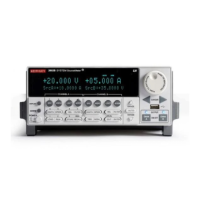
The instruments are capable of operating in various modes, including sourcing voltage with current limits, or sourcing current with voltage limits. The front panel provides dedicated keys for setting source function, measurement function, range, and limits. A navigation wheel and cursor keys allow for precise adjustment of values on the display. The output can be turned on and off via a dedicated control, and the display provides real-time feedback on sourced values and measurements.
One notable feature is the inclusion of a Model 2400 software emulation personality script on a USB flash drive. This script allows the Series 2600B instrument to accept 2400 SCPI commands, providing backward compatibility for users migrating from older Keithley equipment or integrating into existing test setups designed for the Model 2400. This flexibility ensures that users can leverage their existing programming knowledge and test routines with the new instruments.
The Series 2600B instruments are designed for both benchtop and rack-mount applications. For benchtop use, they can be placed on a stable surface. For rack installation, specific rack-mount kits and instructions are provided. The instruments feature an auto-sensing line voltage capability, operating from 100 VAC to 240 VAC at 50 Hz or 60 Hz, eliminating the need for manual voltage selection switches. This simplifies setup and reduces the risk of damage due to incorrect voltage settings.
Safety is a paramount consideration in the design and operation of these instruments. Users are advised to read and follow all safety warnings provided with the instruments and in the user documentation. This includes ensuring proper grounding of the power cord, avoiding contact with hazardous voltages, and using appropriate test fixtures with safety interlocks when connecting to a device under test (DUT). The documentation emphasizes the importance of understanding signal levels, compliance limits, and output-off states before connecting the instrument to any energy-delivering device to prevent damage to the instrument or the DUT.
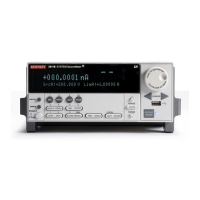
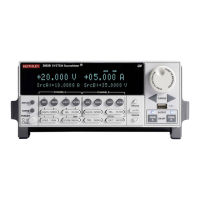
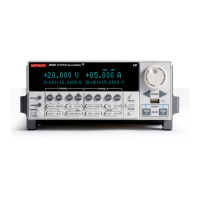
The front panel interface is intuitive, with clearly labeled buttons for common functions such as SRC (source), MEAS (measure), LIMIT, MODE, RANGE, and CONFIG. A numeric keypad and navigation wheel allow for easy data entry and menu navigation. The display provides clear feedback on instrument status, sourced values, and measured results. For instruments with two channels (2612B and 2614B), the DISPLAY button can be used to toggle between dual-channel display mode and single-channel display for detailed settings of SMU channel A.
The power-up sequence includes a series of self-checks, such as displaying dots, lighting all display segments, showing the instrument model, and performing line frequency detection. This process takes approximately 30 seconds, after which the default display screen appears, indicating readiness for operation. Basic functionality can be verified through a simple test procedure outlined in the quick start guide, which involves setting source voltage, current limit, measurement function, and observing measurements without connecting a DUT.
Routine maintenance procedures are described in the user documentation, ensuring the instrument operates properly. These procedures may include setting the line voltage or replacing consumable materials. However, it is explicitly stated that only service personnel should perform procedures not designated for operators.
For cleaning, a damp cloth or mild, water-based cleaner should be used on the exterior of the instrument only. Liquids should not be allowed to enter or spill on the instrument. If the instrument consists of a circuit board without a case, it should not require cleaning if handled according to instructions. If such a board becomes contaminated, it should be returned to the factory for proper cleaning/servicing.
In cases where replacement components are needed, particularly for mains circuits (such as power transformers, test leads, and input jacks), these must be purchased from Keithley Instruments to maintain protection from electric shock and fire. Standard fuses with applicable national safety approvals may be used if the rating and type are the same. The detachable mains power cord should only be replaced with a similarly rated power cord. For non-safety-related components, other suppliers may be used if the parts are equivalent to the original, but purchasing through Keithley Instruments is recommended to maintain accuracy and functionality. If there is any doubt about component applicability, users are advised to contact a Keithley Instruments office.
The instruments are designed for indoor use only, within specific environmental conditions: altitude at or below 2,000 m (6,562 ft), temperature 0 °C to 50 °C (32 °F to 122 °F), and pollution degree 1 or 2. Adhering to these environmental guidelines helps ensure the longevity and reliable operation of the instrument. The quick start guide serves as an initial resource for unpacking, basic connections, and operation, while the comprehensive Reference Manual provides detailed information on features, optimization, maintenance, troubleshooting, and programming commands.
 General
| Type | SourceMeter |
|---|---|
| Channels | 2 |
| Maximum Power per Channel | 100 W |
| Communication Interface | GPIB, USB, Ethernet |
| Resolution | 5.5 digits |
| Current Range (Pulse) | ±10A (Pulse) |


 To Next Page
