13REMOTE QUICK START
ASSIGNMENTS WITHOUT REMOTE
If your PROFILER Remote is not connected, or if your stage is so huge that your PROFILER is miles away from the
Remote, you will not be able to reach both at the same time. In this case, enter the Remote Eect Buttons page
in Rig Settings, hold one of the four soft buttons, and press one or more eect module buttons to complete the
assignment.
KEEPING OVERSIGHT
To help you maintain an overview, a list of your current assignments will be displayed on the Remote Eect Buttons
page in Rig Settings. You can also immediately clear assignments on this page.
ACTION & FREEZE
Besides toggling the status of eect modules, each of the Eect Buttons can also be used to trigger so-called
“Action & Freeze” functions like “Rotary Speaker (slow/fast)”, “Delay Feedback Infinity”, or the Freeze function of
most delay and reverb eects. To assign, simply navigate to the respective function within the eect e. g. “Rotary
Speed Slow/Fast” within the Rotary Speaker eect. Now press the respective soft button above the display of
the PROFILER together with one of the Remote’s Eect Buttons. Done! Don’t forget to store the Rig to make your
assignment permanent.
LATCHED / MOMENTARY
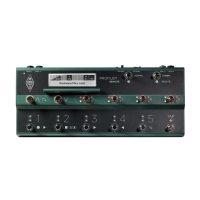
Every Eect Button on the PROFILER Remote supports an automatic latched / momentary detection: A quick press
of the button will latch the assigned function - in other words, the assigned eect modules will change their on/o
state permanently, until you press the button again.
However, if you hold the Eect Button for a second or more, it will automatically change to momentary operation.
Momentary operation means that as soon as you release this Eect Button, it will immediately revert to the initial
state. This behavior applies to on/o switching as well as to “Action & Freeze” functions.


 To Next Page