40
COOLING/ICE & WATER
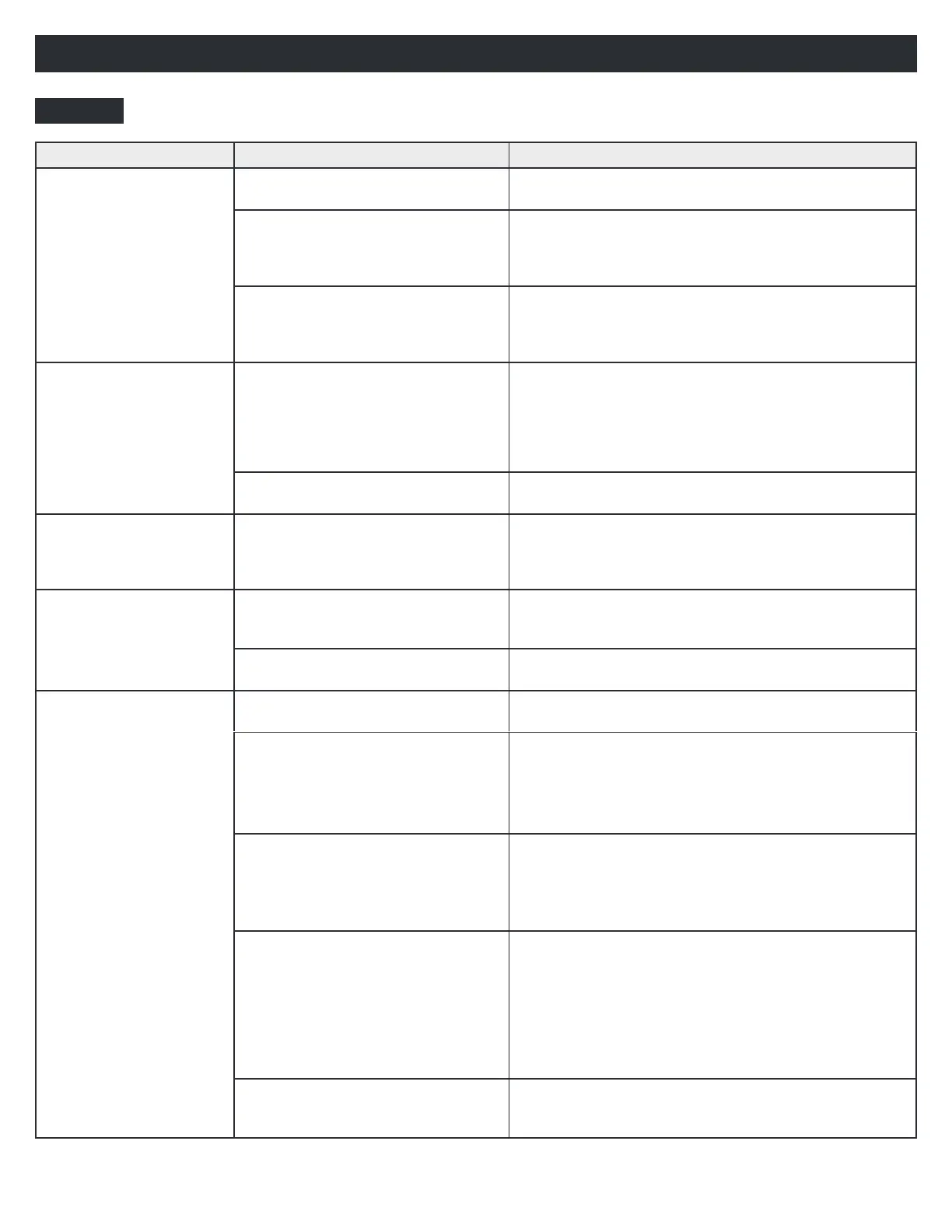
Problem Possible Causes Solutions
Food i s f reezi ng
in the refrigerator
compartment.
Food with high water content was
placed near an air vent.
Rearrange items with high water content away from air
vents.
Ref rigerator temperature control is set
incorrectly.
If the temperature is too cold, adjust the control one
increment at a time and wait f or the temperature to
stabilize. Refer to the Setting the Controls section for
more information.
Refrigerator is installed in a cold
location.
When the ref rigerator is operated in temperature
below 41°F (5°C), food can freeze in the refrigerator
compartment. The refrigerator should not be operated in
temperature below 55°F (13°C).
Frost or ice crystals
form on frozen food
(outside of package).
Door is opened frequently or for long
periods of time.
When the doors are opened of ten or for long periods
of time, warm, humid air enters the compartment. This
raises the temperature and moisture level within the
compartment. Increased moisture will lead to frost and
condensation. To lessen the eff ect, reduce the frequency
and duration of door openings.
Door is not closing properly. Refer to the Doors will not close correctly or pop open
sect i on i n t he Troub l eshoot i ng sect i on.
Refrigerator or
Freezer section is too
cold.
Incorrect temperature control settings. If the temperature is too cold, adjust the control one
increment at a time and wait f or the temperature to
stabilize. Refer to the Setting the Controls sect;ion for
more information.
Frost or ice crystals
on frozen food
(inside of sealed
package).
Condensation from food with a high
water content has f rozen inside of the
food package.
This is normal for f ood items with a high water content.
Food has been left in the freezer for a
long period of time.
Do not store f ood items with high water content in the
freezer for a long period of time.
Icemaker is not
making enough ice.
Demand exceeds ice storage
capacity.
The dispenser icemaker will produce approximately
216-288 cubes in a 24 hour period.
House water supply is not connected,
valve is not turned on fully, or valve is
clogged.
Connect the refrigerator to a cold water supply with
adequate pressure and turn the water shutoff valve fully
open.
If the problem persists, it may be necessary to contact a
plumber.
Water filter has been exhausted. It is recommended that you replace the water filter:
Approximately every six months.
• When the water filter indicator turns on.
• When the water dispenser output decreases.
• When the ice cubes are smaller than normal.
Low house water supply pressure.
NOTE:
The water pressure must be from 30 to 125 psi
or 207-862 kPa or 2.1-8.8 kgf/ cm
²
. If the refrigerator
is installed in an area with low water pressure below
30 psi, you can install a booster pump to compensate
for the low pressure.
If the problem persists, it may be necessary to contact a
plumber or install a booster pump to compensate for the
low pressure.
Reverse Osmosis fil t ra t i on syst em i s
used.
Reverse osmosis fil t rat i on sy st ems can red uce t he wa t er
pressure below the minimum amount and result in
icemaker issues. (Refer to Water Pressure section.)
TROUBLESHOOTING GUIDE



 To Next Page