21
DISC BRAKES continued
11. It is important to completely understand the operation of your bicycle’s brake system.
Improper use of your brake system may result in loss of control or an accident, which could
lead to severe injury. Because each bicycle may handle differently be sure to learn proper
braking technique (including brake lever pressure and bicycle control characteristics) and
operation of your bicycle. This can be done by consulting a professional bicycle mechanic and
referring to the disk brake instruction sheet included with your bike. This can also be done by
practicing your braking technique in a safe area before hitting the trails.
CAUTION: Disc brakes have a burn-in period, and the braking force will gradually increase
as the burn-in period progresses. Make sure that you are aware of any such increases in
braking force when using the brakes during the burn-in period. The same thing will happen
when the brake pads or rotor are replaced.
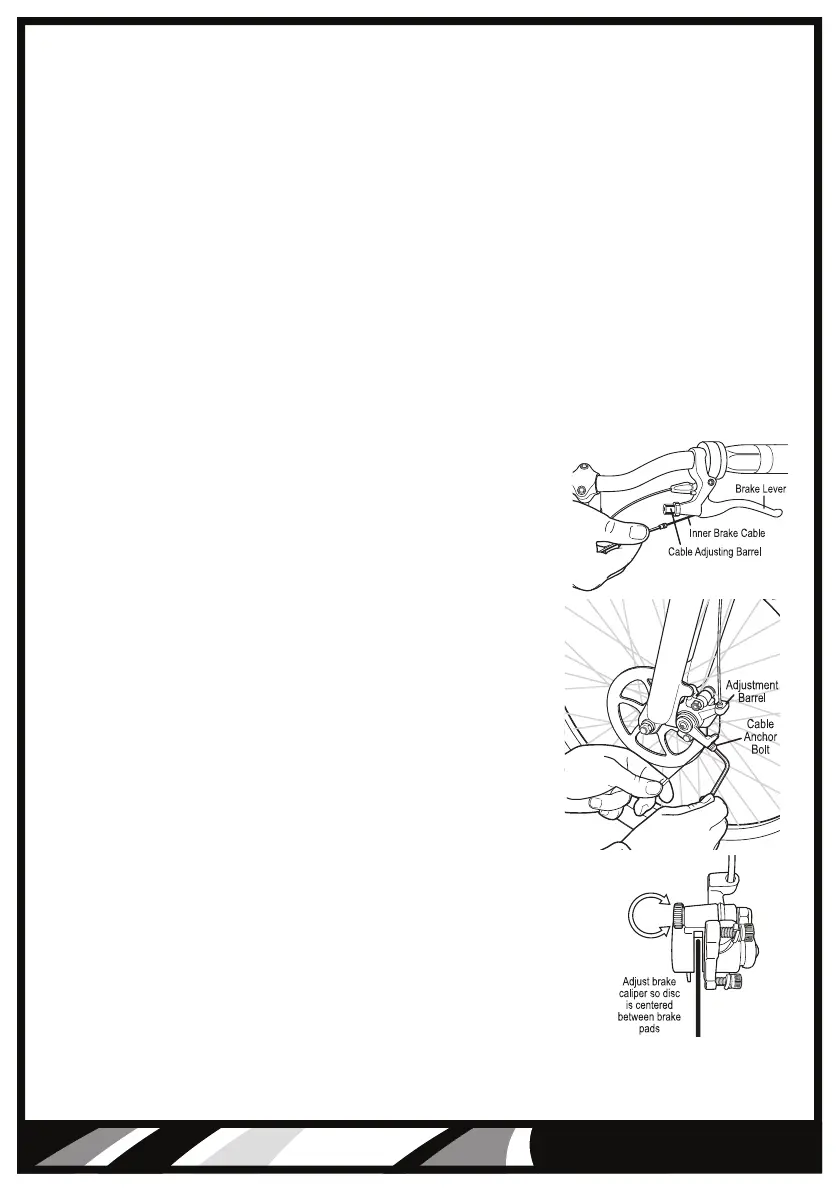
If the brake cable is not connected at the brake lever, line up
brake barrel slot with brake lever slot before installing the cable.
Slide the head of the brake cable into the brake lever per the
diagram. Thread the cable through the slot in the brake lever
so the cable end rests squarely in the adjusting barrel. Turn the
adjusting barrel to close.
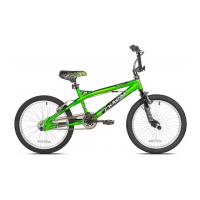
If the brake cable is disconnected at the disc caliper, thread
the brake wire through the adjustment barrel, loosen the cable
anchor bolt until you can see a hole through the anchor bolt for
the cable wire to attach. Thread the cable wire through the cable
anchor and tighten by hand.
Centering brake - First determine if the wheel is centered. Look
at the space between the tire and the frame on either side. If it is
not even, loosen the wheel axle nuts and center the wheel, then
proceed to center the brake.
If the brake is not centered, look at the disc brake caliper for
centering adjustment screws at the center of the brake pad on
either side. Looking down into the brake where the brake pads
contact the disc rotor, determine which side needs to move away
or towards the disc. Turn the centering adjustment screws so
that there is about 1/32 of an inch of clearance on either side of
the disc rotor. Spin the front wheel and listen for any rubbing
noise or excess friction. Repeat the steps until the brake is
centered.
ASSEMBLING YOUR BIKE


 To Next Page