23
TIRES AND TUBES
After assembling your bike, it will be necessary to inflate the tires. Check the side wall of the
tire for the correct tire pressure (PSI) and inflate tires accordingly with a MANUAL BICYCLE
PUMP. Improper inflation is the biggest cause of tire failure. Due to the slightly porous
nature of bicycle inner tubes, it is normal for your bike tires to lose pressure over time. For
this reason it is critically important to maintain the proper tire inflation on your bike.
1. Your bicycle has been equipped with tires which the bike’s manufacturer felt were the best
balance of performance and value for the use for which the bike was intended. The tire size
and pressure rating are marked on the sidewall of the tire. CAUTION: Pencil type automotive
tire gauges and gas station air hose pressure settings can be inaccurate and should not be
relied upon for consistent, accurate pressure readings. Instead, use a high quality dial gauge.
WARNING: NEVER INFLATE A TIRE BEYOND THE MAXIMUM PRESSURE MARKED
ON THE TIRE’S SIDEWALL. EXCEEDING THE RECOMMENDED MAXIMUM PRESSURE MAY
BLOW THE TIRE OFF THE RIM, WHICH COULD CAUSE DAMAGE TO THE BIKE AND INJURY
TO THE RIDER AND OTHERS. THE BEST WAY TO INFLATE A BICYCLE TIRE TO THE CORRECT
PRESSURE IS WITH A BICYCLE PUMP. NEVER USE A SERVICE STATION AIR HOSE TO
INFLATE A BICYCLE TIRE. IT IS DESIGNED FOR LARGER TIRES AND IT CAN EXCEED THE
RECOMMENDED MAXIMUM PRESSURE AND IT MAY BLOW THE TIRE OFF THE RIM.
Tire pressure is given either as maximum pressure or as a pressure range. How a tire
performs under different terrain or weather conditions depends largely on tire pressure.
Inflating the tire to near its maximum recommended pressure gives the lowest rolling
resistance; but also produces the harshest ride. High pressures work best on smooth, dry
pavement. Very low pressures, at the bottom of the recommended pressure range, give the
best performance on smooth, slick terrain such as hard-packed clay, and on deep, loose
surfaces such as deep, dry sand. Tire pressure that is too low for your weight and the riding
conditions can cause a puncture of the tube by allowing the tire to deform sufficiently to pinch
the inner tube between the rim and the riding surface.
Some special high-performance tires have unidirectional treads: their tread pattern is designed
to work better in one direction than in the other. The sidewall marking of a unidirectional tire
will have an arrow showing the correct roation direction. If your bike has unidirectional tires,
be sure that they are mounted to rotate in the correct direction.
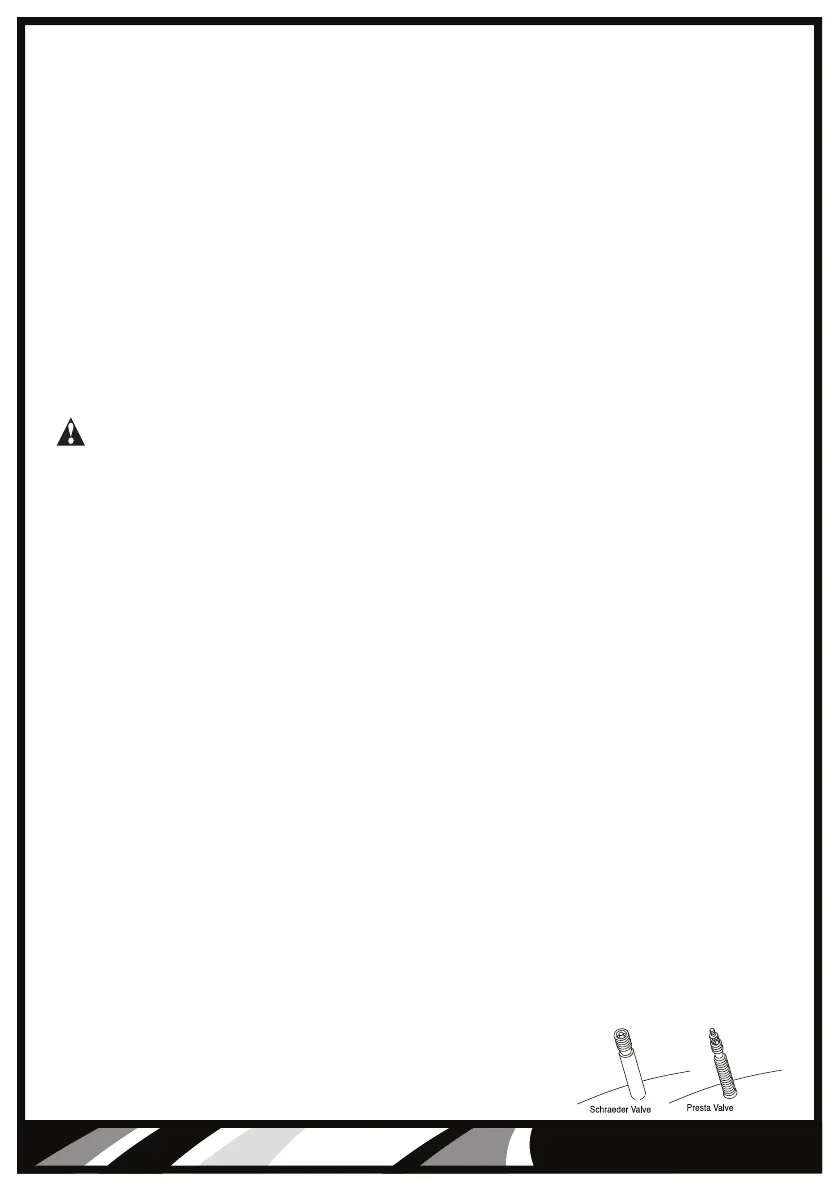
2. The tire valve allows air to enter the tire’s inner tube under pressure, but doesn’t let it back
out unless you want it to. There are primarily two kids of bicycle tube valves: the Schraeder
Valve and the Presta Valve. The bicycle pump you use must have the fitting appropriate to the
valve stems on your bicycle. The Schraeder is like the valve on a car tire. This is the type of
valve stem you should have on your bike. To inflate a Schraeder valve tube, remove the valve
cap and push the air hose or pump fitting onto the end of the valve
stem. To let air out of a Schraeder valve, depress the pin in the end
of the valve stem with the end of a key or other appropriate object.
ASSEMBLING YOUR BIKE


 To Next Page