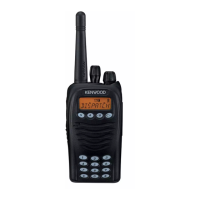
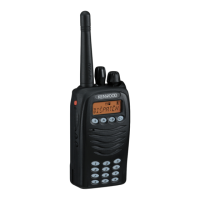
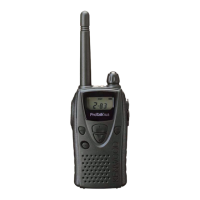
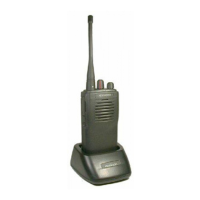
The Kenwood TK-3101 is a UHF FM transceiver designed for dependable and reliable wireless communications. It incorporates advanced technology, making it suitable for both serious hobbyists and commercial users in business, industry, and public safety.
Function Description:
The TK-3101 operates as a two-way radio, allowing users to transmit and receive voice communications on UHF FM frequencies. It features 15 programmable channels, enabling users to select desired frequencies and signaling codes for group communication. The transceiver includes a Push-To-Talk (PTT) switch for initiating calls, a Monitor key for checking channel activity and receiving signals without matching codes, and a Channel selector for choosing between channels. An LED indicator provides visual feedback on the transceiver's status, showing red during transmission, green during signal reception, and orange in setup mode. It also flashes red when the battery voltage is low during transmission. The Power switch/Volume control allows users to turn the device ON/OFF and adjust the audio level.
Important Technical Specifications:
- Frequency Range: UHF FM (specific frequencies are programmable, with examples like 446.00625 MHz, 446.09375 MHz, etc., listed in the manual).
- Channels: 15 programmable channels.
- Signaling: Supports Quiet Talk (QT) tones and Digital Quiet Talk (DQT) codes, with 38 available codes (e.g., 67.0 Hz, D132N).
- Battery Pack: Supplied with a NiCd battery pack (KNB-14). An optional KNB-15A battery pack is also available.
- Battery Life (Average): KNB-14: 8 hours; KNB-15A: 10 hours (calculated using 5% transmit, 5% receive, and 90% standby time).
- Power Output: Not explicitly stated but implied by the UHF FM transceiver classification.
- Operating Temperature for Charging: 41 to 104°F (5 to 40°C).
Usage Features:
- Easy Operation: The transceiver is designed for ease of use with intuitive controls like the PTT switch, Monitor key, Channel selector, and Power switch/Volume control.
- Channel Selection: Users can rotate the Channel selector to choose from 1 to 15 channels.
- Volume Adjustment: The volume can be adjusted by pressing and holding the Monitor key while rotating the Power switch/Volume control.
- Making Calls: To make a call, press and hold the PTT switch, speak into the microphone (approximately 1.5 inches or 3-4 cm from lips), and release the PTT switch to receive.
- Monitoring Channels: Press and hold the Monitor key to check channel activity and listen to signals that do not contain the matched QT/DQT code.
- Programmable Frequencies: Users can reprogram the frequencies of the 15 channels by entering setup mode, selecting a channel, and then choosing a frequency number from 0 to 8 (0 to 7 for Spanish market models).
- Programmable QT/DQT Tones: The QT/DQT codes can be changed for each channel by entering setup mode, selecting a channel, and then choosing the 10's digit and 1's digit of the desired signaling number from the provided list of 38 codes.
- Time-out Timer (TOT): Prevents a single user from occupying a channel for an extended period. If transmission exceeds 1 minute (30 seconds for Spanish models), the transceiver stops transmitting and emits a tone. Releasing the PTT switch stops the tone and allows transmission to resume.
- Battery Save Function: Decreases power consumption when no signal is being received and no operations are performed. It activates after 10 seconds of inactivity and deactivates upon signal reception or operation.
- Low Battery Warning: The LED blinks red during transmission when battery power is low. A tone sounds, and transmission stops, indicating the need for recharging or replacement.
- Water Resistance: The transceiver is designed to be water-resistant, but this feature is compromised if the speaker/microphone jacks are not covered with the supplied cover or if an optional speaker/microphone is connected.
Maintenance Features:
- Battery Charging: The NiCd battery pack must be charged before use. The charging process involves plugging the AC adaptor into the charger, then into an AC outlet, and finally sliding the battery pack or transceiver into the charging slot.
- Initial Charging: After purchase or extended storage, the battery pack may not reach full capacity immediately. Repeating the charge/discharge cycle two or three times will increase its operating capacity.
- Charging Precautions:
- Do not recharge a fully charged battery pack to avoid shortening its life or damaging it.
- Disconnect the battery pack from the charger after recharging to prevent overcharging, which can reduce battery life.
- Charge the battery within the specified ambient temperature range (41 to 104°F or 5 to 40°C) for proper charging.
- Always switch OFF the transceiver before charging to prevent interference with correct charging.
- Replace the battery pack when its operating time decreases despite being fully charged.
- Belt Clip Installation: The belt clip can be attached using two supplied screws. A caution is provided against using glues designed to prevent screw loosening, as these may damage the transceiver's back panel.
- Speaker/Microphone Jack Cover: If not using an optional speaker/microphone, the supplied cover must be installed over the jacks to maintain water resistance.
- Speaker/Microphone Attachment: An optional speaker/microphone can be inserted into the jacks and secured with a locking bracket and screw. Note that water resistance is not fully maintained when using an external speaker/microphone.
- Troubleshooting Guide: The manual includes a troubleshooting section to address common issues such as no power, short battery life, inability to communicate with other group members, or interference from other voices on the channel. Solutions typically involve checking battery status, ensuring correct installation, replacing the battery, verifying frequency and QT/DQT tone settings, or changing the QT/DQT tone for the group.
- Service: Refer all service to qualified technicians only.
- Modifications: Do not modify the transceiver for any reason.
- Environmental Protection: Avoid exposing the transceiver to long periods of direct sunlight, heating appliances, excessively dusty, humid, or wet areas, or unstable surfaces.
- Safety: Do not operate or charge the battery pack in an explosive atmosphere. Turn OFF the transceiver while refueling or at gasoline service stations.

 Need help?
 General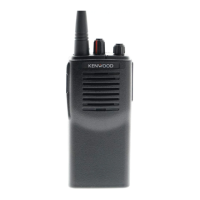


 To Next Page