Need help?
Do you have a question about the Kenwood TK-D240V and is the answer not in the manual?
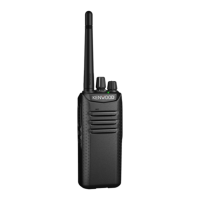
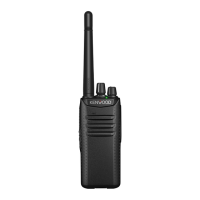
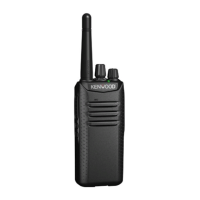
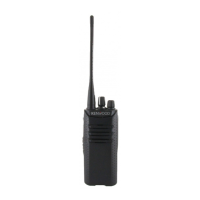
The provided document is a user manual for Kenwood TK-D240, TK-D240V, TK-D340, TK-D340U, and TK-D348R VHF/UHF digital transceivers. These devices are designed for two-way radio communication, offering both VHF and UHF digital transceiver capabilities. The manual outlines various features and operations, from basic setup to advanced functions, ensuring users can effectively utilize the transceivers for their communication needs.
The Kenwood transceivers are primarily used for two-way radio communication, allowing users to transmit and receive voice calls. They support both VHF and UHF digital frequencies, making them versatile for different environments and communication requirements. A key function is the ability to select zones and channels, each pre-programmed with specific settings for transmitting and receiving. The transceivers support various call types, including group calls and individual calls, enhancing communication flexibility.
One of the core functions is Transmitting, where users press the PTT (Push to Talk) switch and speak into the microphone to send their message. Conversely, Receiving allows users to hear incoming calls, with the transceiver's LED indicator providing visual cues about the call status. The devices are equipped with a Power switch/Volume control knob, which serves to turn the transceiver ON/OFF and adjust the audio volume.
For enhanced privacy and security, the transceivers feature a Scrambler function, which encrypts conversations to prevent unauthorized listening. In emergency situations, an Emergency Call function can be activated, placing the transceiver into a dedicated emergency mode and transmitting on a pre-set emergency channel. The Lone Worker Mode is a safety feature that monitors transceiver activity and automatically initiates an emergency call if no operation is detected for a programmed period.
The transceivers also support VOX (Voice Operated Transmission), enabling hands-free operation when a compatible headset is connected. This feature allows transmission to be triggered by voice, eliminating the need to manually press the PTT switch.
For more structured communication, the devices incorporate FleetSync: ALPHANUMERIC 2-WAY PAGING FUNCTION and SELCALL (Selective Calling). FleetSync is a proprietary alphanumeric paging protocol, while Selcall allows for voice calls to specific stations or groups. These functions use identification codes, combining a 3-digit Fleet number and a 4-digit ID number, to ensure calls reach the intended recipients. A Paging Call function is also available to transmit a PTT ID list and request a call.
The transceivers offer Scan capabilities, allowing them to monitor multiple channels for signals. When a signal is detected, the scan pauses on that channel. A Priority Scan feature ensures that if a call is received on a pre-programmed priority channel, the transceiver automatically switches to it, even if it's currently receiving a call on a normal channel.
DMR (Digital Mobile Radio) is a generic digital communication system protocol supported by these transceivers, utilizing 4-level FSK. This enables digital signal transmission and reception on DMR digital channels, with DMR IDs (Unit ID or Group ID) facilitating various communication types.
Signaling features include QT/DQT (Quiet Talk/Digital Quiet Talk), which segregates talk groups, allowing users to hear only calls from their own group. DTMF (Dual-Tone Multi-Frequency) PTT ID is included for dispatch operations and remote control, supporting Selective Call ID, Transpond with ID, and "Wild Card" Group Calling. Additionally, 2-Tone and 5-Tone Signaling open the squelch only when the transceiver receives calls containing matching tones, ensuring only relevant communications are heard.
Background Operations include a Time-Out Timer (TOT) to prevent extended continuous transmissions, a Battery Saver function to conserve power during periods of inactivity, and a Low Battery Warning to alert users when the battery needs recharging. Busy Channel Lockout (BCL) prevents interference on channels already in use, with an optional BCL Override for urgent transmissions.
PTT ID is a unique ID code transmitted each time the PTT switch is pressed or released, useful for identifying the caller. The Voice Annunciation feature provides audible announcements of zone and channel numbers when they are changed, enhancing usability, especially in low-light conditions or for visually impaired users.
The transceivers are designed for ease of use with several user-friendly features. The Channel Selector knob allows for quick selection of channels, and the manual provides instructions for installing a Channel Stopper to prevent accidental selection of non-existent channels. Programmable keys, including the Selector, Side 1, and Side 2 keys, can be customized by a dealer to activate various functions, such as Channel Up/Down, Zone Up/Down, Home Channel selection, Key Lock, Low Transmit Power, and Monitor/Squelch Off. The duration of key presses can also be configured for momentary or sustained activation of functions.
The LED Indicator Status provides immediate visual feedback on the transceiver's operational state, indicating transmitting (red), receiving (green), low battery (blinking red), scanning (blinking green), and receiving encoded calls (blinking orange or blue).
For managing scan lists, Scan Delete/Add allows users to add or remove channels and zones from the scanning sequence. A Temporary Channel Lockout feature enables temporary removal of specific channels from the scan list during active scanning.
The Monitor/Squelch Off function allows users to listen to weak signals or background noise, with options for momentary or continuous activation. This is useful for checking channel activity before transmitting or for adjusting volume when no signals are present.
Talk Around is a feature that allows direct communication between transceivers without the need for a repeater, useful in situations where repeater access is unavailable or unnecessary.
Compander is a feature that, when programmed by a dealer, helps remove excessive noise from transmitted signals, resulting in higher clarity of communication, particularly in analog operation.
The manual provides clear instructions for the physical maintenance and setup of the transceiver. This includes Installing the Antenna, emphasizing the importance of securing it properly and warning against using it as a handle or attachment point to prevent damage.
Installing/Removing the Battery Pack instructions detail how to securely attach and detach the battery, along with a caution against shorting terminals or disposing of batteries in fire. The battery pack is not charged at the factory, requiring initial charging before use.
Installing the Belt Clip instructions are provided, along with a note about potential heat generation if the belt clip is not installed, and a caution against using certain glues that could damage the transceiver's back panel.
Installing the Cap Over the Speaker/Microphone Jacks is crucial for maintaining the transceiver's water resistance when optional accessories are not in use. The manual also details how to install optional speaker/microphones or headsets, noting that the transceiver is not fully water resistant when these accessories are connected.
While not explicitly "maintenance" in the traditional sense, the Transceiver Password function can be considered a security maintenance feature, protecting the device from unauthorized use by requiring a password upon power-on.
Overall, the Kenwood transceivers are robust communication devices with a wide array of features catering to various professional and personal communication needs, supported by clear instructions for setup, operation, and basic care.
 General
| Brand | Kenwood |
|---|---|
| Model | TK-D240V |
| Category | Transceiver |
| Language | English |

 To Next Page